
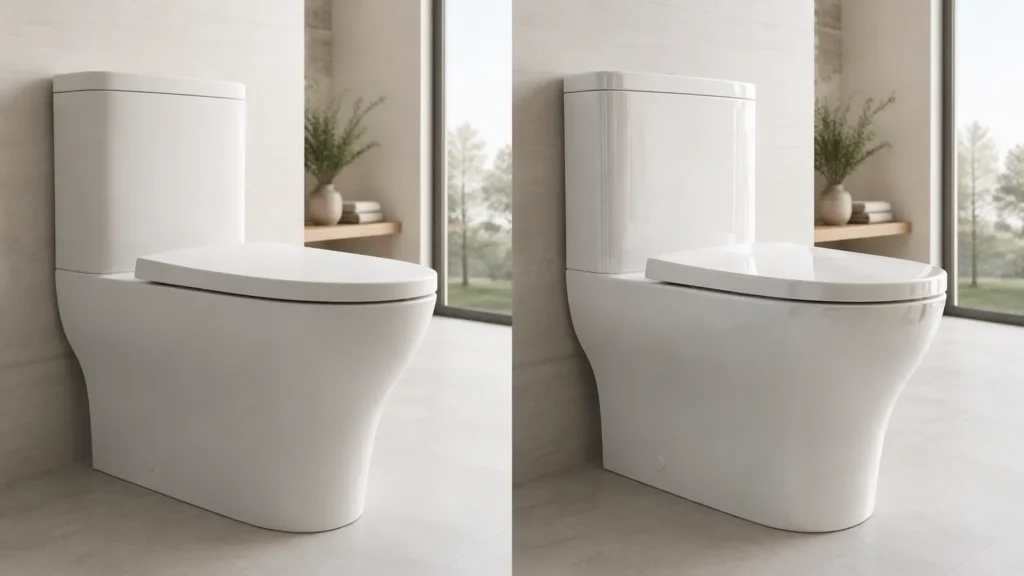
A facilities manager in Dubai replaced 40 toilets in a staff dormitory and specified “ceramic” on the purchase order. Halfway through the delivery, the supplier asked a question that changed the job: did they mean vitreous china, or standard earthenware ceramic? The two look identical in a showroom, but they fire differently, wear differently, and price differently. That matters on a volume order. This 2026 guide gives contractors and importers the full ceramic vs porcelain toilets comparison. It covers what actually differs in the material, what it means on site, and how to spec it so the bowl you quote is the bowl that ships.
Why the Ceramic vs. Porcelain Distinction Matters
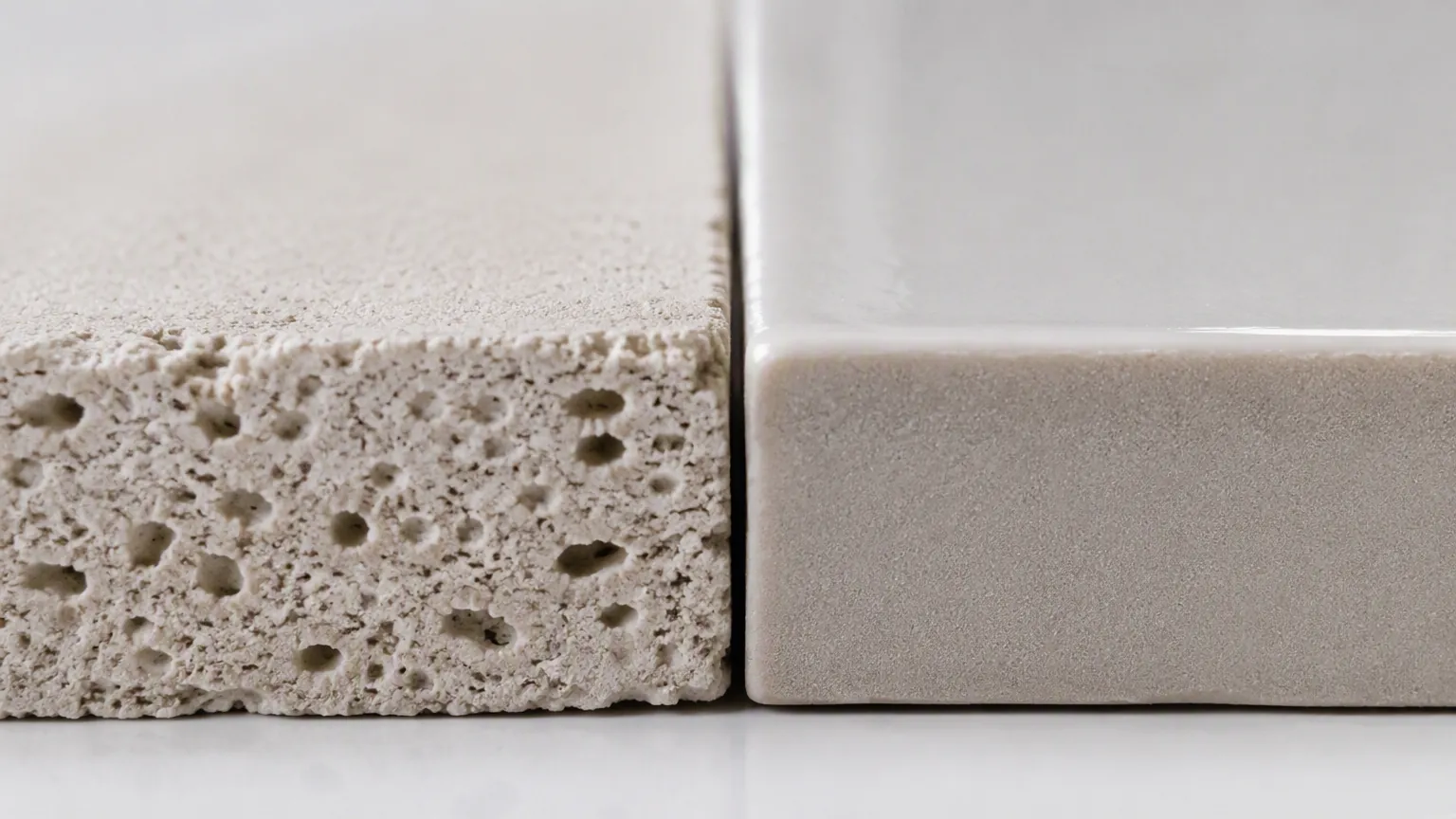
Most buyers never see the difference until it costs them money. The distinction matters at three points in a project: at specification (the wrong material gets quoted), at installation (density affects handling and drilling), and at the five-year mark (surface wear shows up as staining and chipping). In the trade, “porcelain” usually means vitreous china — a ceramic body fired hot enough to vitrify, or turn glass-like. Standard ceramic fires cooler and stays slightly porous under the glaze. That one manufacturing difference drives most of the performance gap.
For a contractor, the material choice also changes the numbers you present to the client. A porcelain spec changes the unit price, the freight weight, the expected service life, and the maintenance budget. Presenting those four numbers side by side is what separates a proposal that wins on total cost from one that wins only on sticker price.
What Changes in the Factory: Firing Temperature and Body
The single biggest difference between the two materials is not visible in a showroom. It happens in the kiln. Standard ceramic bodies fire at roughly 1,200–1,400°C; vitreous china fires at 1,400–1,600°C. At the higher range, the silica and feldspar in the body melt into a glassy phase that fills the pores. The result is a non-porous, denser material with roughly 20–30% higher mechanical strength for the same wall thickness.
Why does this matter on site? Three reasons:
- Chipping resistance: A vitreous china rim survives the impact of a dropped metal brush holder or a tile offcut; a standard ceramic rim often does not.
- Stain behavior: Non-porous bodies do not absorb water, so limescale and mineral deposits stay on the surface where cleaners can reach them.
- Longevity in commercial use: Hotels track replacement cycles per floor. A ceramic bowl in a staff toilet typically gets replaced around year 10–15; vitreous china routinely passes 20 years.
Some suppliers describe the body as “high-temperature ceramic” to blur the line. Ask for the firing temperature in writing — it is the cheapest spec check you can make.
What Is a Ceramic Toilet?
A ceramic toilet is shaped from a clay-based body mixed with minerals, then fired at roughly 1,200–1,400°C. The result is a sturdy, glazed fixture that resists everyday wear. Most budget and mid-range toilets sold globally — including a large share of what ships from Chinese factories — are ceramic in this general sense.
Ceramic Toilet Advantages
- Lower unit cost: Ceramic models generally run 20–30% below porcelain equivalents at the same quality tier. On a 500-unit project, that spread can fund the whole installation labor.
- Wide design range: Available in round, elongated, compact, wall-hung, and RV-specific formats. Color options beyond white are easier to source.
- Easy daily cleaning: The glazed surface sheds most soil with a wipe; standard bathroom cleaners are sufficient.
- Light enough for retrofit: Lighter wall thickness makes handling and installation simpler for standard floor-mounted setups.
- Faster factory lead times: The shorter firing cycle means ceramic production slots are easier to secure, which matters when the client’s opening date cannot move.
Ceramic Toilet Disadvantages
- Shorter service life: Typical ceramic bowls last 10–15 years under commercial use, versus 20–30 for vitreous china. Budget hotels that track maintenance spend consistently see ceramic replacement cycles 30–40% shorter.
- Chip and crack risk: Thin sections — especially around the rim and the mounting points — chip if struck. Repair is difficult and usually visible. On wall-hung ceramic, the thinner body also places more load on the carrier.
- Glaze wear: Abrasive cleaners and acidic products left in the bowl degrade the glaze over time, leading to yellowing and watermark retention. In hard-water regions, the maintenance cost differential between ceramic and porcelain widens significantly.
- Porosity under the glaze: If the glaze is scratched, moisture can enter the body, which accelerates staining in hard-water regions. This is harder to spot in inspection but shows up within 2–3 years in commercial settings.
- Color drift across batches: Lower-grade ceramic bodies can show slight shade differences between production runs. On a phased project, order all units from one batch or accept a visible mismatch.
What Is a Porcelain (Vitreous China) Toilet?
When buyers search for the best ceramic vs porcelain toilets comparison, this is usually the section they are actually looking for: porcelain toilets — properly called vitreous china in the plumbing trade — use a refined body of kaolin clay, feldspar, and quartz, fired at 1,400–1,600°C. The higher firing temperature vitrifies the body: the material becomes dense, non-porous, and glass-like. That is why “porcelain” fixtures are the default spec for hotels, hospitals, and high-traffic commercial washrooms.
Porcelain Toilet Advantages
- Density and strength: Vitrified china resists chipping, cracking, and impact far better than standard ceramic. Lifespan under daily commercial use is typically 20–30 years.
- Non-porous surface: The body does not absorb water. Staining, mold growth, and limescale adhesion are dramatically reduced — a meaningful difference in Gulf-region water conditions.
- Better glaze systems: Premium models add a second glaze firing, giving the familiar glossy “China coating” finish that stays white for decades.
- Lower lifecycle cost: The higher purchase price is offset by fewer replacements and less maintenance. Hotels that track maintenance per room per year consistently show lower porcelain costs over a 10-year horizon.
- Superior rim and trapway finish: The glaze extends into the trapway, where most staining and odor problems actually start. Standard ceramic often leaves the trapway less protected.
Porcelain Toilet Disadvantages
- Higher first cost: Expect a 30–50% premium over standard ceramic at comparable quality. The gap narrows on large volume orders but rarely disappears.
- Heavier: Dense body means more weight per unit — relevant for freight cost and for wall-hung installations where the carrier must handle the load.
- Still not indestructible: A hard impact can chip vitreous china; repairs are more expensive because matching the glaze finish is difficult.
- Longer production lead time: The higher firing cycle extends factory production time, which matters when you are working to a delivery deadline.
- Fewer color options: The premium glaze process is usually offered in white and a small set of standard colors. If the client wants a custom color match, ceramic is often the only practical route.
Ceramic vs. Porcelain Toilets: Head-to-Head Comparison
The ceramic vs porcelain toilets comparison below condenses everything into one table you can drop into a client proposal. Keep it on the spec sheet — it answers the five questions every project stakeholder asks: cost, durability, weight, cleaning, and lifespan.
| Property | Ceramic Toilet | Porcelain (Vitreous China) Toilet |
|---|---|---|
| Material body | Clay-based mix with minerals | Kaolin clay + feldspar + quartz |
| Firing temperature | 1,200–1,400°C | 1,400–1,600°C |
| Porosity | Low-porous under glaze | Non-porous, vitrified |
| Typical lifespan | 10–15 years | 20–30 years |
| Chipping resistance | Moderate | High |
| Stain / limescale resistance | Good (glaze-dependent) | Excellent |
| Weight (standard 1-piece) | ~40–50 kg | ~50–60 kg |
| Unit cost (same tier) | Baseline | +30–50% |
| Cleaning effort | Regular maintenance | Very low |
| Best use | Budget projects, rentals, RVs | Hotels, hospitals, high-traffic, long-term homes |
Ceramic vs. Porcelain Water Efficiency: The 2026 Update
The biggest change in this category since the 2025 version of this guide is the tightening of flush-efficiency requirements. WaterSense-labeled toilets now certify at 1.28 gallons per flush (gpf) or less, with high-efficiency models at 1.0 gpf. Several Gulf-region municipalities and US states now require 1.28 gpf as the baseline for new construction.
- Ceramic and porcelain both qualify — flush efficiency is a function of the cistern and bowl design, not the body material.
- Where they differ: porcelain’s non-porous surface keeps the trapway cleaner, which preserves flush performance longer in hard-water areas.
- Spec note: If the project requires WaterSense or SASO certification, confirm the certificate matches the exact model number, not the product family.
Ceramic vs. Porcelain Pricing: What the Spread Looks Like
FOB China estimates for a standard 1-piece toilet, MOQ 100–500 units per model:
| Tier | Ceramic | Porcelain (Vitreous China) |
|---|---|---|
| Entry (2-piece, manual flush) | USD 22–38 | USD 35–58 |
| Mid (1-piece, dual flush) | USD 45–70 | USD 68–110 |
| Premium (1-piece, rimless, soft-close) | USD 85–130 | USD 120–190 |
The spread is not a fixed percentage — it narrows as volume grows. On container-level orders (500+ units per model), factories typically quote porcelain within 18–28% of the ceramic equivalent, because the firing cost is amortized across the run. Small orders (under 100 units) widen the gap to 40% or more.
Two things the table does not show, but the invoice will:
- Freight: Porcelain weighs roughly 20–25% more per unit. On a 40-foot container that is 10–15 fewer units per load.
- Lead time: High-temperature firing extends production by 5–10 days per run. If the opening date is fixed, confirm the porcelain schedule before committing.
Ceramic vs. Porcelain Specification Mistakes
Contractors who skip the ceramic vs porcelain toilets comparison in the spec phase usually pay for it later. The recurring errors:
- Sourcing by photo, not by spec sheet: Two toilets can look identical and differ in firing temperature. Ask for the body composition and firing range in writing.
- Ignoring weight in freight: The porcelain premium includes freight — heavier bowls mean higher per-container cost. Get FOB and landed cost side by side.
- Forgetting the trapway: The trapway glaze matters as much as the visible surface. A poorly glazed trapway stains and smells regardless of body type.
- Over-specifying for the use case: A rental property that will be renovated in 8 years does not need a 20-year porcelain bowl. Match the material to the building lifecycle.
Ceramic vs. Porcelain: A Dormitory Retrofit Case Study
A facilities contractor in Riyadh was asked to retrofit 240 toilet fixtures across three staff dormitories. The initial quotation specified standard ceramic at a unit price 22% below the porcelain alternative. On paper, ceramic saved roughly USD 9,000 on fixtures — but the analysis stopped there.
The contractor looked at the five-year operating picture instead. The dormitories ran 24/7 with hard water from a local well supply. Ceramic bowls in the first building began showing limescale rings within 14 months; two rims chipped during a furniture move. The maintenance team was spending an extra 9 hours per month on descaling cycles.
Switching the remaining two buildings to vitreous china cost an additional USD 6,200 in fixtures and freight. After 18 months, the porcelain buildings had zero chipped rims, no limescale staining, and maintenance time per building had dropped by 60%. The client’s total cost of ownership projection flipped: porcelain paid back its premium within 26 months. It saved an estimated USD 14,000 over five years.
The lesson for contractors: the ceramic vs porcelain toilets decision is a lifecycle calculation, not a unit-price comparison. Always model maintenance hours, replacement cycles, and water quality before you sign.
Ceramic vs. Porcelain by Region
The right material varies by market, and a contractor sourcing internationally should adjust the recommendation by region:
- Gulf region (Saudi Arabia, UAE, Qatar): Hard water and high use make non-porous porcelain the lower-risk spec for hotels and labour camps. SASO-certified models are mandatory for Saudi projects; confirm the certificate covers the exact model.
- North America: WaterSense compliance is effectively required for new construction in many states. Both materials qualify, but the 1.28 gpf baseline and ADA clearances drive most specs.
- Europe: CE-marked fixtures are standard; water efficiency is regulated under the EU water label. Ceramic holds a larger share in budget segments.
- Southeast Asia and Africa: Price sensitivity dominates. Standard ceramic with a good glaze is often the right call for mid-range projects, with porcelain reserved for premium hotels.
Which Should You Choose?
| Scenario | Recommendation |
|---|---|
| Rental units, budget hotels, frequent renovations | Standard ceramic |
| Primary residences, long-term homes | Porcelain / vitreous china |
| Hotels, hospitals, airports, high-traffic washrooms | Porcelain / vitreous china |
| RV and mobile applications | Lightweight ceramic RV models |
| Gulf-region projects with hard water | Porcelain (non-porous surface) |
| Large volume orders with price sensitivity | Ceramic, if lifecycle allows; otherwise negotiate porcelain volume pricing |
Common Questions
Is a porcelain toilet just a ceramic toilet?
Technically, porcelain is a subset of ceramic. In the plumbing trade, “porcelain” refers to vitreous china fired at higher temperature, which makes it denser and non-porous.
How can I tell ceramic from porcelain?
Check the spec sheet for firing temperature and body composition. In hand, porcelain feels denser and heavier for the same size. A scratch test on an inconspicuous area shows porosity differences, but the spec sheet is the reliable answer.
Are porcelain toilets worth the extra cost?
For hotels, hospitals, and long-term homes, yes — the 20–30 year lifespan and lower maintenance offset the 30–50% premium. For short-lifecycle rentals, usually not.
Do ceramic toilets use more water?
No. Flush efficiency depends on the cistern and bowl design, not the body material. Both ceramic and porcelain toilets are available with WaterSense-certified 1.28 gpf or 1.0 gpf flush systems.
What is the HS code for ceramic toilets?
The HS code for ceramic sanitary fixtures, including toilets, is 6912 (with 69120030 commonly used for ceramic wash basins and sanitary ware). Confirm the exact code with your customs broker for the destination market.
Can porcelain toilets be installed on the same rough-in as ceramic?
Yes. Rough-in dimensions follow the same standards (typically 12-inch rough-in in North America). See our porcelain toilet dimensions guide for the full measurement breakdown.
Which is better for a hotel project, ceramic or porcelain?
Porcelain (vitreous china). Hotels run fixtures 24/7, clean with industrial chemicals, and cannot tolerate staining callbacks. The 20–30 year lifespan and lower maintenance offset the higher unit price. Budget-tier hotels with renovation cycles under 8 years can reasonably spec ceramic.
Do porcelain toilets need special installation?
No special tools are required, but the extra weight means wall-hung porcelain needs a correctly rated carrier frame. Floor-mounted units use standard wax or rubber seals. Plan for heavier lifting on upper floors.
Why do some suppliers call porcelain “vitreous china”?
The terms are interchangeable in the plumbing trade. “Vitreous” refers to the glass-like quality of the body after high-temperature firing. A supplier that uses the term precisely is usually more transparent about material specs.
Contractor’s Checklist
- Write “vitreous china” or “porcelain” explicitly in the spec, not just “ceramic”
- Request firing temperature and body composition in the supplier’s spec sheet
- Confirm WaterSense / SASO / CE certification matches the exact model number
- Compare FOB price and landed cost, including the weight-driven freight difference
- Check the trapway glaze, not just the visible surface
- Match material to building lifecycle: rentals = ceramic, long-term = porcelain
- Order spare glaze-matching repair kits for porcelain if chipping risk is high
Related Guides
- Porcelain Toilet Buying Guide for Contractors
- Porcelain Toilet Dimensions & Rough-In Guide
- Are You Buying from the Right Porcelain Toilet Supplier?
- How to Choose a Bathroom Manufacturer in China
- Wholesale Toilets for Contractors: Volume Pricing Guide
- Commercial Urinal Buying Guide for Contractors