

Choosing the right porcelain toilet supplier can make or break a commercial project. I have audited the supply chains of over a dozen hotel and residential developments across the Middle East and Southeast Asia. In almost every case, the project team had done their due diligence on the big-ticket items. The HVAC contractor had been vetted. The stone supplier had submitted samples and test reports. But when I asked who was supplying the porcelain toilets, the answer was often a shrug. “We got a good price from a trading company.” “The factory sent a sample, and it looked fine.” “They’re all the same, right?”
They are not all the same. Porcelain toilets carry more hidden variability than almost any other sanitary ware item. Two toilets that look identical out of the box can differ by a factor of five in glaze durability, by ten percentage points in water absorption, and by an entire building code compliance gap that surfaces only when the project inspector refuses to sign off. This guide provides a practical porcelain toilet supplier procurement checklist. It covers what to look for in a porcelain toilet supplier, not just in the product. It is written for importers, project procurement managers, and contractors who need their order to arrive on time, meet spec, and generate zero callbacks.
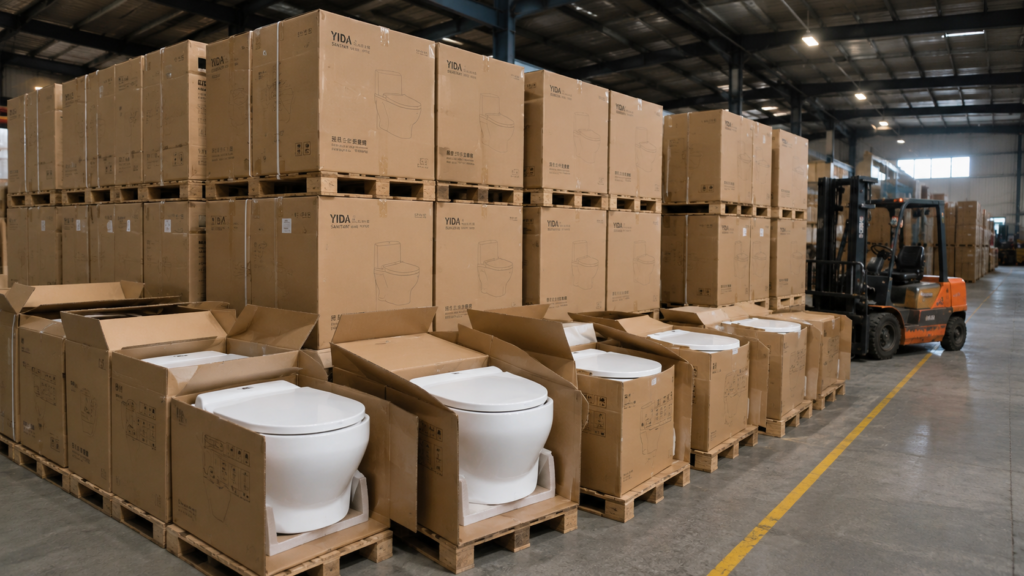
1. Material Quality: Why a Porcelain Toilet Supplier’s Raw Materials Matter
The word porcelain gets used so loosely in sanitary ware marketing that it has almost lost its technical meaning. For a porcelain toilet supplier, however, the distinction between true vitreous china and its cheaper imitations has direct commercial consequences.
True Vitreous China vs. Semi-Vitreous Ceramic
True vitreous china—what a quality porcelain toilet supplier provides—is a specific ceramic body composed of clays, feldspar, and quartz, fired at temperatures exceeding 1,200°C. At this temperature, the clay particles fuse together into a dense, glass-like body with a water absorption rate of less than 0.5%. Consequently, the toilet body does not swell, crack, or harbor bacteria within the material itself. It is hygienic by its nature, not by its coating.
Semi-vitreous ceramic, sometimes marketed as “ceramic” or “porcelain-like,” fires at lower temperatures—typically below 1,150°C—and retains a water absorption rate between 0.5% and 3%. The difference is invisible to the eye but significant over time. A semi-vitreous toilet body absorbs moisture from the bathroom environment, and this absorbed moisture expands and contracts with temperature changes. Over years of thermal cycling, micro-cracks develop in the body. These cracks eventually telegraph through the glaze as hairline fissures that cannot be cleaned and cannot be repaired.
Every procurement manager should ask: how do you verify which material a porcelain toilet supplier is actually using? The answer is the water absorption test report. Reputable porcelain toilet suppliers provide this report from an accredited laboratory as part of their standard technical documentation. A supplier who cannot or will not provide it is either selling semi-vitreous ceramic or does not know what their factory is producing. In either case, that supplier is a procurement risk. (Learn more about ceramic manufacturing standards in our Manufacture & Tech section.)
Glaze Quality: The Surface That Determines Cleanability
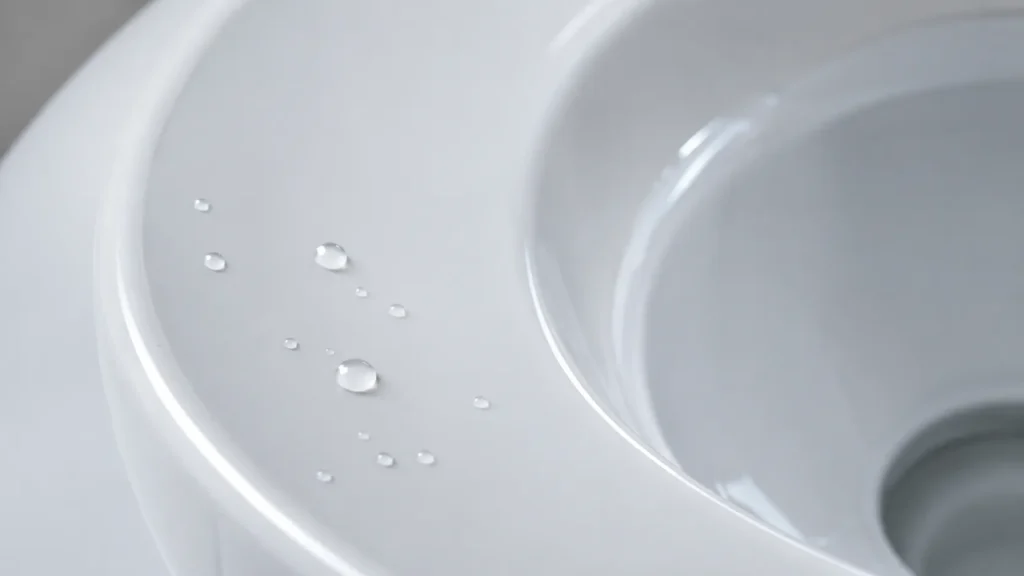
The glaze on a porcelain toilet is not just a shiny coating. It is a thin layer of glass fused to the ceramic body during firing. A quality glaze from a conscientious porcelain toilet supplier is smooth at the microscopic level, which prevents waste and bacteria from adhering to the surface. A poor glaze, in contrast, has microscopic pits and roughness where waste accumulates.
The key technical indicator is surface roughness, measured in microns (µm). A high-quality porcelain toilet glaze has a surface roughness below 0.2 µm Ra. This is smooth enough that water and waste slide off with minimal residue. A low-quality glaze, meanwhile, may measure 0.5 µm Ra or higher—still smooth to the touch, but rough enough at the microscopic level to trap waste. As a result, it requires more frequent and more aggressive cleaning.
For commercial projects, the glaze quality directly affects housekeeping costs. A hotel with 200 porcelain toilets that require daily scrubbing to stay clean is spending significantly more on cleaning labor than a hotel with 200 toilets whose glaze resists soiling. The glaze quality is specified once. The cleaning cost is paid every day for the life of the building.
2. Structural Integrity: How a Reliable Porcelain Toilet Supplier Tests for Hidden Defects
A porcelain toilet must support the weight of a person sitting on it, often shifting, leaning, and applying uneven pressure to the rim and bowl. A toilet that cracks under load is not just a warranty claim. It is a safety incident and a potential liability. A responsible porcelain toilet supplier addresses this through rigorous testing.
What Causes Structural Failure in Porcelain Toilets
Structural failures in porcelain toilets fall into two categories. The first is a manufacturing defect—an air pocket or an uneven wall thickness created during casting, or a firing schedule that was too fast and left internal stresses in the body. The second is transport damage—a hairline crack that develops during shipping and handling, and goes undetected until the toilet is installed and subjected to body weight.
A quality porcelain toilet supplier tests for structural integrity as a routine part of production quality control. The standard load test for residential toilets applies a minimum of 220 kg of static load to the seat area without cracking or permanent deformation, as defined by standards like ASME A112.19.2. For commercial and accessible toilets, the test load is often higher. A supplier who provides the load test report from an accredited laboratory is demonstrating that their quality control includes structural verification. A supplier who does not provide this report is asking you to take the risk on yourself.
Inspection Before Installation
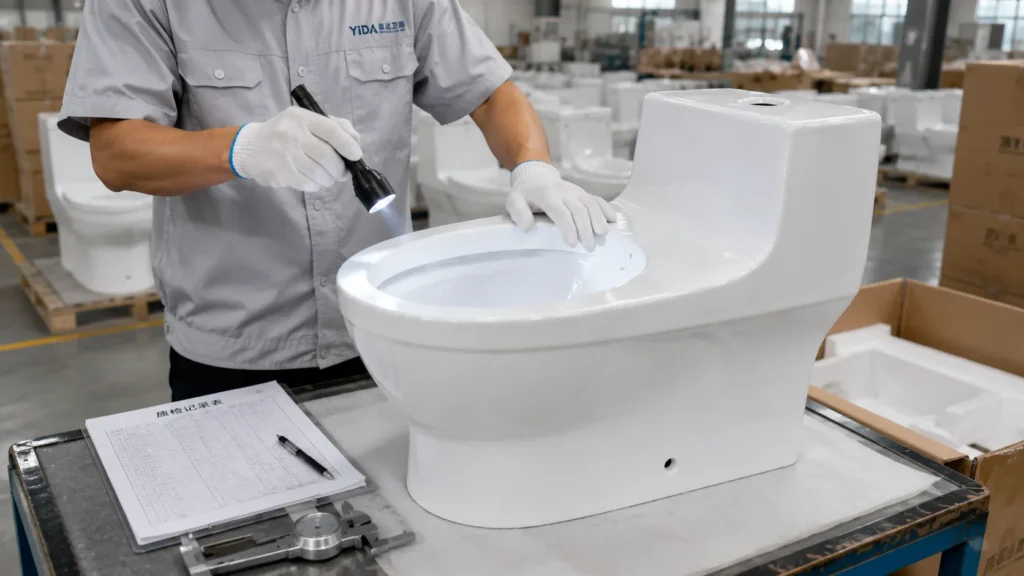
Even a structurally sound toilet from a reputable porcelain toilet supplier can be damaged in transit. A hairline crack that is invisible under warehouse lighting will open up when someone sits on the toilet. The pre-installation inspection protocol is straightforward. Check the bowl rim for any visible chips or cracks. Run a finger along the inside of the bowl and the trapway to feel for roughness or irregularities. Shine a flashlight into the trapway to check for internal cracks. Check the base of the toilet for any sign of impact damage from handling. Any toilet that shows damage, however minor, should be set aside and replaced under the supplier’s transit damage policy. A porcelain toilet supplier who does not have a clear transit damage policy is a supplier who expects the buyer to absorb the cost of shipping damage. That policy should be in the supply contract, not in a verbal assurance.
3. Flush Performance: What Your Porcelain Toilet Supplier Must Disclose
The flush mechanism on a porcelain toilet is not part of the ceramic body, but the body design determines how effectively the flush works. A knowledgeable porcelain toilet supplier will guide you through trapway design and water efficiency certifications.
The Trapway: Siphonic vs. Wash-Down
Two porcelain toilet bowl designs dominate the global market, and they are not interchangeable. A siphonic toilet uses a narrow, S-shaped trapway that creates a vacuum during flushing. The trapway on a siphonic porcelain toilet is typically 60 mm to 80 mm in diameter, requiring a minimum water volume of 4.5 to 6 liters to initiate the siphon. Siphonic toilets dominate the North American, Australian, and parts of the Middle Eastern market. A wash-down toilet uses a wider trapway—typically 100 mm in diameter—and relies on gravity, often achieving effective flushes with 3 to 4.5 liters. Wash-down toilets are standard in Europe, Southeast Asia, and increasingly the Middle East and Africa.
For a procurement manager, the flush type decision should match the target market of the project. A porcelain toilet supplier who understands the difference between the two systems and can recommend the correct type for the project’s plumbing conditions is adding value beyond the unit price. (See our Toilets category for a deeper comparison of flush technologies.)
Water Efficiency Certifications
In most regulated markets, porcelain toilets must meet water efficiency standards. The EPA WaterSense specification limits full-flush volume to 1.6 gallons (6 liters) or less. The EU Water Label scheme classifies toilets by flush volume. Singapore’s PUB WELS mandates maximum flush volumes. GCC countries are increasingly adopting similar standards.
A reliable porcelain toilet supplier provides the water efficiency certification for each model they offer. The certification must be from a recognized body in the target market. Cross-market certification is a sign of a porcelain toilet supplier who understands compliance complexity and has invested in testing across multiple jurisdictions.
4. Evaluating a Porcelain Toilet Supplier: Beyond the Sample and the Price
The sample a porcelain toilet supplier sends for approval is not the product you will receive. It is the best example the supplier could produce. The production batch will not receive the same attention unless the supplier has systematic quality control in place.
Factory Audit or Third-Party Inspection
For any porcelain toilet order above 500 units, a factory audit or a third-party pre-shipment inspection is a worthwhile investment. A porcelain toilet supplier who welcomes a factory audit and provides contact details of previous buyers is a supplier with nothing to hide. A supplier who resists an audit may be relying on certificates to substitute for actual process control. ISO certification is a starting point, not a guarantee. (For more on quality management in production, visit our Industry & Trends section.)
Defect Rate and After-Sales Policy
Every porcelain toilet production batch has a defect rate. The question is how low that rate is and what the porcelain toilet supplier does about it. A high-quality manufacturer targets a defect rate below 1% for visible defects and provides a clear after-sales policy specifying who pays for the replacement unit, who pays for the shipping, and the timeline for the replacement to arrive. A supplier who offers a realistic defect rate with a clear remedy procedure is demonstrating industry knowledge and commercial responsibility.
Lead Time Reliability and Packaging
A porcelain toilet supplier’s lead time reliability is partly a function of production planning and partly of logistics. Packaging for porcelain toilets must be designed for the transit route—a full carton with corner protection and internal bracing for sea freight. A supplier who ships with inadequate packaging will have a higher transit damage rate.
5. Regional Markets and What They Demand from a Porcelain Toilet Supplier
Middle East
The Gulf market demands porcelain toilets in standard white for volume projects and in custom finishes for luxury hospitality. Water conservation regulations are tightening. A porcelain toilet supplier with a Gulf distribution warehouse reduces the buyer’s lead time risk and provides local stock for replacement orders.
Europe
European projects require CE marking and compliance with EN 997 for WC pans. Wall-hung porcelain toilets are the dominant format, and the porcelain toilet supplier must provide the compatible concealed cistern and mounting frame. Rimless bowl design is now the standard expectation.
Southeast Asia
Porcelain toilets for Southeast Asian markets must accommodate local plumbing norms. A porcelain toilet supplier must understand local rough-in dimensions, which differ from European and North American standards. Water efficiency labeling under the Singapore PUB WELS and similar schemes is increasingly mandatory.
Americas
The North American market operates under ASME A112.19.2 for vitreous china fixtures and EPA WaterSense for water efficiency. A porcelain toilet supplier must provide product certified to these standards. Latin American markets are more price-sensitive but are gradually adopting higher standards for commercial and hospitality projects.
6. The Porcelain Toilet Supplier Procurement Checklist
- Material certification verified. Water absorption test report showing less than 0.5%. Glaze surface roughness below 0.2 µm Ra. Reports from an accredited laboratory, not an in-house test.
- Structural load test documented. Minimum 220 kg static load without cracking. Report provided with the technical documentation.
- Flush performance and water efficiency certification provided. Relevant to the target market. Not a generic certificate that does not reference a specific standard.
- Factory audit or third-party inspection completed. For orders of 500 units or more. Inspection report reviewed before shipment is authorized.
- Defect rate and after-sales policy in writing. Clear procedure for replacement units, shipping responsibility, and timeline.
- Packaging specification confirmed for the transit route. Full corrugated carton with corner protection. Internal bracing. Moisture barrier if shipping by sea.
- Lead time guarantee with penalty clause. Ex-factory date confirmed. Shipping schedule confirmed with the freight forwarder.
- Regional compliance documentation provided. CE, WaterSense, WELS, or equivalent. Certificate valid for the specific model being ordered, not a blanket company certificate.
- Reference projects verified. Contact details of at least two projects of similar scale and market where the supplier’s porcelain toilets have been installed for two years or more.
- Local after-sales support confirmed. Either a local distributor, a regional warehouse, or a clear process for handling warranty claims from the project country.
Final Thoughts
A porcelain toilet is a long-life building component, and the porcelain toilet supplier you choose determines whether it performs or fails. The procurement decision is made at the supplier evaluation stage, when someone checks the water absorption report, verifies the load test, reads the after-sales policy, and confirms the packaging.
A porcelain toilet supplier who provides this documentation willingly, welcomes a factory audit, and connects you with previous buyers has earned the right to be on your shortlist. A supplier who deflects these requests will cost you more in the long run than you save on the purchase order. The time to verify is before the order is placed—not after the toilets are installed and the first guest complains.