
Why Commercial Wash Basins Need a Different Specification Process
Specifying wash basins for a commercial project is not the same as picking one for a residential bathroom. The stakes are higher, the code requirements are stricter, and the people using them will not treat them with the same care as a homeowner.
A contractor we worked with in Florida once ordered standard residential pedestal sinks for a 40-unit hotel renovation. The basins arrived with 3-inch faucet centers—standard for residential—but the commercial faucets specified by the architect required 8-inch widespread spacing. Every single basin had to be returned and reordered. That mistake cost two weeks and nearly $4,000 in restocking fees.
This guide covers what every contractor needs to know before specifying a commercial hand wash basin, including ADA compliance, bowl dimensions, material choices, faucet configurations, and the certifications that matter for different project types.
ADA Height and Reach Requirements for Commercial Wash Basins
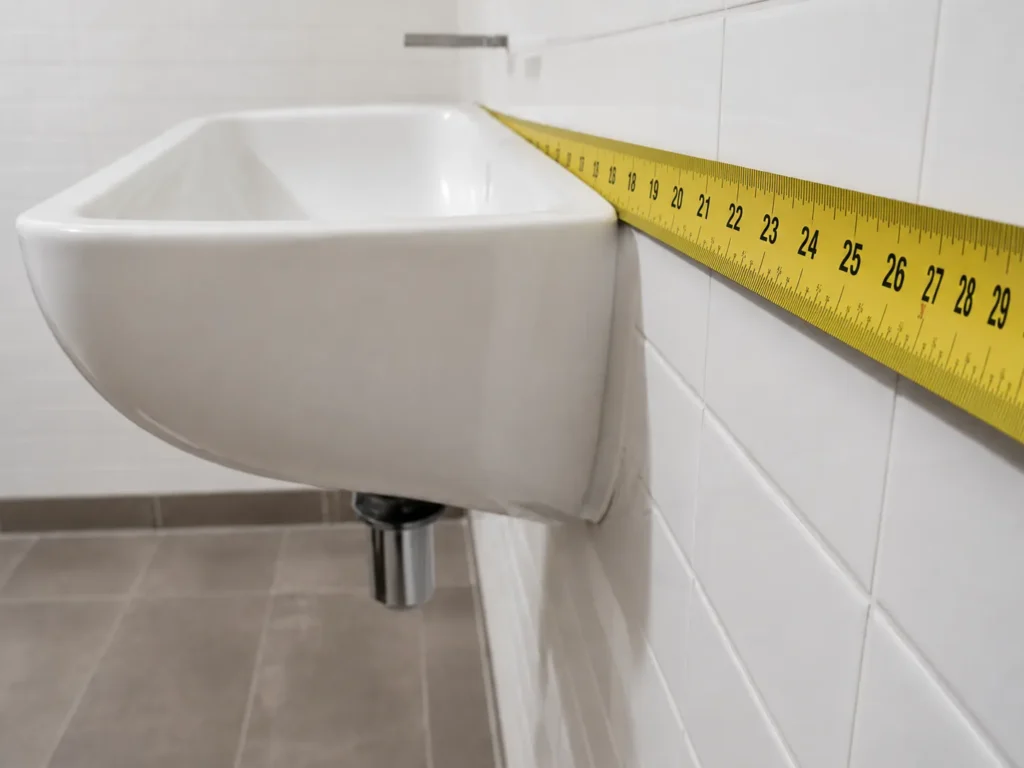
The most common specification mistake in commercial wash basins is ignoring ADA accessibility height. Under the 2010 ADA Standards for Accessible Design, the rim or counter surface of a lavatory must be no more than 34 inches above the finished floor. The clear knee space beneath must be at least 27 inches high, 30 inches wide, and 19 inches deep.
Why it matters: A wall-hung commercial hand wash basin that sits at 36 inches is automatically non-compliant, even if everything else about the specification is correct. The contractor ends up field-modifying the mounting height or swapping units altogether.
What to check with your supplier:
- Confirm the basin mounting height range in the spec sheet before ordering.
- Wall-hung models should include adjustable mounting brackets that allow the finished rim height to sit between 32 and 34 inches.
- For countertop installations, verify that the vanity or counter frame provides at least 27 inches of knee clearance after the basin is installed.
ADA also requires that faucet handles and controls are operable with one closed fist—no tight grasping, pinching, or twisting. Lever-style handles or sensor-operated faucets are the standard choice for commercial projects.
Bowl Depth and Splash Control
Bowl depth is one of those specifications that looks minor on paper but causes real complaints after installation. A shallow basin in a high-traffic restroom means water splashes onto the counter, the floor, and anyone standing in front of it.
Recommended minimum:
- Bowl depth: 5 inches minimum for commercial applications
- Overflow drain: strongly recommended for public restrooms to prevent flooding if a drain clogs
Hotels and office buildings typically specify basins with a 5.5- to 6-inch bowl depth. Healthcare facilities sometimes go shallower for wheelchair accessibility, but compensate with deeper aprons and splash guards.
Common mistake: Specifying a vessel sink for a commercial restroom. Vessel sinks look modern but are notorious for splash issues, require taller faucets, and are harder to keep clean in public settings. Unless the design brief explicitly calls for them, undermount or wall-hung basins are the more practical choice.
Materials: Vitreous China vs Stainless Steel vs Solid Surface
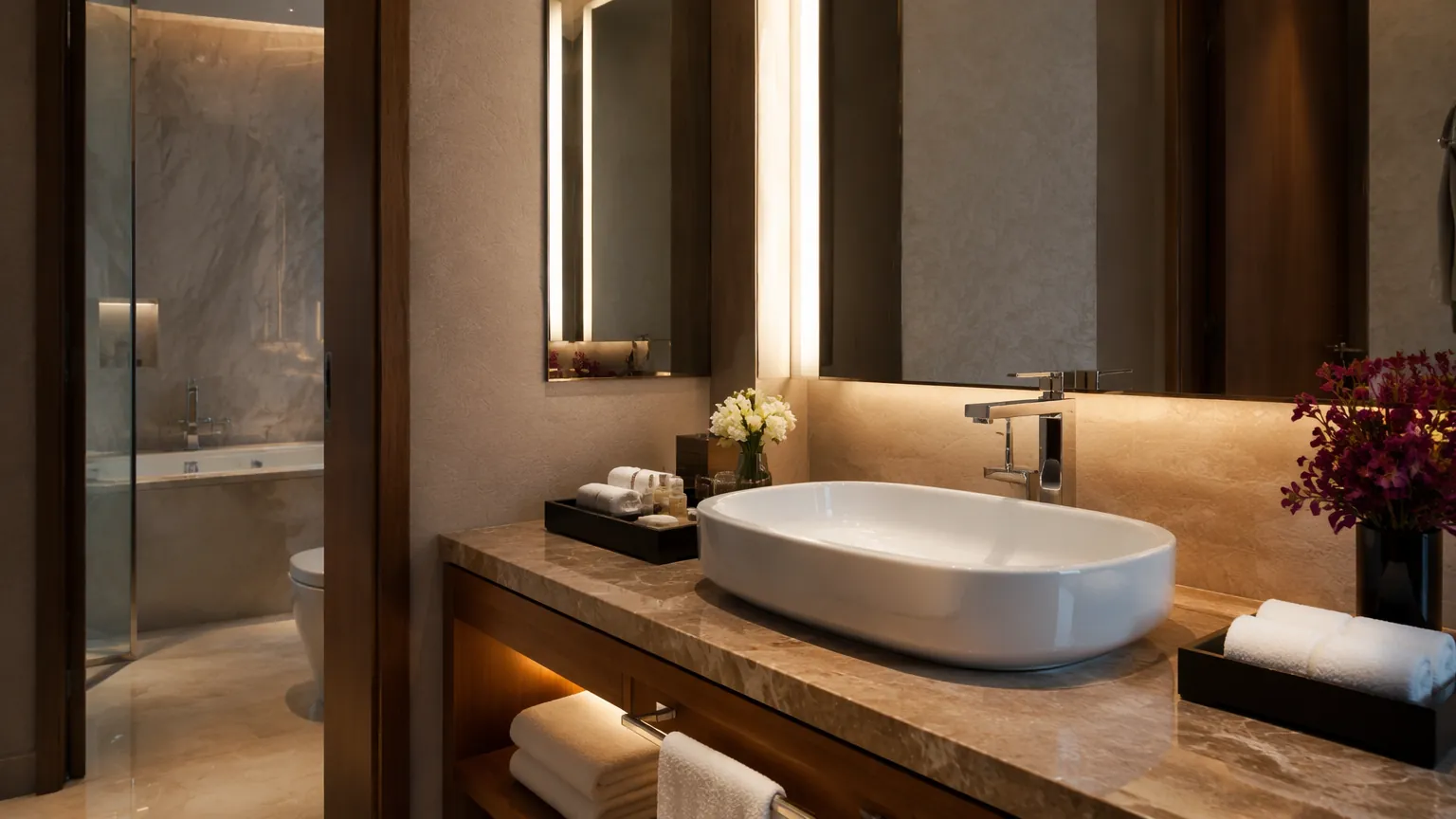
Each material has a place in commercial wash basin specifications. The right choice depends on the project type, traffic volume, and maintenance capacity.
Vitreous China
The most widely specified material for commercial wash basins in North America and Europe. It is fired at high temperature, producing a hard, non-porous surface that resists stains and is easy to clean.
- Pros: Affordable, widely available, compatible with most fittings
- Cons: Can chip if struck by heavy objects; not repairable in the field
- Best for: Hotels, office buildings, schools, retail restrooms
- Typical FOB range: $35–$90 per unit (MOQ 100–500)
Stainless Steel
Favored in healthcare and food-service settings where hygiene is the top priority. Stainless steel is non-porous, antimicrobial, and can withstand harsh cleaning chemicals.
- Pros: Highly durable, hygienic, scratch-resistant, repairable (can be polished)
- Cons: More expensive, shows water spots, can be noisy without undercoating
- Best for: Hospitals, clinics, commercial kitchens, laboratories
- Typical FOB range: $60–$150 per unit (MOQ 200–500)
- Gauge recommendation: 16-18 gauge for commercial durability
Solid Surface (Cultured Marble / Acrylic)
Common in hotels and premium commercial projects for its seamless appearance and design flexibility.
- Pros: Seamless integrated sinks, warm to touch, repairable
- Cons: Can scratch and scorch, requires gentle cleaning products
- Best for: Hotel guest bathrooms, upscale office washrooms
- Typical FOB range: $80–$200 per unit (MOQ 100–300)
Faucet Hole Configurations and Compatibility
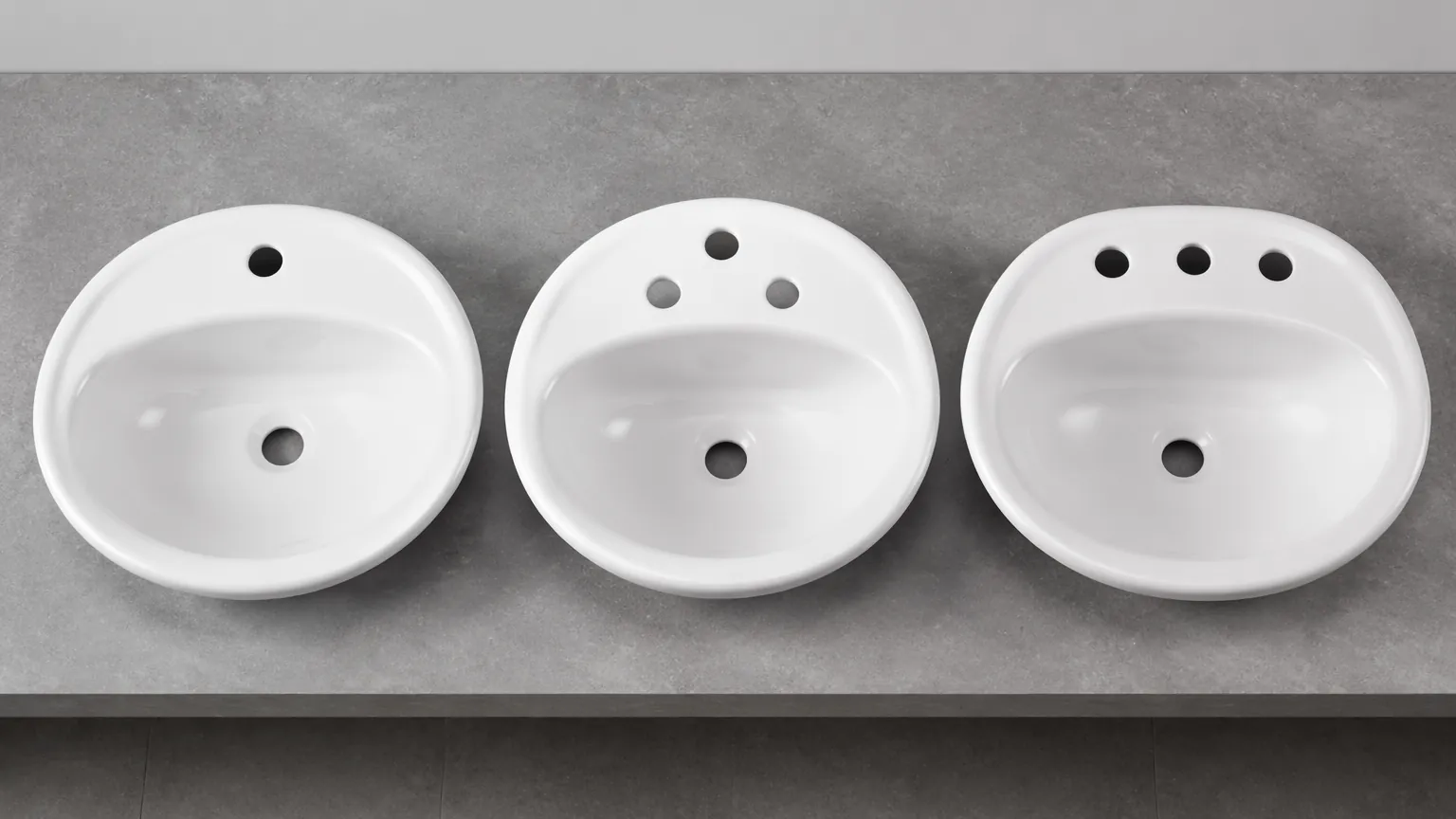
Faucet compatibility is the number one field issue we see on commercial basin installations. The basin arrives with the wrong number of faucet holes, or the hole spacing does not match the specified faucet.
Standard configurations
| Configuration | Hole Count | Spacing | Typical Use |
|---|---|---|---|
| Centerset | 3 | 4 inches | Hotels, office lobbies |
| Single-hole | 1 | N/A | Commercial restrooms with sensor faucets |
| Wall-mount | 0 | N/A | ADA-compliant hand washing stations |
| Widespread | 3 | 8 inches | Premium hotel suites |
Rule of thumb for commercial projects: If the restroom is public (open to building occupants or visitors), specify single-hole or centerset configurations with sensor-operated or lever-handle faucets. Widespread configurations add cost and require more counter space that is rarely available in standard commercial stalls.
Commercial Plumbing Connections and Drain Sizes
Commercial projects follow the International Plumbing Code (IPC) or local equivalents. The key plumbing specifications to confirm before ordering include:
- Drain opening: Standard 1-1/4 inch for basin drains; confirm the P-trap connection type with local code
- Supply connections: 1/2 inch NPT is standard in North America; some export orders require 3/8 inch compression
- Overflow: Required by IPC for public lavatories to prevent floor flooding from clogs
Overseas sourcing tip: Chinese-manufactured commercial wash basins typically ship with 40mm or 50mm metric drain outlets. If your project is in North America, confirm that the supplier offers ANSI-compatible drain connections or plan to order adapters.
A contractor sourcing from Asia should always request a plumbing connection diagram before placing the order. A mismatch in drain or supply thread standards is not discovered until the basin is at the job site.
Certifications Checklist by Market
Commercial wash basins require product certifications that residential units do not. The absence of the right certification means the basin cannot pass inspection.
| Market | Required Certification | What It Covers |
|---|---|---|
| USA | cUPC or ASME A112.19.2 | Material quality, dimensions, drain compliance |
| USA | ADA | Accessibility height and clearance |
| Canada | CSA B45 | Material and performance standards |
| Europe | CE (EN 14688) | Sanitary appliances functional requirements |
| Australia | WaterMark | Plumbing and drainage compliance |
| Middle East | SASO | Saudi standards for imported fixtures |
Common contractor oversight: Assuming that a CE-certified basin is also compliant for a US project. CE and cUPC are entirely separate certification systems. A basin manufactured in China with CE marking will still fail inspection on a US job site unless it also carries cUPC or ASME certification.
Wall-Hung vs Countertop vs Pedestal for Commercial Use
Each mounting style has trade-offs that affect installation cost, maintenance access, and long-term durability.
Wall-Hung
The most popular choice for public commercial restrooms. Wall-hung commercial hand wash basins make cleaning underneath easy for janitorial staff and provide clear knee space for ADA compliance.
- Installation: Requires a wall-mounting bracket or carrier system
- Weight capacity: Confirm the bracket is rated for the basin weight plus live load
- Best for: High-traffic public restrooms
- Watch out for: Hollow-wall construction—basins heavier than 40 pounds may need blocking or a floor-mounted carrier
Countertop (Drop-in / Undermount)
Common in hotel guest bathrooms and executive washrooms. Undermount basins give a seamless look but require more careful countertop fabrication.
- Installation: Requires a compatible countertop with a cutout template
- Best for: Hotels, upscale offices
- Watch out for: Undermount basins in ADA stalls must still provide 27 inches of knee clearance underneath
Pedestal
Rare in commercial settings. Pedestal basins look elegant but expose the plumbing underneath and provide no storage or counter space. They also make ADA compliance difficult because the pedestal typically blocks knee clearance.
Best for: Small powder rooms in professional offices (not public restrooms)
Project Example: 80-Unit Hotel, Ontario, Canada
The challenge: A mid-scale hotel chain was renovating 80 guest bathrooms. The original spec called for undermount vitreous china basins with single-hole faucets. The contractor received samples and found that the specified basin glaze coverage at the drain opening was incomplete, which would lead to rust rings within 6 months of occupancy.
The solution: The contractor switched to a full-glazed vitreous china commercial hand wash basin from an Asian OEM supplier with cUPC certification. The change added a 50-cent per-unit premium but eliminated the rust issue entirely.
The result: 80 basins installed. Zero callback for drain rust. The contractor went from a 4% callback rate on the previous project (using the original supplier) to 0%.
Common Specification Mistakes
- Ordering residential basins for commercial projects. Residential basins lack the ADA height clearance, flow-rate compatibility, and durability for continuous public use.
- Ignoring faucet hole configuration. The most common mismatch we see in the field.
- Assuming one certification covers all markets. CE is not cUPC. WaterMark is not SASO.
- Not confirming drain thread standards. Metric vs. imperial—verify before the container ships.
- Overlooking overflow requirements. Public restroom basins without overflow drains fail IPC inspection in most US jurisdictions.
Commercial Wash Basin Specification Checklist
- ADA rim height ≤34 inches (wall-hung) or ≥27 inches knee clearance (countertop)
- Bowl depth ≥5 inches; overflow drain included
- Faucet hole count and spacing match your faucet spec
- Drain connection compatible with local plumbing standards
- Certification: cUPC / CE / WaterMark / SASO—matching your project market
- Material grade confirmed (vitreous china: first-quality glaze; stainless steel: 16-18 gauge)
- MOQ and lead time compatible with project schedule
- Mounting hardware included or specified
- Field samples approved before full production
FAQ
Are commercial hand wash basins different from residential ones?
Yes, they are. Commercial basins must comply with stricter codes for ADA height, bowl depth, drain overflow, and faucet compatibility. They are also built from more durable materials to handle higher traffic.
What is the standard commercial hand wash basin height?
Under ADA, the rim of a commercial basin must be no more than 34 inches above the finished floor. Knee clearance underneath must be at least 27 inches.
Can I use a residential basin in a commercial bathroom?
It is not recommended. Residential basins generally do not meet ADA requirements or commercial code standards for bowl depth, overflow, and fixture rating. You risk failing inspection.
What certifications do commercial basins need in the USA?
cUPC or ASME A112.19.2 certification is required for material and dimensional compliance. ADA compliance is also mandatory for publicly accessible facilities.
Which material is best for a high-traffic commercial restroom?
Vitreous china is the most common choice for its balance of cost, durability, and cleanability. Stainless steel is preferred in healthcare settings.
Do commercial basins need an overflow drain?
Yes. The International Plumbing Code requires overflow drains in public lavatories to prevent floor flooding if the drain clogs.
What is the minimum bowl depth for a commercial wash basin?
Five inches is the recommended minimum for adequate splash control in commercial applications.
Can a single-hole faucet work with a three-hole basin?
Only if you use a basin plate or escutcheon to cover the unused holes. Otherwise, the faucet will not seal properly, and water can leak into the cabinet.
References
- ADA Standards for Accessible Design, 2010. United States Department of Justice.
- ANSI Z124.1-2022: Plastic Bathing Units. American National Standards Institute.
- International Plumbing Code (IPC), 2024 Edition. International Code Council.
- ASME A112.19.2-2023: Vitreous China Plumbing Fixtures. American Society of Mechanical Engineers.
- EN 14688: Sanitary Appliances — Washbasins — Functional Requirements and Test Methods. CEN.