
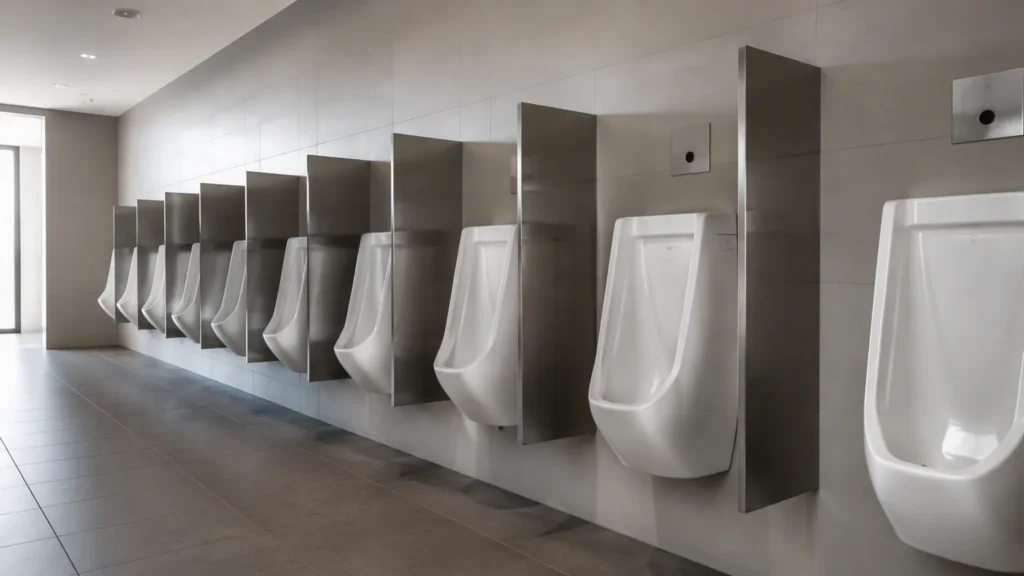
A facilities manager in Phoenix opened bids for a 14-stall men’s restroom and got three quotes that differed by $9,000. The fixture counts were identical. The gap came down to two things: flush-valve type and whether the urinals were specified as sensor or manual. That spread is routine in commercial urinal procurement, and most contractors lose it in the spec sheet rather than the install.
Six months later, a project manager in Dubai was specifying a 60-fixture order for a hotel corridor. She had selected a WaterSense-certified model and confirmed SASO certification. Three weeks before the container was due, her supplier told her the GSO mark was not on the batch. The container sat at port until the paperwork was resolved. The delay cost more than the price difference between the compliant and non-compliant models. That outcome is equally routine, and equally avoidable.
This guide gives contractors a procurement lens on the commercial urinal category. It covers how the types differ, which flush system fits which building, and which water-efficiency rules change your spec. It also covers where the FOB pricing moves on volume orders. For the architectural spec and installation-pitfall side, our commercial urinal specification guide covers partition privacy, sensor placement, and drainage slopes in depth.
—
Why the Urinal Spec Drives Bid Margin
The unit price of a urinal is a small part of the project. The installed cost is not. A sensor valve, a concealed carrier, and a recessed water supply each add labor and parts. Those costs multiply across a bank of ten or twenty fixtures. Specifying the right combination up front keeps the install predictable and the punch list short.
The wrong mounting type triggers one of three outcomes: a re-pipe to move the drain, a change order for the valve type the owner wanted, or a water-code rejection at inspection. Any of the three costs more than the extra planning time. None of those protect your margin.
—
The Two Mounting Types: Wall-Hung vs Floor-Mounted
Every urinal decision starts here, because mounting type fixes your drain location and wall structure before anything else.
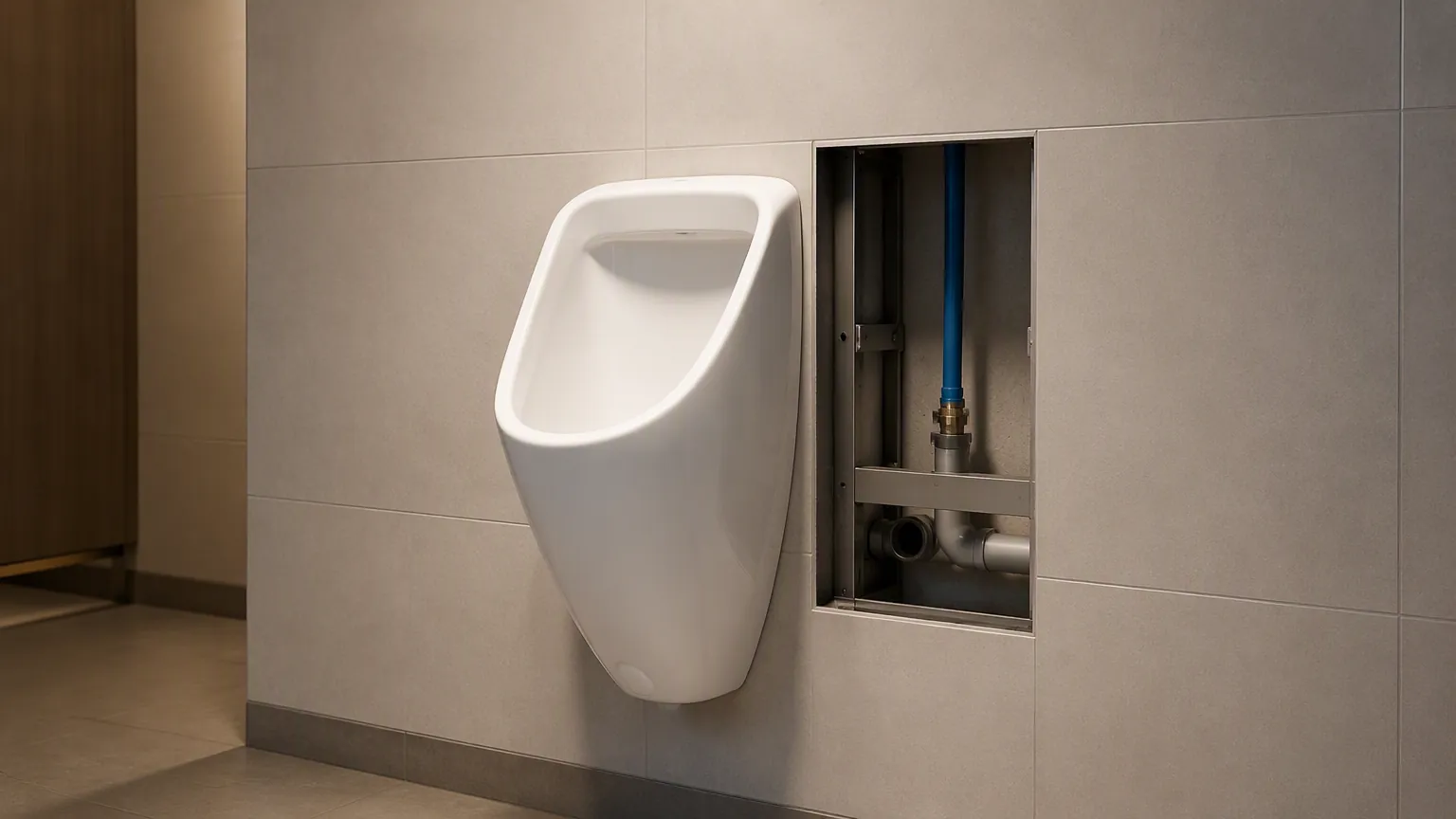
Wall-Hung (Wall-Outlet) Urinals
The bowl mounts to the wall and the waste exits horizontally through the wall into a carrier or pipe chase. This is the default for most new North American and European commercial builds.
- Drain location: horizontal through the wall, requires a carrier or concealed pipe chase
- Floor: completely clear, easiest to mop and maintain
- Best for: offices, airports, hotels, any high-traffic restroom where floor cleaning speed matters
- Watch out for: the wall chase must be framed and plumbed before the tile goes up; retrofitting a wall-hung urinal into a finished floor-mounted wall is expensive
Floor-Mounted (Floor-Outlet) Urinals
The bowl stands on the floor and the waste drops vertically through the slab. Common in older buildings and budget renovations.
- Drain location: vertical through the floor
- Structure: no wall carrier needed, simpler rough-in
- Best for: retrofit into existing floor drains, lower-spec commercial, warehouses
- Watch out for: the base collects grout and debris; cleaning is slower than wall-hung
For a retrofit, match the outlet type to the existing rough-in. A floor-mounted drain cannot take a wall-hung urinal without cutting the slab. Our wholesale toilets volume pricing guide explains how rough-in matching governs fixture substitution across a whole order.
—
Flush Systems: Sensor, Manual, and Waterless
The flush system is where most of the bid spread lives. Three options dominate commercial specifications.
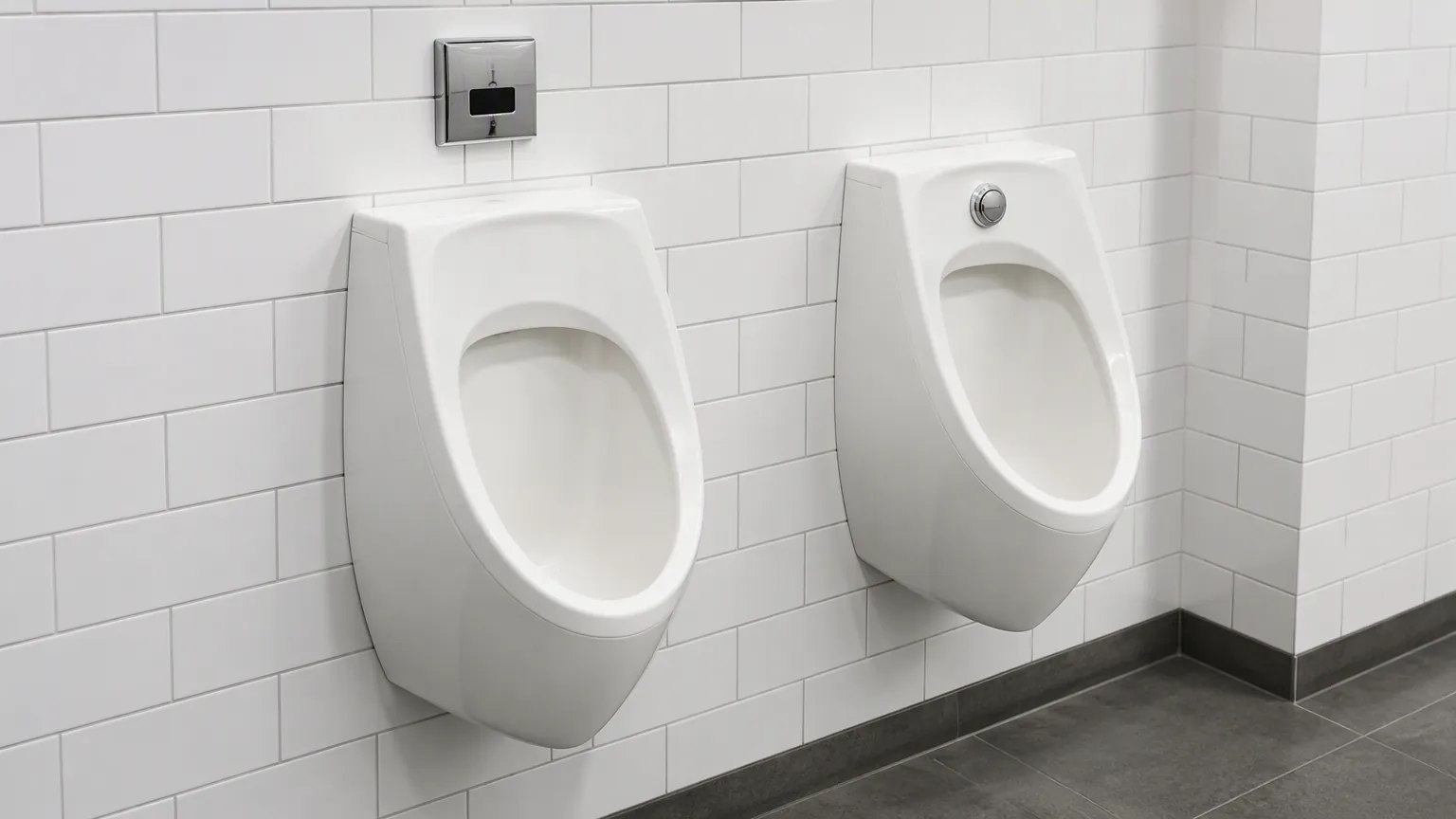
Sensor (Touchless) Flush
An infrared sensor triggers the flush valve. This is now the baseline for new commercial construction in most markets.
- Hygiene: no touch surface, lower cross-contamination in high-traffic restrooms
- Water control: programmable flush volume, typically 0.125–0.5 gallons per flush (gpf) on compliant models
- Cost: highest upfront (valve + sensor + power or battery), lowest lifetime water cost
- Watch out for: battery vs hardwired matters for maintenance; a dead battery bank in a 20-urinal bank is a service call you do not want
Manual (Handle or Push-Button) Flush
A user actuates the flush with a handle or button. Still common in value-engineered projects.
- Cost: lowest upfront, no sensor electronics
- Water control: fixed volume, harder to tune below code minimums
- Best for: low-budget builds, areas with unreliable power
- Watch out for: handle wear and the touch surface hygiene trade-off in health-sensitive facilities
Waterless (Cartridge) Urinals
A sealed cartridge and trap liquid handle waste with zero flush water.
- Water savings: 100% of flush water eliminated
- Best for: drought-prone regions, green-building projects chasing water credits
- Watch out for: the cartridge needs scheduled replacement (typically every 1,500–7,000 uses depending on model); skip it and odor follows. Maintenance teams must be trained before install.
Waterless units change the plumbing layout in one important way: without a flush supply, the wall chase only needs a drain connection. That simplifies new construction and opens retrofit options in buildings where water supply to the restroom is limited. The trade is operational. Cartridge replacement is a recurring consumable cost, and the trap liquid must be kept topped up. Facilities teams that do not schedule cartridge swaps will see odor complaints within the first year, which is why waterless specifications work best when the maintenance contract is clear from day one.
The sensor-vs-manual decision usually tracks the building type, not the budget alone. A hospital specifies sensor for infection control. A back-of-house warehouse may stay manual to avoid electronics. When sourcing internationally, the UAE bathroom fixtures guide covers regional code differences that affect valve selection. The water-efficiency standard for the target market is the first filter in any urinal specification.
—
Water Efficiency Standards That Change the Spec
Water rules are not optional in commercial procurement. They vary by market, and they determine which models you can legally specify.
United States: EPA WaterSense and UPC
The EPA WaterSense program labels urinals at 0.5 gpf or below. The Uniform Plumbing Code caps flushing urinal volume at 0.5 gpf for new installations. Specifying a WaterSense-labeled unit protects you at inspection and supports LEED water credits.
Canada: CSA and NAFTA Alignment
Canadian projects follow CSA B45 series requirements, aligned closely with U.S. efficiency levels. Confirm the specific model carries the mark for the province.
Europe: CE and the EU Water Label
CE marking covers essential health and safety; the EU Water Label rates water efficiency on a visual scale. Public buildings often target the higher tiers.
Middle East: SASO and GSO
Saudi and Gulf projects require SASO or GSO marks on imported sanitary ware. A model without the mark cannot clear customs. Our Saudi Arabia procurement guide details the SABER certification path for fixture imports.
—
Installation and Rough-In Details
A commercial urinal that installs cleanly is the product of decisions made before the fixture arrives. The rough-in dimensions, mounting hardware, and supply connections are all spec-level details that shape the on-site outcome.
Wall-Hung Rough-In Dimensions
For wall-hung models, the critical numbers are the height of the drain outlet above the finished floor and the carrier spacing. Most wall-hung carriers use a standard 230mm center-to-center mounting bolt pattern. The drain outlet typically sits 150–250mm above the finished floor depending on the model. Always match the carrier to the bowl brand — carriers and bowls are engineered together, and mixing brands voids the dimension guarantee.
The supply line location matters just as much. A sensor model needs a low-voltage connection near the valve; a manual model only needs the water supply. If the project intends a sensor upgrade later, run the low-voltage conduit at rough-in even when manual valves are installed initially. Retrofitting conduit after tiling is a demolition job.
Floor-Mounted Rough-In
Floor-mounted urinals need the drain stub located to the bowl’s exact footprint. The standard approach is to use the manufacturer’s template — most suppliers provide a paper template with the bowl dimensions and drain center marked. Set the floor drain before the slab pour using that template, and verify with a dry-fit after the bowl arrives.
Supply and Trap Requirements
All urinals need a supply stop within reach of the valve, usually 300mm below the rim on the side. The trap is integral on most wall-hung vitreous china bowls, which simplifies the install. Floor-mounted models may rely on the floor drain trap and require a trap primer where code dictates.
—
Material and Build Quality
Most urinals are vitreous china — the same fired ceramic body used for toilets, with the density and non-porosity that commercial traffic demands. A few stainless-steel models appear in transit stations and correctional facilities where impact resistance matters more than aesthetics.
For vitreous china, the same rule that applies to toilets applies here: Chinese manufacturers firing at 1,200–1,400°C produce a dense body with critical-dimension tolerances around ±3mm. That tolerance band is what lets a 20-unit order arrive and install without a single misfit. Always request the dimension sheet for the specific model before the order ships.
The surface finish matters almost as much as the body. A quality glaze resists staining, hard water buildup, and cleaning-chemical damage. Look for a dense, glossy surface without pin holes or crazing lines, and confirm the glaze specification covers the full exterior — some budget models leave the back and underside unglazed, which stains and odors over time. For heavy-traffic applications, ask the supplier for the glaze hardness rating and any abrasion test documentation.
—
Common Procurement Mistakes
Mistake 1: Specifying Sensor Without Confirming Power
A sensor bank needs power at each fixture or a battery system with a service plan. Contractors who specify sensor urinals and then discover no rough-in for low-voltage wiring face a change order. Confirm power availability before the fixture schedule is locked.
Mistake 2: Mixing Outlet Types in One Bank
A bank of urinals should share one outlet type. Mixing wall-hung and floor-mounted in the same row creates two rough-in standards, two carriers, and two failure modes. Keep the bank uniform.
Mistake 3: Forgetting the Carrier in Wall-Hung Specs
The wall carrier is a separate purchased item from the bowl in most specs. Forgetting it leaves a $40 bowl with no way to mount it. Call the carrier out explicitly in the schedule.
Mistake 4: Skipping Waterless Cartridge Training
Waterless urinals save water but fail on maintenance, not installation. If the facilities team is not trained on cartridge replacement, the unit smells within months. Train before install, or specify flush models.
Mistake 5: Ordering Before Verifying the Rough-In
As with toilets, measure the actual rough-in at site before ordering a container. A floor-mounted drain cannot accept a wall-hung bowl. Re-piping after the slab is poured costs more than a site visit. When sourcing internationally, our how to choose a bathroom manufacturer in China guide covers the verification steps that prevent these errors.
—
Dimension Standards and Accessibility
Commercial urinals follow dimension conventions that vary by market, and accessibility rules add another layer that contractors cannot skip.
Standard Mounting Heights
The rim height of a standard urinal is typically 24 inches (610mm) above the finished floor. Many jurisdictions require at least one accessible urinal with the rim at 17–19 inches (432–483mm) for wheelchair users. Others accept a wall-hung unit that meets reach range requirements. The exact numbers come from the local accessibility code, not the fixture catalog.
The U.S. Access Board restroom design requirements specify clear floor space and reach ranges that affect urinal placement. A contractor who places the sensor valve out of reach range fails inspection even if the bowl height is correct.
Clearance and Spacing
Banks of urinals need clear space between units and from adjacent fixtures. A common minimum is 600mm center-to-center spacing between urinals, with more where privacy screens are specified. Privacy partitions — full-height or floor-to-ceiling — are increasingly specified in all-gender restrooms and high-traffic facilities.
Metric vs Imperial Rough-Ins
North American projects use imperial rough-in measurements; most other markets use metric. A wall-hung carrier specified at 230mm does not translate to an even inch measurement, and mixing systems in one project invites errors. Keep the measurement system consistent across the entire fixture schedule and confirm the supplier’s dimension sheet uses the same system as the project drawings.
—
Gulf and Middle East Project Notes
Projects in the Gulf region — Saudi Arabia, the UAE, Qatar, Kuwait — add dimension and certification requirements. These are conditions that North American contractors rarely see. Rough-in distances there follow metric standards, typically 300mm or 305mm wall-to-drain-center for wall-hung carriers. Floor-mounted drains follow local plumbing code, which usually references the international or British system.
Two outlet configurations dominate: floor-mounted for affordable housing and worker accommodation, wall-hung for hotels, offices, and government buildings. Confirm the outlet type with the project’s plumbing consultant before ordering, because the two are not interchangeable without re-piping. SASO or GSO marks restrict which models you can specify. A model without the mark may force a complete re-spec.
—
Maintenance and Lifecycle Cost
The purchase price is the smallest part of a urinal’s lifecycle cost. The operating cost — water, maintenance, and replacement — usually exceeds the unit price. In a high-traffic building, that crossover happens within two to three years. That is why procurement decisions based on unit price alone tend to look different once the building is operating.
A sensor wall-hung unit at 0.125 gpf uses roughly a quarter of the water of an older 1.0 gpf manual model. Across a 30-urinal bank flushing 80 times a day, that difference is tens of thousands of gallons per year. In a drought-restricted region, the water savings alone can justify the sensor upgrade on a single budget cycle.
Maintenance divides by flush type. Manual valves need periodic cartridge replacement as the seals wear. Sensor valves need battery or power checks plus occasional sensor cleaning. Waterless units need cartridge swaps on a use-based schedule. The cheapest unit to buy is rarely the cheapest to operate, and the operating cost is what the building owner feels every month.
Spare-parts planning matters on volume orders. Specify a single valve platform across the whole bank so one spare cartridge type covers every fixture. A mixed bank means mixed spares, and a missing part on a 20-unit order is a service delay, not a rounding error. When sourcing, ask the supplier for the recommended spare-parts kit per 100 units and fold it into the initial order.
—
Pricing Levers on Volume Orders
Commercial urinal pricing is not one number. It moves with five levers on a volume order:
As a planning reference, FOB China estimates for standard vitreous china urinals run from roughly $15–40 per unit for manual floor-mounted models. Sensor wall-hung units with carrier run $40–90 per unit at container MOQs. These are planning ranges, not quotes — final pricing depends on volume, finish, certification marks, and current material costs. Always request a written quote tied to the specific model and certification set your project requires.
—
Quick Reference: Urinal Selection Checklist
Use this as your ordering checklist:
Getting these right before the order goes in is faster and cheaper than any remediation after the fixtures arrive.
—
FAQ
What is the standard urinal height?
Most urinals mount with the rim at 24 inches (610mm) above the finished floor, measured to the lip of the bowl. Confirm against the local plumbing code, because some jurisdictions specify a range rather than a single height.
Are sensor urinals worth the extra cost?
For high-traffic and health-sensitive buildings, yes. The touchless operation reduces cross-contamination and the programmable flush volume lowers water bills. For low-traffic back-of-house areas, manual models are a reasonable cost trade.
Can a waterless urinal be retrofitted into a flushed rough-in?
Only if the existing drain is compatible with the cartridge trap and the local code permits waterless fixtures. In many jurisdictions waterless urinals require specific approval. Confirm with the authority having jurisdiction before specifying.
Do urinals need a trap primer?
Floor-mounted urinals with floor drains often need a trap primer to prevent sewer gas. Wall-hung models with integral traps typically do not. Check the model specification and local code.
How many urinals per restroom stall is typical?
A common planning ratio is one urinal per toilet stall in a men’s restroom. Peak-use buildings like stadiums and transit hubs adjust upward, with urinal count often exceeding stall count.
What is the difference between a urinal and a water closet for commercial bids?
Urinals use far less water per use: 0.125–0.5 gpf versus 1.28 gpf for a standard toilet. They also take less floor space, which is why commercial men’s restrooms pair them with fewer stalls. Code minimums usually allow fewer water closets when urinals are provided. For volume pricing comparisons across both fixture types, see our wholesale toilets volume pricing guide.
How long does a vitreous china urinal last in commercial use?
A well-installed vitreous china bowl has a service life of 20-plus years; the flush valve and sensor electronics are the replaceable parts that fail first. Budget valve replacement at 5–10 year intervals in heavy-traffic facilities.
Are urinals required in women’s restrooms?
No. Urinals are almost exclusively installed in men’s and all-gender restrooms, typically in stalls or along a wall. In all-gender designs, privacy partitions become more important, which is covered in our commercial urinal specification guide.
—
References
- Fixture type: floor-mounted vitreous china is the lowest cost; sensor wall-hung with concealed carrier is the highest
- Flush system: manual is cheaper than sensor; waterless sits between on unit cost but saves on water infrastructure
- Order volume (MOQ): container-level orders (typically 200–1,000 units per model) unlock the best FOB China pricing
- Finish and accessories: stainless vs vitreous china, and whether valves, carriers, and supply lines are bundled
- Customization: private-label branding, color, or logo adds tooling and minimums
- Confirm outlet type at site — wall-hung (horizontal) or floor-mounted (vertical)
- Decide flush system — sensor, manual, or waterless — based on building type and power
- Verify water-code compliance — WaterSense / UPC / CE / SASO for the target market
- Call out the carrier separately for wall-hung specs
- Match material — vitreous china for most, stainless for high-impact locations
- Request dimension sheets from the supplier for the exact models
- Confirm certification marks before the container ships, especially for Gulf imports
- EPA WaterSense Specification for Flushing Urinals (Version 1.0)
- IAPMO Uniform Plumbing Code (UPC) Chapter 4: Fixtures
- ASME A112.19.2 / CSA B45.1: Vitreous China Plumbing Fixtures
- EPA WaterSense Labeled Products
- U.S. Access Board: Restroom Design Requirements
- ICC International Plumbing Code (IPC) Chapter 4: Fixtures, Faucets and Fixture Fittings
For assistance sourcing urinals at the correct specification for your project, reach out to our procurement team.