
If you’re a contractor sourcing kitchen faucets for a 200-unit apartment complex or outfitting a hotel’s main kitchen, here’s something no product catalog will tell you: most warranty claims don’t come from the faucet itself — they come from mismatched specifications.
A commercial-grade kitchen faucet installed in a standard residential countertop. A pull-down sprayer specified where a touchless sensor was required by local health code. A beautiful brushed brass faucet that starts pitting after six months because the water has higher-than-average chloride content.
These are real problems that procurement teams face. And they’re avoidable.
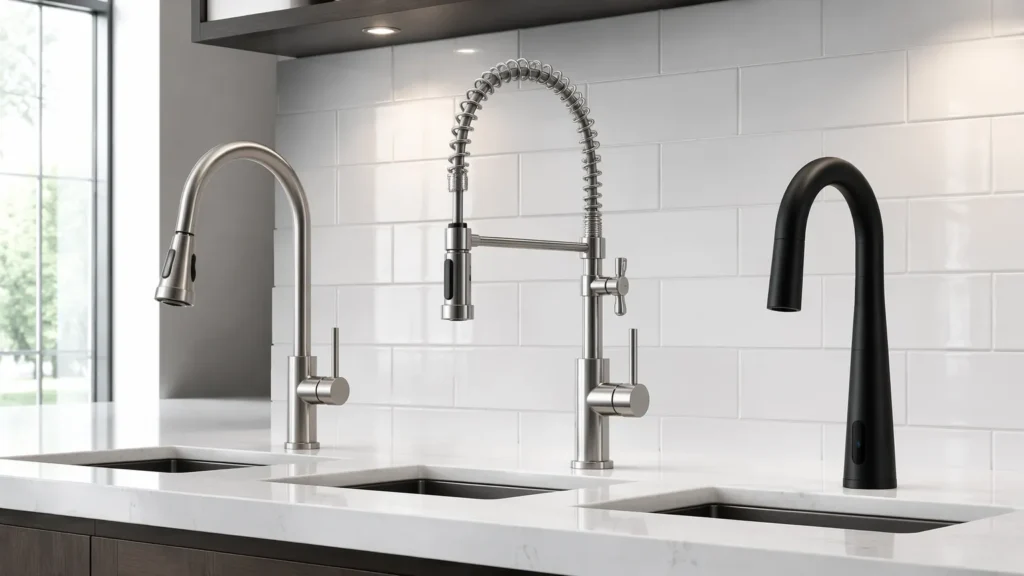
This guide covers the three most common kitchen faucet types for commercial and multi-residential projects, explains when each type makes sense (and when it doesn’t), and includes a practical contractor checklist for bulk procurement.
The Three Kitchen Faucet Types Contractors Actually Specify
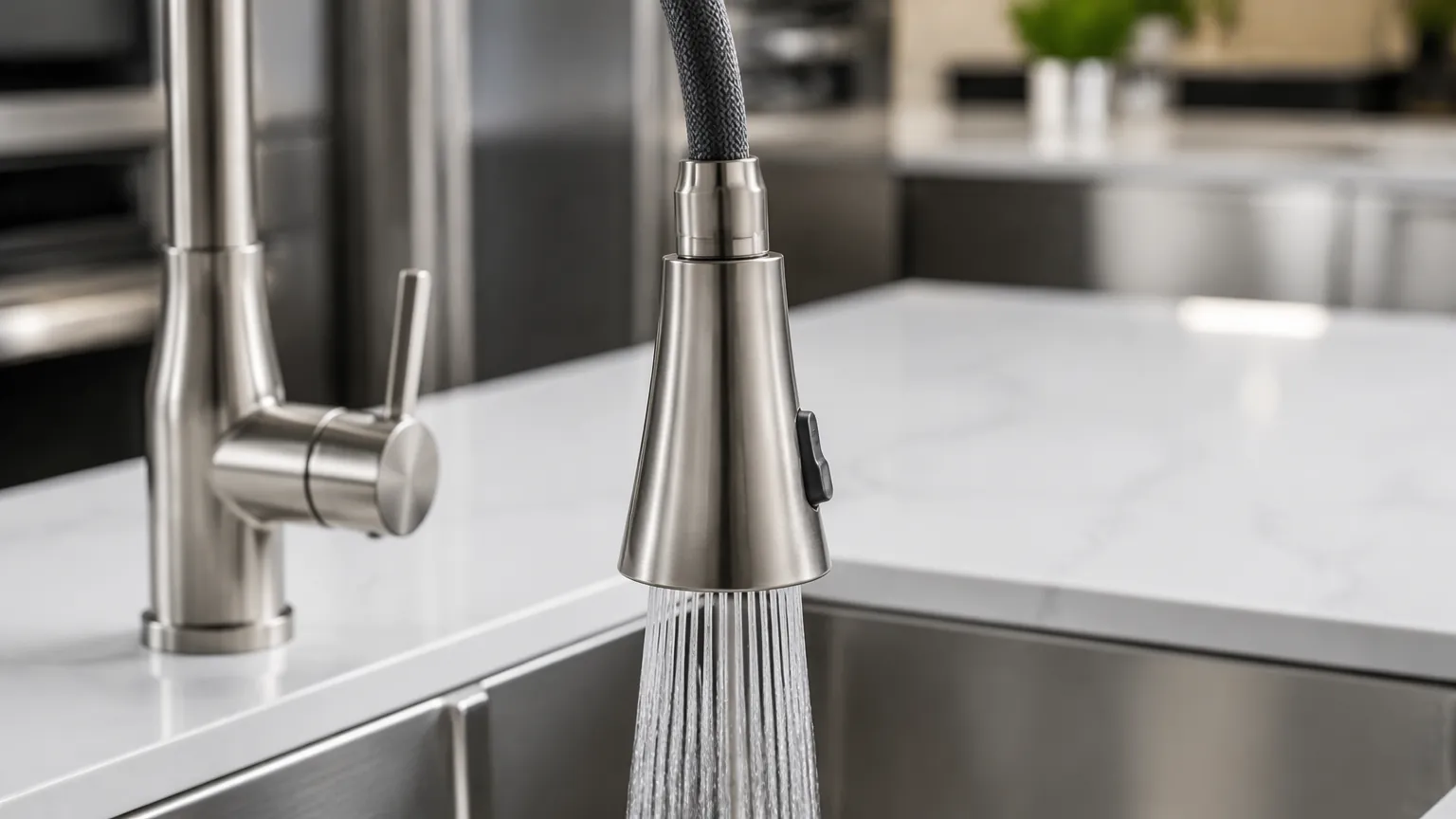
Pull-Down Kitchen Faucets
Pull-down faucets feature a spray head that pulls straight down into the sink. The head is typically heavier and delivers higher water flow than pull-out models.
When to specify:
- Standard hotel kitchenettes and apartment kitchens
- Mid-density residential projects (20–200 units)
- General-purpose kitchen sinks where the spray head stays clean and out of the way
Watch out for:
- The hose retraction mechanism — low-quality springs fail within 12–18 months in commercial settings
- Spout height clearance: pull-down faucets typically reach 15–17 inches. If your sink is deeper than 10 inches, verify clearance before ordering.
- Weight compatibility: heavier heads need a stronger internal weight, which means higher costs
Why it matters: In multifamily projects, the faucet that tenants interact with most is the kitchen faucet. A pull-down model with a cheap retraction mechanism creates maintenance calls within the first year. Specifying a ceramic cartridge faucet (500,000-cycle rating) versus a rubber washer cartridge can make the difference between “maintenance-free for the lease term” and “tenant complaint call every six months.”
Commercial / Spring Kitchen Faucets
Commercial-style kitchen faucets (also called restaurant faucets or pot-filler-style faucets) use a high-arc spring spout and often come with a side sprayer or integrated spray head. They’re built for high-use environments.
When to specify:
- Hotel main kitchens, staff canteens, and prep stations
- Apartment complex common-area kitchens
- High-end residential projects where the homeowner explicitly requests commercial style
Watch out for:
- Flow rate compliance: commercial faucets often deliver 1.8–2.2 GPM. Verify this meets local regulations (California/CEC max 1.8 GPM, Europe max 6 L/min).
- Spring coating: budget springs peel within one year. Look for 304 stainless steel braided hose with a heavy-duty nylon or metal spring cover.
- Mounting: commercial faucets are heavier. Not suitable for thin laminate or hollow-core countertops without reinforcement.
Why it matters: The spring faucet’s appeal is durability, but only if the spring itself is built to last. A $40 zinc-alloy spring faucet with painted spring coating will start showing rust within 8 weeks in a commercial kitchen environment. A 304 stainless steel faucet with ceramic cartridge will outlast the kitchen renovation cycle.

Touchless / Sensor Kitchen Faucets
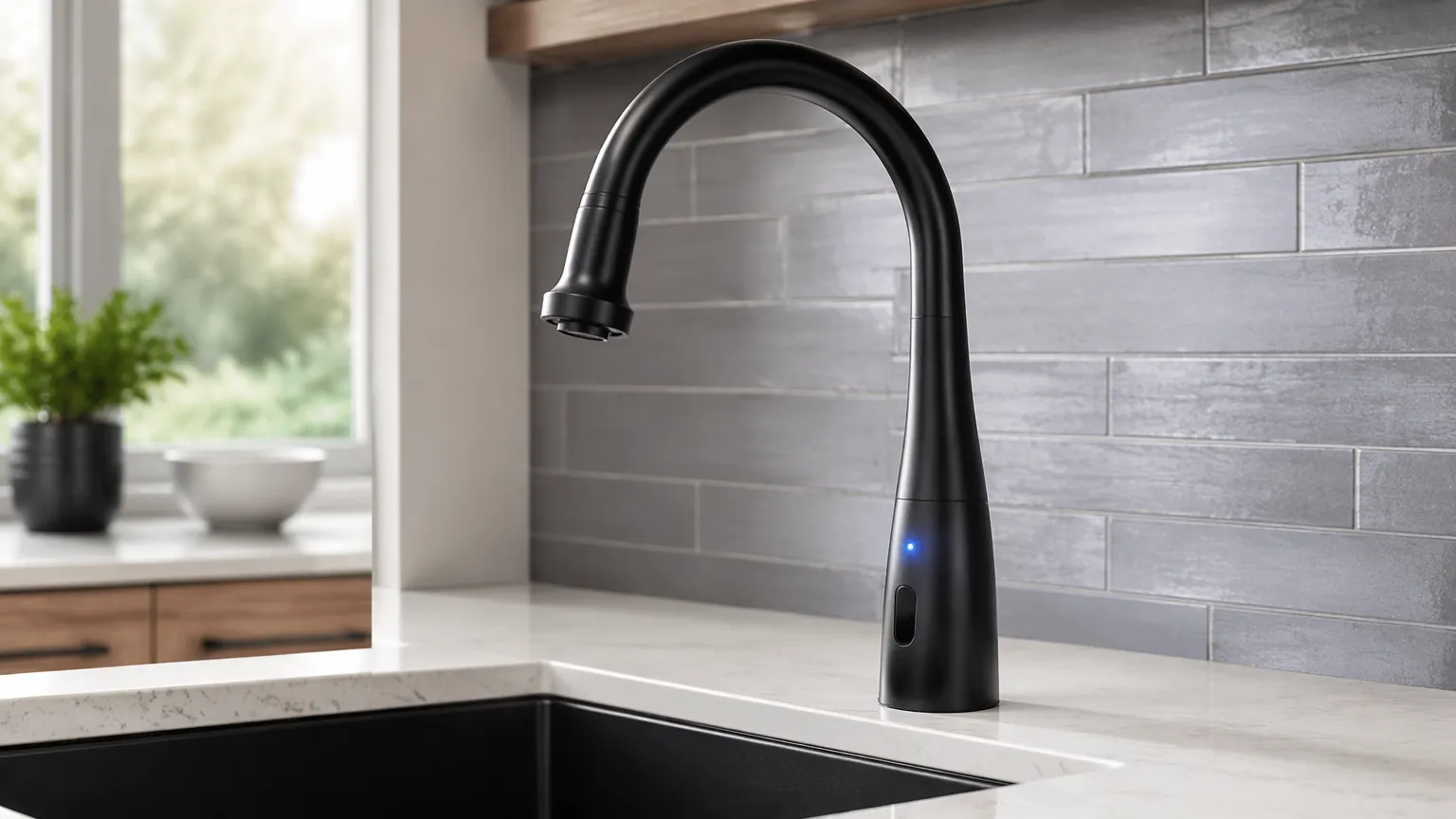
Touchless kitchen faucets use an infrared sensor to detect hand motion, turning water on and off automatically.
When to specify:
- Commercial kitchens where health code requires hands-free operation
- Hotel accessible rooms (ADA compliance)
- Multifamily buildings aiming for “smart home” positioning
- Post-pandemic projects where touch reduction is a stated design goal
Watch out for:
- Sensor reliability: passive infrared sensors struggle with dark countertops (black granite, dark marble)
- Battery vs. hardwired: for multi-unit projects, hardwired touchless faucets with AC adapters are more maintainable
- Response delay: cheap sensors have a 0.5–1 second delay; premium sensors respond in 0.2 seconds or less
Why it matters: Touchless faucets have a roughly 15–20% higher return rate in commercial settings than manual faucets, primarily due to sensor calibration issues. The difference between a reliable touchless faucet and one that generates complaint calls comes down to two things: sensor type (active infrared vs. passive) and valve quality (ceramic solenoid vs. plastic).
The Actual Ordering Checklist (Not the Manufacturer’s Version)
Here’s the checklist experienced contractors use when sourcing kitchen faucets wholesale — not what the factory’s sales sheet would put first:
- Depth test — Measure sink depth. Kitchen faucet spout must extend at least 2 inches past the sink’s back rim.
- Deck thickness — Measure countertop thickness at the mounting point. Some commercial faucets require 1.5 inches or thicker.
- Water pressure test — For pull-down and touchless faucets, minimum dynamic water pressure should be 40 PSI (2.8 bar).
- Hole count — Single-hole faucets need exactly one 1⅜-inch hole. Three-hole configurations require matching countertop drilling.
- Local code check — Verify flow rate limits, backflow prevention, and lead-free compliance per your project’s jurisdiction.
- Spare parts availability — Ask the supplier if cartridges, hoses, and sensor boards will be available for at least 5 years post-installation.
Project Example: 40-Unit Serviced Apartment Kitchen Fit-Out
Background: A developer in the Middle East was fitting out 40 serviced apartment units. The original specification called for a mid-range touchless kitchen faucet with brushed nickel finish.
The issue the contractor identified: The specified touchless faucet used passive infrared sensors and a plastic solenoid valve. After reviewing 12-month failure data from similar projects, the contractor calculated that each sensor-failure call-out would cost approximately $80–120 in technician time. Over 40 units, a 20% sensor failure rate within two years meant potential costs of $840–$1,320 in service calls alone.
What they did instead: Switched to a manual pull-down faucet with a ceramic cartridge and solid brass body (same brushed nickel finish), installed a single touchless unit only in the accessible ground-floor apartment.
Result: Developer saved an estimated $3,500–$5,000 in projected 5-year maintenance costs. Zero faucet-related maintenance requests after 18 months.
Common Specification Mistakes Contractors Make
- Assuming “commercial” means “universal” — A kitchen faucet rated for restaurant use may not comply with residential flow rate limits. Always verify local code.
- Ordering the finish first, material second — A zinc-alloy faucet with a good matte black finish looks identical to a solid brass faucet for about 12 months. After that, the threads wear out.
- Skipping the aerator check — Different regions have different standard aerator sizes (US: 15/16-inch male, Europe: M22 male). Wrong aerator thread means buying adapters for every unit.
- Ignoring cabinet clearance — Pull-down faucets need 6–8 inches of vertical clearance below the countertop for the hose and weight.
- Not requesting pre-production samples — For any order over 100 units, insist on a pre-production sample. The cost of one sample is negligible compared to 100 units of wrong-spec faucets.
Certification Guide for Kitchen Faucets
| Certification | Relevance | When It Matters |
|---|---|---|
| NSF 61 / NS 372 | Mandatory | US projects — lead content and drinking water safety |
| cUPC | Mandatory | US and Canada — plumbing code compliance |
| CE (EN 817) | Mandatory | European projects — hydraulic safety |
| WATERMARK | Mandatory | Australia and New Zealand |
| SASO / GSO | Mandatory | Saudi Arabia and GCC countries |
| ADA | Required for accessible units | US projects with accessibility requirements |
The real question contractors should ask: “Which certification applies to the project’s destination market, and does the supplier have that specific certification for the exact model they’re quoting?” A general “we have CE/cUPC” doesn’t help if the certification only applies to their brass models, but the quote is for zinc alloy.
Frequently Asked Questions
Can I use residential kitchen faucets in a commercial kitchen?
Not recommended. Residential faucets are tested to a lower cycle count (typically 100,000–200,000 cycles) and may not hold up to commercial usage patterns. For any licensed kitchen, specify commercial-rated faucets.
What’s the most durable finish for a kitchen faucet?
Brushed nickel and chrome. Matte black is popular aesthetically but shows water spots in high-traffic settings, and some lower-cost matte black coatings wear off within 12–18 months in rental use.
What’s the most common warranty issue with wholesale kitchen faucets?
Aerator clogging and cartridge failure. Specify ceramic disc cartridges — they don’t degrade from hard water sediment the way rubber does.
Do you offer OEM / custom branding for large projects?
Yes. YIDA Bath supports OEM and private label for bulk orders. Contact us for project-specific requirements.
Related guides:
- Wholesale Bathroom Faucets: The Complete Contractor Guide
- Shower Enclosure Buying Guide for Contractors
- Basin Faucet Buying Guide for Contractors
References
- ASME A112.18.1 / CSA B125.1 — Plumbing Supply Fittings
- NSF/ANSI 61 & 372 — Drinking Water System Components
- EN 817 — Sanitary tapware (Mechanical mixers)
- ADA Standards for Accessible Design — Sections 309, 606
- California Energy Commission (CEC) Title 20 — Appliance Efficiency Regulations