Ask an importer in Rotterdam, Dubai, or São Paulo to name the world’s top toilet supplier, and they will likely mention a handful of European brands. The names that come to mind are German, Italian, maybe Japanese. These companies have showrooms in design districts and product launches at international fairs. But if you ask the same importer where those toilets were actually manufactured, the answer gets quieter. A significant share of those premium ceramic fixtures were made in factories the brand-name buyer has never visited, by workers whose names do not appear on the packaging. The global toilet supplier landscape is not what it appears to be from the showroom floor.
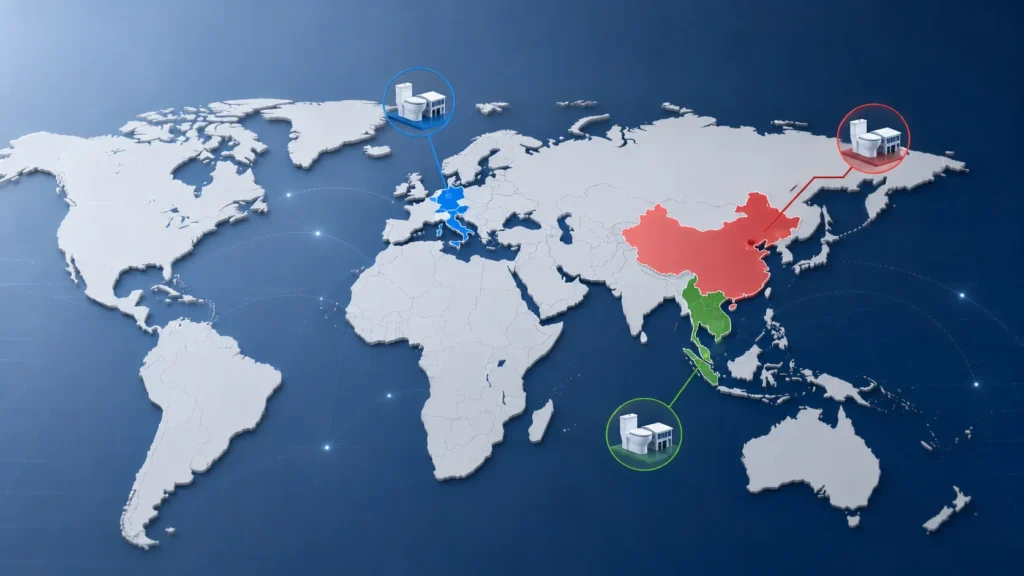
This article maps out three major manufacturing regions that produce the world’s ceramic sanitary ware. It explains what each does well, and it identifies where the industry is heading. For importers who need consistent quality, complete certification, and supplier relationships that outlast a single order, understanding these regions is the first step. Choosing the right toilet supplier is the second.
1. Europe: Precision Engineering and Brand Heritage
European toilet manufacturing has earned its reputation over more than a century. Factories in Germany, Italy, and Portugal produce vitreous china fixtures under brand names that architects have specified for decades. The European strength is not volume. It is precision.
What a European Toilet Supplier Does Well
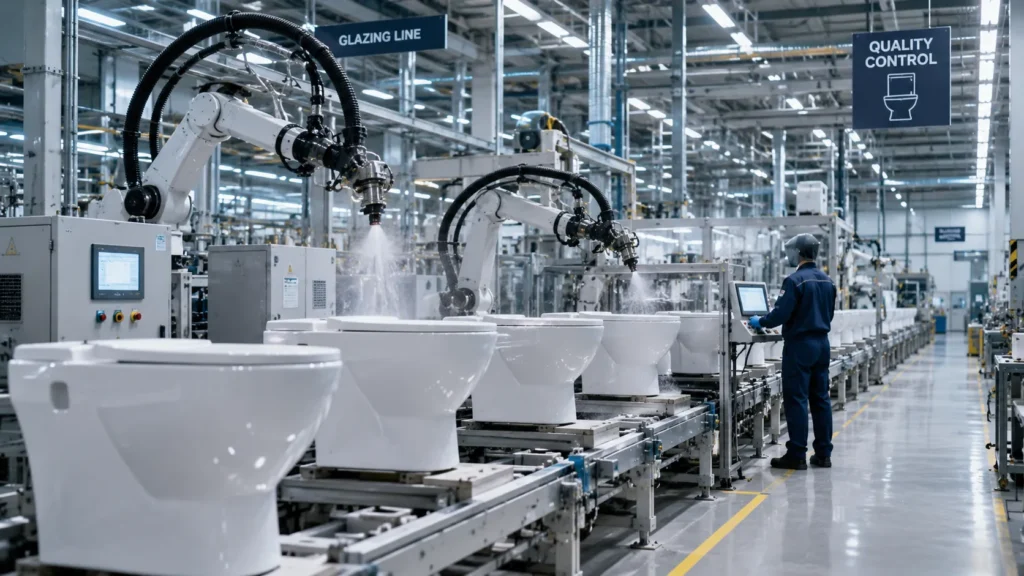
A German-manufactured toilet comes from a factory where dimensional tolerances are measured in fractions of a millimeter. Every unit passes through automated glaze inspection. Furthermore, the documentation package meets the expectations of building inspectors across the EU without revision. European toilet suppliers have also led the industry in water efficiency innovation. The shift to 4.5-liter full-flush toilets, rimless bowl technology, and concealed mounting frames all originated in European R&D departments.
For importers serving markets where European brand recognition drives specification—luxury hotels in Dubai, high-end residential in Singapore—a European toilet supplier provides marketing value that a factory in another region cannot replicate, regardless of quality equivalence.
The Trade-Offs
The European manufacturing model carries two structural limitations. The first is cost. Labor, energy, and regulatory compliance in Germany or Italy produce a factory gate price that is typically two to three times the equivalent product from an Asian factory with comparable quality control. The second is production flexibility. European factories run on fixed schedules with lead times of twelve to sixteen weeks. Consequently, a large-volume order with a tight deadline is difficult to accommodate. The European toilet supplier model works best for importers who order standard products on predictable schedules.
2. Southeast Asia: Emerging Capacity and Regional Reach
Over the past fifteen years, Thailand, Vietnam, and increasingly India have built significant ceramic sanitary ware production capacity. This manufacturing cluster developed partly to serve domestic demand and partly as a diversification option for importers who wanted an alternative to Chinese supply chains.
What a Southeast Asian Toilet Supplier Does Well
The primary advantage of a Southeast Asian toilet supplier is geographic proximity to key growth markets. A factory in Thailand or Vietnam can ship to Singapore, Kuala Lumpur, or Jakarta in days rather than weeks. For importers serving the ASEAN region, the freight cost advantage and shorter lead time make Southeast Asian sourcing attractive. Several Southeast Asian factories also operate under joint ventures with European or Japanese sanitary ware companies. As a result, quality control knowledge and production discipline have transferred into the region.
Some Southeast Asian toilet suppliers have also benefited from trade policy shifts. Importers seeking to diversify away from China for tariff or supply chain resilience reasons have directed orders toward Vietnam and Thailand. This trend accelerated after 2020 and has sustained through 2026.
The Trade-Offs
The Southeast Asian production cluster has not yet reached the scale or maturity of the Chinese ceramic industry. Total production capacity is smaller, which means large-volume orders may need to be split across multiple factories. The supply chain for raw materials—clays, feldspar, quartz, glazes—is less developed than in China’s ceramic-producing provinces. In addition, some factories rely on imported materials that add cost and lead time uncertainty. Certification coverage also varies. While many Southeast Asian toilet suppliers carry CE marking for the EU market, fewer have obtained CUPC certification for North America or WELS registration for Australia and Singapore.
3. China: Scale, Speed, and a Quiet Quality Revolution
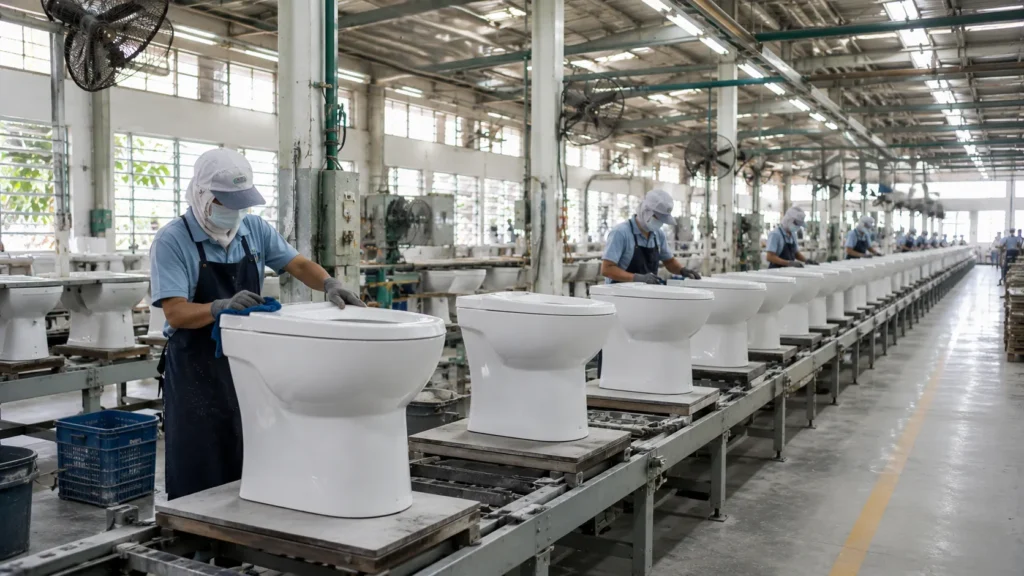
The Chinese ceramic sanitary ware industry produces more toilets than Europe, Southeast Asia, and the Americas combined. The scale of production in ceramic clusters like Chaozhou, Foshan, and Tangshan has no global equivalent. But the story that matters for importers in 2026 is not about volume. It is about quality trajectory.
What a Chinese Toilet Supplier Does Well
The Chinese toilet supplier that competes on price alone is still easy to find. However, the Chinese toilet supplier that competes on quality, certification, and service is the one international importers increasingly seek out. These suppliers have invested in European and Japanese production equipment. They have hired quality control teams trained to international standards. Moreover, they have obtained certification portfolios that cover CE, CUPC, WaterSense, and WELS simultaneously. They do not just manufacture. They handle compliance documentation, custom packaging, mixed-container loading, and after-sales support.
YIDA Bath, based in the Chaozhou ceramic production zone, exemplifies this model. The factory produces floor-mounted toilets, wall-hung toilets, one-piece toilets, and matching bidets across a product range designed for international project markets. Certification is a core part of the operation. The CE certification portfolio covers the full product line—floor-mounted bidets, wall-hung bidets, floor-mounted toilets, wall-hung toilets, and one-piece toilets. CUPC certification through IAPMO extends compliance coverage into the North American market. For an importer serving projects in the Middle East, Southern Europe, and Latin America—markets where a matched bidet and toilet set is standard specification—a single Chinese toilet supplier with complete certification eliminates the complexity of splitting orders across multiple factories.
Production flexibility is another real advantage. A Chinese factory can typically accept a custom finish request, a mixed-container order combining several product types, or a revised delivery schedule. This flexibility does not come from lower quality standards. It comes from a manufacturing ecosystem where raw material suppliers, mold makers, and logistics providers are clustered within a short radius. This allows faster turnaround on changes. (Explore YIDA Bath’s full product range to see available configurations.)
What to Verify
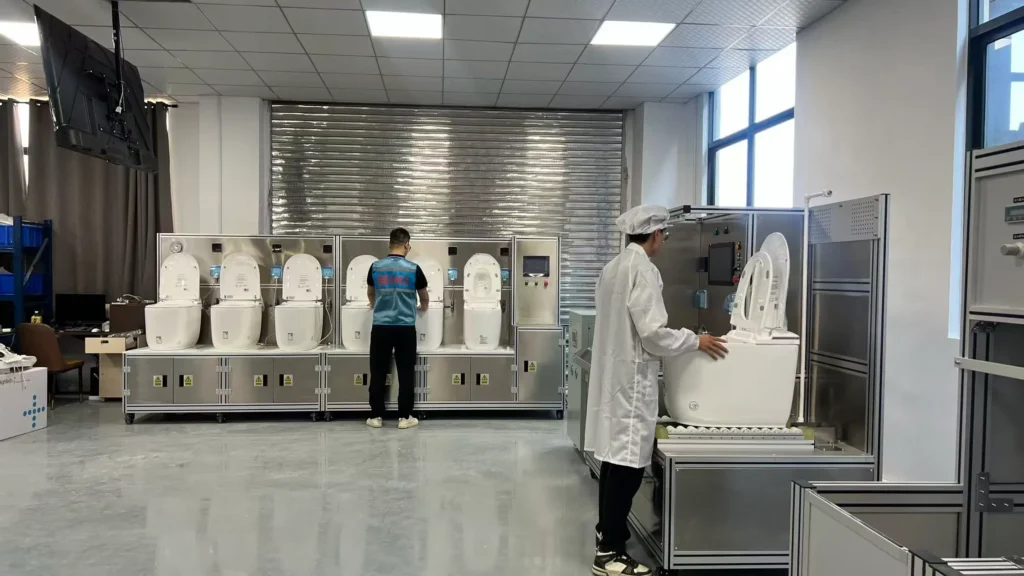
The diversity of the Chinese ceramic industry means that factory selection matters more than country selection. A Chinese toilet supplier with ISO-certified quality management, documented batch-testing procedures, and a track record of export compliance is a different proposition from a trading company that sources from whichever factory offers the lowest price that week. Importers evaluating a Chinese toilet supplier should verify the factory address, the certification documents for the specific models being ordered, and the defect rate and after-sales policy. A supplier who provides this documentation promptly and who welcomes a factory audit is operating at the standard that international project procurement demands. The IAPMO website provides a useful reference for understanding certification standards.
4. The Convergence: What the Best Toilet Suppliers Share
Twenty years ago, a European toilet supplier, an Asian factory, and a trading company were three distinct business models. That is no longer the case. The industry is converging toward a single supplier profile that combines the best of each region.
The European toilet supplier brings design heritage and brand value. The Southeast Asian supplier brings regional logistics advantage. Meanwhile, the Chinese supplier brings production scale and flexibility. But the supplier that wins long-term contracts is the one that combines multiple advantages: certification coverage across target markets, consistent quality from batch to batch, flexible production that accommodates custom specifications, and direct factory accountability without intermediary markups.
For importers, this convergence simplifies decision-making. The question is no longer which country to source from. It is which specific factory has the certification, the quality control, and the service infrastructure to function as a long-term toilet supplier, not just a one-order vendor. A factory like YIDA Bath, which combines CE and CUPC certification with a broad product range and direct export capability, represents the direction the industry is moving. The geographic location is China, but the operating standard is global. (Learn more about international compliance in our industry trends section.)
5. Six Questions to Evaluate Any Toilet Supplier
Regardless of where a factory is located, the same six questions separate a reliable toilet supplier from a procurement risk.
- What certifications does the supplier hold, and are they current? Ask for copies of CE, CUPC, WaterSense, or WELS certificates for the specific models you are ordering. A valid certificate from three years ago is not a valid certificate today.
- Does the certification cover the complete product? A toilet is an assembly of pan, cistern, flush mechanism, and seat. Certification that covers only the ceramic pan leaves the rest of the product in a compliance gap.
- Can the supplier produce matched sets? If your market demands a matching toilet and bidet, can the factory supply both from the same production batch with the same glaze and quality control?
- What is the defect rate, and what happens when a defect is found? A supplier who claims zero defects is not being honest. A supplier who specifies a realistic defect rate and a clear remedy procedure is demonstrating accountability.
- Is the supplier a factory or a trading company? Visit the production line or commission a third-party audit. A supplier who owns their kilns and glaze lines has control over quality that a trading company does not.
- Can the supplier handle mixed containers? An importer who needs toilets, bidets, and basins in the same shipment wants a supplier who can load a mixed container at the factory, not a supplier who outsources consolidation to a third-party warehouse.
Final Thoughts
The global toilet supplier map has three major manufacturing regions, each with genuine strengths. Europe leads in precision engineering and brand equity. Southeast Asia is building capacity and serving regional demand with improving quality. China operates at a scale that no other region matches, and the best Chinese factories have closed the quality and certification gap that once separated them from their European competitors.
For the importer, the procurement decision is not about choosing a country. It is about choosing a factory. A toilet supplier with complete certification, consistent quality control, matched-set production capability, and direct export experience—regardless of location—is worth more to a long-term import business than a brand name with a three-month lead time and no flexibility.
The industry has changed. The factory that simply produces and ships is no longer enough. The toilet supplier that provides compliance, consistency, and partnership is the one that importers reorder from. That is the standard worth looking for, and it exists across all three continents for those who take the time to verify what is behind the product page. To discuss your sourcing requirements with a certified toilet supplier, contact YIDA Bath directly.