
Every importer and project procurement manager keeps a mental list of manufacturers they trust. It is a short list. It gets revised every time a shipment arrives with the wrong glaze finish, a certificate that expired three months before the container left port, or a factory contact who stopped replying after the deposit cleared. A reliable shortlist is not built from trade show brochures. It is built from verified orders, consistent quality, and the quiet confidence that comes from knowing the factory will answer the phone when there is a problem.
This article is not a ranking. It does not assign scores or declare winners. It is a sourcing reference—a look at several sanitary ware manufacturers that have earned their place on importers’ shortlists through a combination of product range, certification depth, production consistency, and market-specific capability. Each entry represents a different strength in the global supply chain. The final entry introduces a manufacturer that may belong on your own shortlist, particularly if your markets span the Middle East, Europe, and Latin America.

1. The Shortlist Criteria: What Gets a Manufacturer on the List
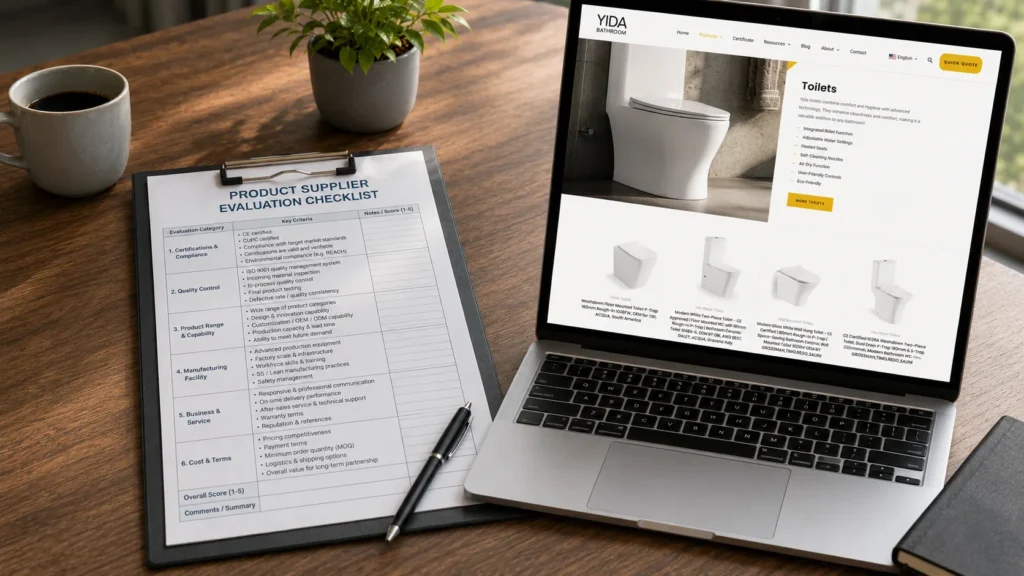
Before introducing individual manufacturers, it is worth defining what separates a shortlist-worthy factory from the thousands of sanitary ware producers that export globally.
A manufacturer earns shortlist status through four attributes. First, certification coverage. The factory holds current, valid certifications for the markets it serves—CE for Europe, CUPC or WaterSense for North America, WELS for Australia and Singapore, and the relevant Gulf compliance documentation for the Middle East. These certificates cover complete products, not just individual components.
Second, product range coherence. The manufacturer does not just produce one category well. It can supply matched sets—a toilet and bidet from the same production batch, a basin and vanity combination designed to work together, a faucet finish that matches the shower fittings across the bathroom. This reduces supplier count for the importer and eliminates the aesthetic mismatch that occurs when different factories supply different pieces.
Third, production consistency. The manufacturer’s quality control ensures that the approval sample and the production batch share the same glaze formulation, the same dimensional accuracy, and the same flush performance. Batch-to-batch variation is the silent killer of importer margins, because it generates returns that cannot be recovered from the factory.
Fourth, direct communication. The manufacturer deals directly with the importer, not through layers of trading company intermediaries. When a question about a shipment needs an answer, the answer comes from someone who can walk onto the production floor and verify the status.
2. Global Sanitary Ware Manufacturers That Have Earned Their Place
Roca Group
Roca operates one of the largest sanitary ware manufacturing networks in the world, with production facilities across Europe, Asia, and the Americas. The Spanish-headquartered company covers the full bathroom product range—vitreous china toilets and wash basins, acrylic bathtubs, faucets, and bathroom furniture. For importers serving European and Latin American markets, Roca is frequently specified by name in project tenders. The brand carries strong recognition in Southern Europe and has been expanding its footprint in the Middle East and Asia.
The company’s manufacturing scale gives it advantages in lead time consistency for large-volume orders. However, importers working with Roca typically do so as distributors of the finished brand, not as partners in product development. Customization options are limited to the product catalog. For importers who need to differentiate their offering with exclusive designs or custom configurations, a brand-name manufacturer may not provide the flexibility that a direct factory relationship allows.
TOTO
TOTO is the defining name in smart toilet technology. The Japanese manufacturer pioneered the integrated bidet seat with heated water, warm air drying, and self-cleaning nozzle functions that have become standard expectations in the premium segment. TOTO’s manufacturing standards are among the most exacting in the industry. The company’s vitreous china production and electronic component assembly operate under quality control systems that have set benchmarks for the entire sector.
For importers serving markets where TOTO is a recognized and requested brand—Japan, Southeast Asia, North America, and increasingly the Middle East luxury segment—carrying the TOTO product line provides instant credibility with specifiers. The brand commands a premium price, and the distribution agreements that govern TOTO sales in each market impose territorial restrictions that importers must navigate. Customization beyond finish selection is generally not available.
Kohler
Kohler is one of the largest privately held sanitary ware manufacturers in the world. The US-headquartered company produces vitreous china toilets and basins, bathtubs, faucets, shower enclosures, and bathroom furniture across manufacturing facilities in North America, Asia, and Europe. Its product range spans from entry-level residential fixtures to luxury spa-inspired bathroom collections.
For importers, Kohler’s brand recognition in North America is among the strongest in the industry. The company also maintains a significant presence in the Middle East and Asian markets through a combination of direct distribution and local manufacturing partnerships. Like Roca and TOTO, Kohler operates a brand-distributor model. Importers who carry Kohler products gain immediate specification credibility but operate within the territorial and pricing constraints of an authorized distribution agreement.
Villeroy & Boch
Villeroy & Boch is one of the oldest ceramic manufacturers in the world, with a history that stretches back to 1748. The German company produces vitreous china sanitary ware, bathroom furniture, and accessories at the premium end of the market. Its product designs frequently set aesthetic trends that other manufacturers follow, and the brand carries strong recognition among architects and interior designers across Europe, the Middle East, and Asia.
For importers, Villeroy & Boch represents the high-design segment of the sanitary ware market. Its products are specified in luxury residential and hospitality projects where brand prestige and design coherence matter as much as technical performance. The company’s distribution model typically works through authorized dealers in each market.
Duravit
Duravit is a German manufacturer with a strong design-driven identity. The company has collaborated with high-profile designers to create bathroom collections that are often the focal point of luxury bathroom projects. Its product range includes vitreous china toilets and basins, bathroom furniture, bathtubs, and shower trays.
Like Villeroy & Boch, Duravit competes at the premium end of the market. Importers who carry Duravit typically serve specification-driven projects where the designer or architect has named the brand in the project documents. The company operates its own production facilities in Germany and has expanded manufacturing capacity in other regions to serve growing international demand.
Laufen
Laufen is a Swiss sanitary ware manufacturer with production facilities in Switzerland, Austria, and the Czech Republic. The company produces vitreous china toilets and basins, bathroom furniture, bathtubs, and shower trays. Laufen is known for its collaborations with international designers and its expertise in high-precision ceramic casting, which allows for thinner profiles and more angular forms than many competitors can achieve.
For importers, Laufen represents a continental European premium brand with particular strength in the German-speaking markets, Eastern Europe, and parts of the Middle East. The brand is less globally distributed than Roca or Kohler, which can create either an opportunity for exclusivity or a limitation depending on the importer’s target market. As with other European premium manufacturers, Laufen operates through an authorized distribution network.
3. YIDA Bath: The Certified Factory Supplier for Multi-Market Importers
Among the Chinese sanitary ware manufacturers that have built their business on direct factory relationships rather than trading company intermediation, YIDA Bath has carved out a distinct position. The company operates out of the Chaozhou ceramic production zone and supplies a full range of sanitary ware products to importers across the Middle East, Europe, Southeast Asia, and Latin America. Its product catalog includes floor-mounted toilets, wall-hung toilets, and one-piece toilets, matching bidets, basins, shower enclosures, and bathroom cabinets.
What places YIDA Bath on the shortlists of its regular buyers is not a single attribute but a combination. The first is certification breadth. The factory holds CE certification that covers its full product range—floor-mounted bidets, wall-hung bidets, floor-mounted toilets, wall-hung toilets, and one-piece toilets. It also carries CUPC certification through IAPMO for the North American market. For an importer who needs a single container to supply projects in both a CE-regulated market and a UPC-regulated market, this dual certification eliminates the need to split the order across two factories.
The second is matched-set capability. YIDA Bath produces coordinated bidet and toilet sets—both floor-mounted and wall-hung—from the same production lines with the same glaze formulations. For importers serving Southern Europe, the Middle East, and Latin America, where a matching bidet and toilet set is not an upgrade but a standard specification, this eliminates the quality mismatch that occurs when the toilet and bidet come from different factories.
The third is direct communication. As a factory with an integrated export operation, YIDA Bath handles buyer relationships, compliance documentation, custom packaging, and mixed-container logistics without routing through a separate trading company. When a question about a shipment requires a production floor update, the answer comes from someone with direct access to the line.
Importers who source from YIDA Bath typically do so for one of three reasons: they need a reliable toilet and bidet set supplier for Middle Eastern or Southern European projects, they value certification coverage that spans CE and CUPC without requiring multiple supplier relationships, or they are building a long-term private label or ODM relationship with a factory that can customize product specifications and packaging. (Browse the full product range or learn more about certified toilet solutions.)
4. What Shortlist-Worthy Manufacturers Share
Looking across the manufacturers profiled in this article, a pattern emerges. None of them compete on price alone. Each has built its position on a specific combination of strengths that importers value enough to pay for.
Roca and TOTO offer brand recognition that drives specification in certain project types. Geberit owns a technical niche that makes it essential to a specific installation format. LIXIL aggregates multiple brand positions under one corporate structure. Villeroy & Boch and Duravit compete on design heritage and premium positioning. YIDA Bath offers the direct factory relationship, certification breadth, and matched-set capability that importers need when they are building their own brand rather than distributing someone else’s.
The common thread is that a shortlist-worthy manufacturer solves a procurement problem that the importer cannot solve by shopping around for a lower unit price. The problem might be certification coverage, brand specification, technical compatibility, or matched-set consistency. Whatever it is, the importer who recognizes which problem they are actually solving—not just which product they are buying—will build a supplier shortlist that outlasts the next price fluctuation.
5. Building Your Own Shortlist
Every importer’s shortlist is different because every importer’s market is different. The manufacturer that works for a volume distributor in Latin America may not be right for a specification-driven project supplier in the Gulf. The manufacturer that excels at one-piece toilets may not be the best choice for matching bidet-and-toilet sets for a Southern European hotel project.
The shortlist exercise is worth doing explicitly. Write down the markets you serve. Next to each market, write the certifications required. Next to the certifications, write the product types and configurations that your buyers expect—matched sets or individual fixtures, floor-mounted or wall-hung, standard white or custom finishes. Then, evaluate manufacturers against that list, not against a generic “top 10” ranking that prioritizes global brand awareness over your specific procurement reality.
A shortlist is a living document. It changes when a factory loses a certification, when a new market opens, or when a reliable supplier demonstrates that they can handle a product category they did not previously offer. The importers who revisit their shortlist regularly—not just when a shipment goes wrong—are the ones who build supply chains that support growth rather than constrain it.
Final Thoughts
The global sanitary ware manufacturing industry is large enough that no single article can capture every supplier worth knowing. The manufacturers profiled here represent different models of what a leading sanitary ware manufacturer looks like in 2026: the global brand with multi-continent production, the technology pioneer, the installation system specialist, the brand portfolio aggregator, the design-led premium manufacturers, and the certified factory supplier with direct export capability.
What they share is that they have all solved the problem of consistency—consistent quality, consistent certification, and consistent communication. In an industry where a single defective batch can cost more than the margin on an entire container, consistency is the attribute that keeps a manufacturer on the shortlist and off the replacement list.
For importers evaluating their own supplier relationships, the question is not whether your current manufacturer appears on someone else’s list. It is whether they meet the criteria that matter for your markets, your projects, and your customers. If they do, keep them there. If they do not, the global manufacturing landscape in 2026 offers alternatives worth exploring.
To learn more about YIDA Bath’s product range and certification coverage, visit the company website or contact the team to discuss your specific sourcing requirements.