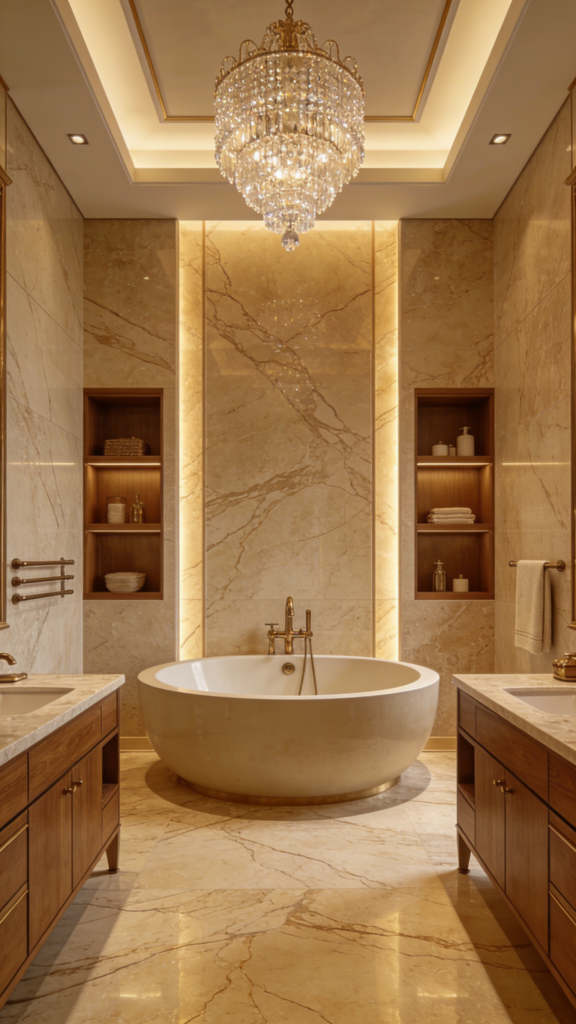

A wash basin is one of the most frequently used fixtures in any bathroom. Yet the mounting style often gets chosen on looks alone. A vessel bowl catches your eye in a showroom. A pedestal basin reminds you of a hotel you once visited. A wall-hung unit appears in a renovation photo you saved months ago. The problem is that each of these three types—countertop, pedestal, and wall-mounted—demands something different from your bathroom. Different wall structures. Different plumbing preparations. Different cleaning routines. Pick the wrong one, and you will be scrubbing inaccessible corners or calling a plumber to move a waste pipe that is now in the wrong position.
This guide walks through all three options honestly. None of them is the universal best. Each one solves a specific set of problems and fits a specific type of bathroom. I have specified all three across projects in Europe, the Middle East, Southeast Asia, and the Americas. What follows is based on how they actually perform once installed, not just how they look in a catalogue.
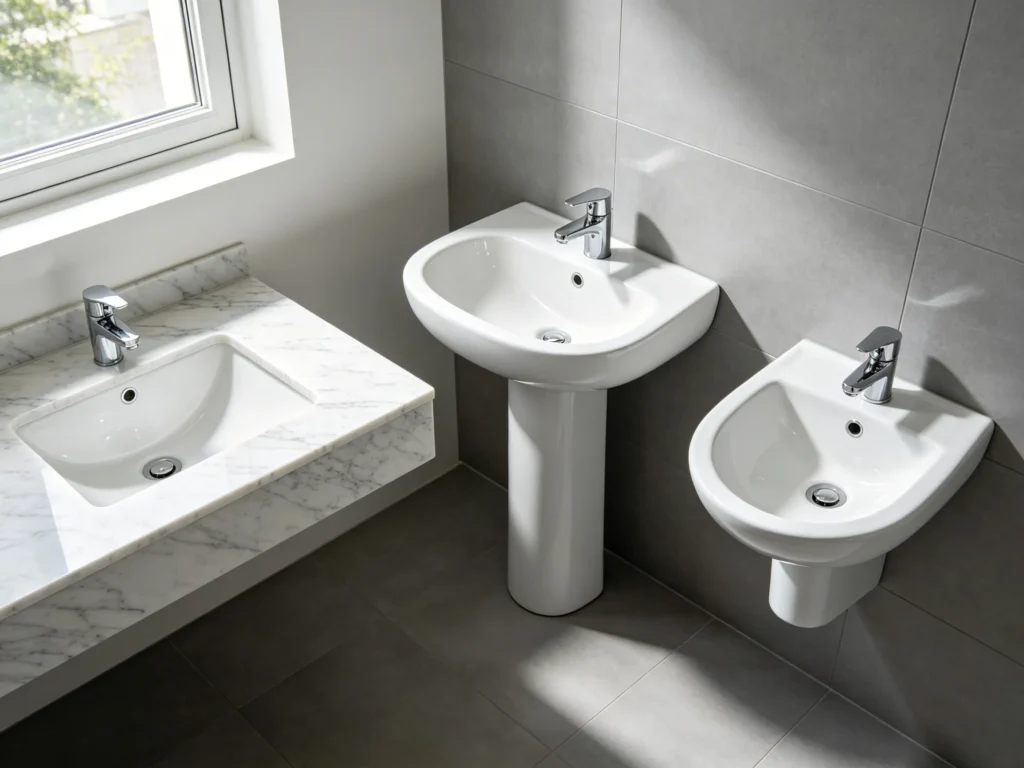
1. Countertop Basins: The Design Statement
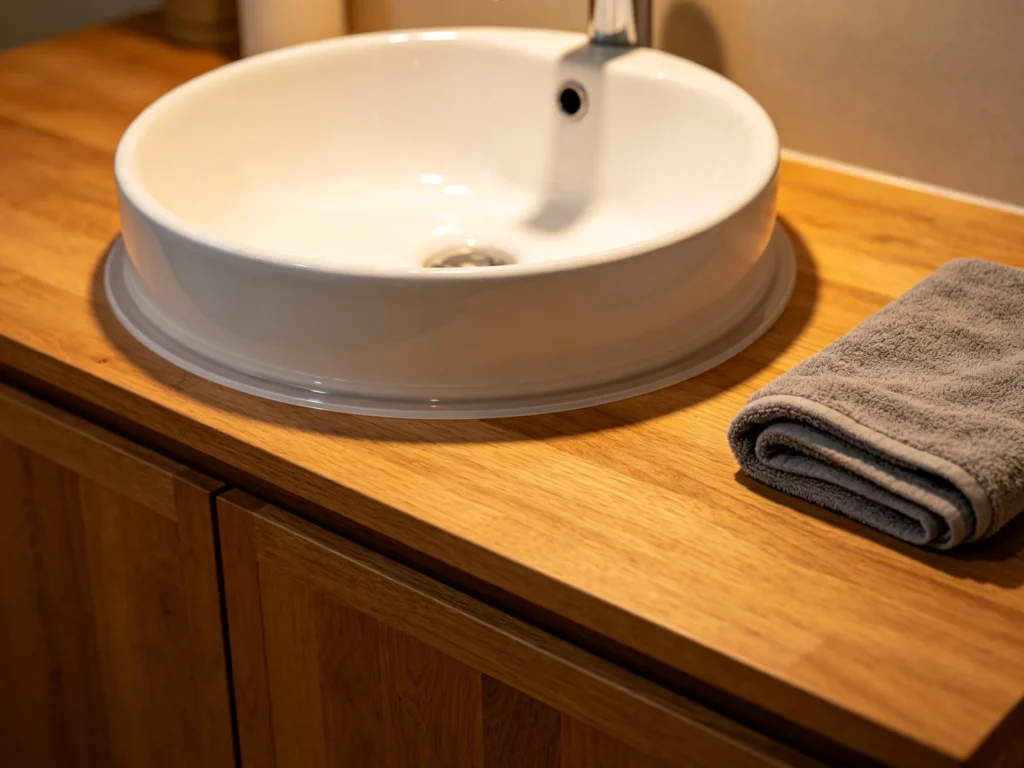
A countertop basin sits on top of a vanity cabinet, a shelf, or a purpose-built counter. The most recognizable version is the vessel basin—a bowl that rises above the surface like a piece of tableware. Semi-recessed and countertop-inset variations also fall into this category. The defining characteristic, however, is that the basin rests on or in a horizontal surface rather than attaching directly to the wall.
What Makes It Work
The countertop basin is, above all, a visual choice. It draws the eye immediately, which is why it has become the default option for powder rooms and master bathrooms where design impact matters more than space efficiency. Because the basin sits on top of the counter, it frees up the cabinet below for storage without a sink bowl taking up internal volume. As a result, you get full-depth drawers and full-height cupboard space underneath—a genuine practical advantage in bathrooms with limited storage.
A countertop basin also gives you flexibility with the vanity itself. The cabinet does not need to be a bathroom-specific product. I have seen antique dressers, vintage sideboards, and custom concrete tables all pressed into service as vanity bases. In these cases, a vessel basin mounts on top and the plumbing feeds through a hole in the surface. For renters or anyone who wants a reversible installation, a countertop basin on a freestanding cabinet does not require any wall alteration.
Installation Requirements
The basin itself is simple to install. A single hole in the countertop for the waste, and a tap mounted either through the countertop or on the wall above the basin. The work that matters, however, happens underneath. The countertop must support the weight of a basin filled with water, plus the occasional downward pressure of someone leaning on the rim. For a stone or solid-surface countertop, this is straightforward. For a timber vanity top, the surface needs to be sealed around the cutout to prevent water ingress.
The tap position requires careful planning. A countertop-mounted tap needs a hole drilled through the deck, and the spout height must clear the basin rim. On the other hand, a wall-mounted tap avoids deck holes but demands supply pipes roughed into the wall at the correct height before tiling. Measure twice, drill once.
What to Watch For
Vessel basins sit higher than standard inset basins. If your vanity is already 850 mm tall and you add a 150 mm vessel basin, the rim sits at 1,000 mm. For someone of average height, that is fine. For a shorter adult, a child, or a wheelchair user, it becomes awkward quickly. I always recommend testing the rim height with the actual users before committing.
In addition, the seal between the basin and the countertop is the most common failure point. Water pools around the base in daily use, and a poor silicone seal allows it to seep underneath. I have seen the top of a solid timber vanity rot from the inside because the basin seal failed and nobody noticed until the cabinet doors started sticking. A continuous bead of mould-resistant silicone, allowed to cure fully before the basin is used, is the simplest defence. Check it every six months and reapply at the first sign of gaps.
2. Pedestal Wash Basins: The Classic Standalone
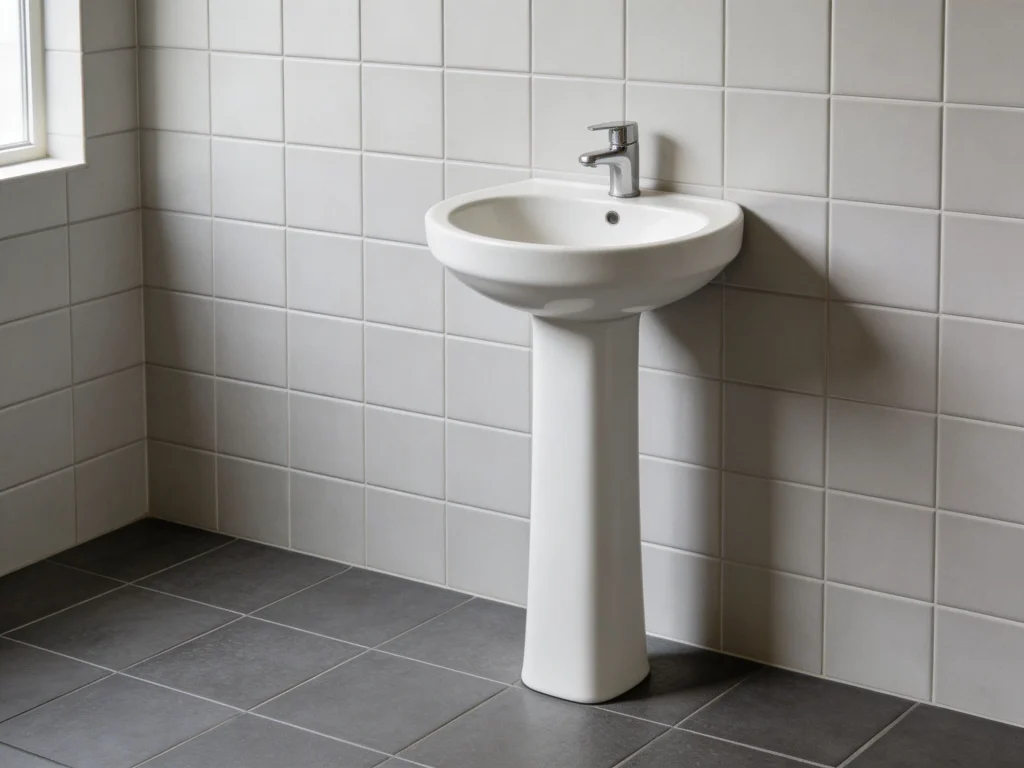
A pedestal basin combines a wall-hung bowl with a ceramic column that supports the weight from below. In addition to bearing the load, the column also conceals the plumbing. This makes it the only basin type that completely hides the waste pipe, trap, and supply lines without needing a cabinet. The design has existed for over a century, and for good reason.
What Makes It Work
The pedestal basin is self-contained. It does not need a vanity or a countertop. It does not even need a specially reinforced wall. The ceramic column transfers the weight down to the floor, so the wall fixings only need to stop the basin from tipping forward, not bear the full load. Consequently, this is the go-to choice for bathrooms with weak or uncertain wall construction. Timber stud walls that cannot easily be reinforced, old plaster walls, and rental properties where major structural work is not an option all suit the pedestal format.
Visually, a pedestal basin reads as traditional and clean. The continuous ceramic form from bowl to floor has a wholeness that a cabinet and basin combination does not replicate. In a cloakroom toilet, a small bathroom, or a period property, a pedestal basin often looks more appropriate than a modern vanity. It also costs less than a countertop basin plus a quality vanity, making it a sensible budget choice.
Installation Requirements
The basin bowl fixes to the wall with two bolts through the back of the ceramic. The pedestal column slots underneath and secures to the floor. Meanwhile, the plumbing connections happen in the space between the bowl and the column. They remain hidden from view but stay accessible by removing the pedestal if necessary.
The floor must be level. A pedestal on an uneven floor will lean, and the gap between the bowl and the column will vary from one side to the other. Shims can correct a slight slope, but a severely uneven floor will make the installation look crooked. Furthermore, the waste pipe must exit the wall at the correct height to align with the pedestal’s cutout, so the rough-in position matters. If the existing waste comes out of the floor rather than the wall, a pedestal basin may not work without replumbing.
What to Watch For
Cleaning around the base of the pedestal is slightly more involved than with a wall-hung basin. The column meets the floor and creates a seam that collects dust. It is not a dealbreaker, but it is worth knowing. The pedestal also takes up floor space—about 200 mm wide by 250 mm deep at the base. In a very small bathroom, this can make floor mopping slightly harder. Some pedestal designs now include a semi-pedestal that stops short of the floor. This option offers a compromise between full coverage and full accessibility.
3. Wall-Mounted Wash Basins: The Space-Saver
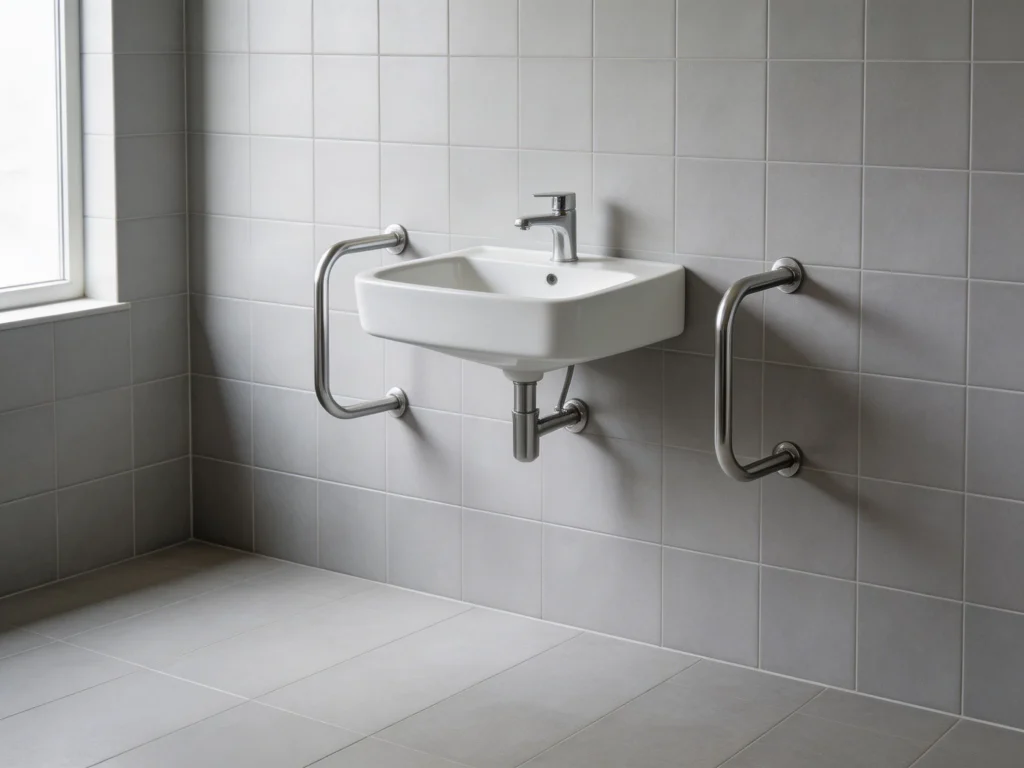
A wall-mounted basin fixes directly to the wall with no pedestal underneath and no countertop around it. The plumbing comes through the wall, and the waste pipe either disappears into the wall or runs exposed down to the floor. This is the most space-efficient of the three basin types. It has also gained the most ground in contemporary bathroom design over the past two decades.
What Makes It Work
The space underneath a wall-mounted basin is completely open. You can walk right up to it with no cabinet, no column, and no pedestal in the way. For wheelchair users, this open space provides a genuine accessibility advantage, allowing forward approach. For anyone who cleans their own bathroom, the open floor underneath makes sweeping and mopping effortless. For a small bathroom, the visible floor area creates the perception of more space, even if the actual footprint is unchanged.
A wall-mounted basin also allows you to set the installation height. There is no preset vanity or pedestal dictating where the rim sits. You can mount it at 850 mm for a tall household, at 800 mm for a mixed-height family, or at 430 mm for a children’s bathroom. This adjustability is unique to wall-mounted basins and is one of the strongest functional arguments for choosing one.
Installation Requirements
This is the most structurally demanding of the three basin types. The wall must bear the full weight of the basin, the water inside it, and the downward force of someone pressing on the rim. In a masonry or concrete block wall, heavy-duty wall anchors handle the load reliably. In a timber stud wall, however, the fixings must land on substantial blocking installed between the studs, or on a concealed steel mounting frame. A wall-mounted basin fixed to plasterboard with toggle bolts will pull away from the wall within months. It will crack the silicone seal and allow water behind the tiles. I have seen this failure enough times to repeat it every time the topic comes up: know your wall before you choose this basin type.
The plumbing must also be roughed into the wall at the correct positions. The waste pipe and supply lines need to align with the basin’s inlet and outlet. They must sit at the right depth to connect cleanly without stressing the pipes. If the plumbing currently comes up through the floor, converting to a wall-mounted basin means opening the wall and rerouting the waste. That is a larger job than many homeowners anticipate.
What to Watch For
Storage disappears with a wall-mounted basin. There is no cabinet underneath, no shelf, no place to put a spare roll of toilet paper or a bottle of hand soap. Some designs incorporate a small integrated shelf or a towel bar on the front edge, but these are minimal solutions. In a powder room or a guest bathroom, the lack of storage is tolerable. In a family bathroom used by multiple people, it can become frustrating. A common workaround is to install a shallow recessed cabinet or open shelving in the adjacent wall. Another option is to pair the basin with a mirrored cabinet above that provides enclosed storage.
4. Head-to-Head Comparison
Here is a summary across the dimensions that drive real-world decisions.
| Feature | Countertop Basin | Pedestal Basin | Wall-Mounted Basin |
|---|---|---|---|
| Floor Space | Requires vanity footprint | Pedestal base occupies floor | Floor completely clear |
| Wall Support Required | Minimal; vanity bears weight | Low; wall fixings are secondary | High; wall bears full load |
| Storage | Full cabinet underneath | None | None |
| Cleaning | Wipe counter; clean around basin base | Clean around pedestal base | Open floor, easiest to clean |
| Installation Complexity | Moderate (countertop + basin + seal) | Simple (bowl + column) | Moderate to high (wall must be structural) |
| Height Adjustability | Fixed by vanity height | Fixed by pedestal height | Fully adjustable |
| Plumbing Visibility | Hidden in cabinet | Hidden in column | Visible or concealed in wall |
| Approximate Cost Range (Hardware) | 60–500 (basin) + vanity cost | 80–300 | 50–350 |
5. Regional Preferences and What Drives Them
Europe
In Northern Europe, wall-mounted basins are the standard in new construction and renovation. The preference for concealed plumbing, the prevalence of masonry walls that easily support wall-hung fixtures, and the compact bathroom sizes all favour this format. Pedestal basins remain common in older housing stock, particularly in the UK, where period properties often retain their original pedestals. Meanwhile, countertop basins on vanities are more popular in Southern Europe. There, bathrooms tend to be larger and the design culture favours furniture-like cabinetry.
Middle East
Countertop basins dominate the luxury segment. Vessel basins in marble, stone resin, or sculptural glass appear in powder rooms and master bathrooms. Gold and brushed brass finishes on taps and wastes are standard. Wall-mounted basins are gaining share in mid-market residential projects, particularly in Dubai and Abu Dhabi, where the modern European aesthetic is influential. Pedestal basins are less common in new construction but appear in staff accommodation and utility bathrooms where budget and simplicity are the priorities.
Southeast Asia
The market splits by housing type. In condominiums and new-build apartments, countertop basins on compact vanities are the most popular choice because they combine storage with a contemporary look. In older housing, rental properties, and rural areas, wall-mounted basins with exposed plumbing are common due to low cost and simple installation. Pedestal basins, on the other hand, occupy a middle ground in hotels and serviced apartments. The region’s high humidity means that any basin with a cabinet underneath must use moisture-resistant materials for the vanity. MDF vanities swell quickly in unventilated bathrooms.
Americas
In North America, countertop basins—particularly undermount and vessel styles—dominate the mid-to-upper residential market. They are paired with bathroom vanities that are essentially furniture pieces. Pedestal basins are standard in powder rooms and smaller bathrooms. Wall-mounted basins remain a niche category, more common in commercial and accessible bathrooms than in residential use. Their adoption is growing, however, in modern and minimalist homes. In Latin America, pedestal and wall-mounted basins are the volume leaders, driven by lower cost and simpler installation. Countertop basins appear in higher-end projects.
6. A Decision Framework for Choosing
With all three options laid out, here is how I guide someone toward the right choice.
Consider a countertop basin when:
- You want storage underneath—drawers or a cupboard for toiletries and cleaning products.
- You are furnishing a master bathroom or powder room where design impact matters.
- You have floor space for a vanity unit (at least 600 mm wide and 450 mm deep).
- You like the flexibility to change the basin later without altering the wall.
A pedestal basin works best if:
- Your wall cannot support a heavy wall-mounted unit and you do not want a full vanity.
- You want the plumbing completely hidden without a cabinet.
- You are working with a limited budget and want a complete, classic look.
- Your bathroom style is traditional, period, or simply understated.
Opt for a wall-mounted basin when:
- Your bathroom is small and you want maximum visible floor space.
- Accessibility is a priority—wheelchair users need clear space underneath.
- You have a solid wall that can bear the load securely.
- You want to set the basin height precisely and keep the floor completely clear for cleaning.
Final Thoughts
A wash basin is a simple object. A bowl with a drain. But the way it meets the wall and the floor shapes how the entire bathroom feels and functions. A countertop basin anchors the room with presence and storage. A pedestal basin offers a clean, classic silhouette that needs nothing else to complete it. A wall-mounted basin opens up the floor, making a small bathroom feel larger and a busy bathroom easier to clean.
The right choice is the one that matches your wall structure, your storage needs, and the way you actually use the bathroom—not just the one that looked best in the showroom. Choose for the room you have, not the room in the photograph, and you will be satisfied with the result for years. use the bathroom—not just the one that looked best in the showroom. Choose for the room you have, not the room in the photograph, and you will be satisfied with the result for years.