
The short answer is no. Not every toilet can accept a bidet attachment, and the ones that can’t are not rare exceptions. They include some of the most common toilet types installed in European bathrooms, luxury hotels, and modern apartments worldwide. Knowing which toilets work and which don’t—before you order, before you open the box, and before you explain to a customer why their purchase doesn’t fit—is the difference between a smooth installation and a return.
This guide covers the compatibility factors that determine whether a bidet attachment will work on a given toilet. It walks through bowl shape, mounting systems, clearance requirements, water connections, and electrical access. It also explains where a bidet attachment fits into the broader landscape of bidet options, and when a more permanent solution—such as a factory-matched bidet and toilet set from a manufacturer like YIDA Bath—makes more sense for the buyer than an add-on accessory.
1. The Three Compatibility Factors
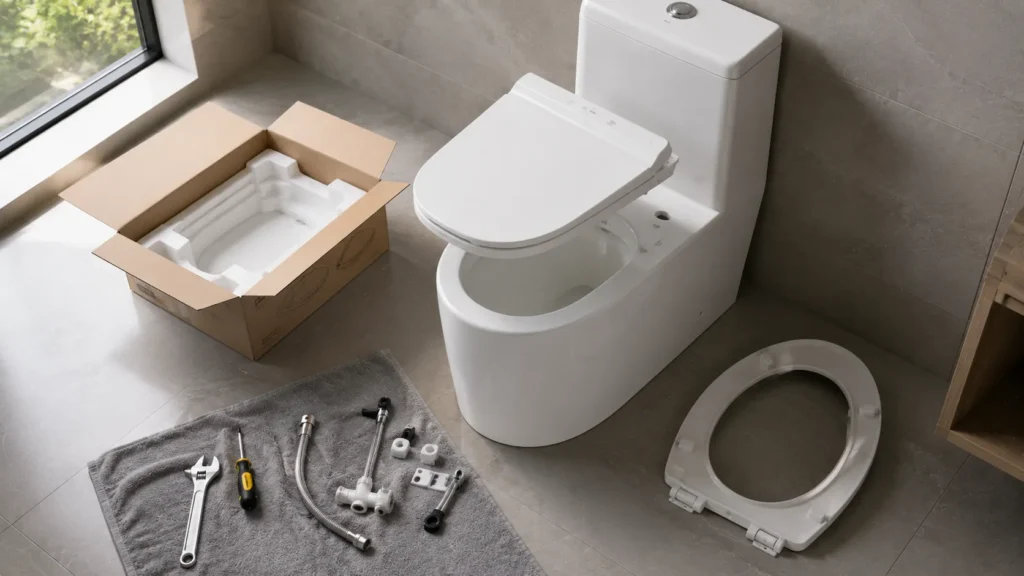
A bidet attachment mounts between the toilet bowl and the existing toilet seat using the seat’s own mounting bolts. The attachment must physically match the bowl contour, align with the bolt holes, and clear the toilet tank. Three factors determine whether that happens.
Bowl Shape: Round vs. Elongated
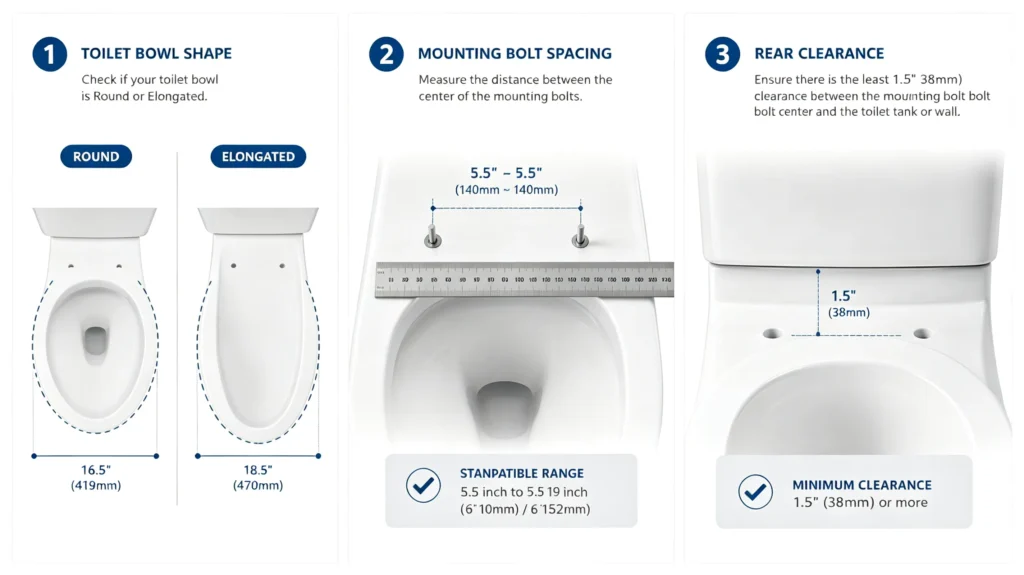
Standard toilet bowls come in two shapes. Round bowls are roughly circular. Elongated bowls are oval, extending further front-to-back. Most bidet attachments accommodate both, but not all. An attachment designed for an elongated bowl will overhang the front of a round bowl, creating an unstable seating surface. An attachment shaped for a round bowl will leave an exposed gap at the front of an elongated bowl.
The check is simple: confirm the attachment’s shape compatibility before ordering. If the product description says “fits most standard toilets” without specifying, ask the supplier directly. The answer you receive—clear or evasive—tells you something about the supplier as well as the product.
Mounting Bolt Accessibility
Bidet attachments install using the same two bolts that hold the toilet seat in place. This requires exposed bolts passing through the bowl from above, with standard spacing of approximately 135 mm to 155 mm center-to-center. Most two-piece toilets and many one-piece toilets use this configuration.
Some toilets do not. Wall-hung toilets with concealed fixings are among the most common incompatible types. On these models, the seat attaches to a hidden bracket integrated into the toilet’s mounting frame, and there are no through-bowl bolts accessible from above. A standard bidet attachment cannot be installed without modifying the mounting system—something that should never be attempted on vitreous china.
Designer toilets with proprietary seat-mounting mechanisms, and some European-manufactured models with bottom-fixing seats, present the same obstacle. If the bolt holes are not visible and accessible from above, a standard bidet attachment will not fit. No adapter solves this. The attachment simply does not work with this toilet type.
Clearance to the Tank
A bidet attachment adds a housing at the rear of the bowl, typically 10 mm to 20 mm thick. This housing must fit between the mounting bolts and the toilet tank without pressing against the tank or preventing the seat from closing flat. The measurement is simple: from the center of the mounting holes to the closest point of the tank or the bowl’s rear contour, you need at least 20 mm.
One-piece toilets with tightly integrated tank-and-bowl profiles sometimes have less clearance than this. Skirted toilets with close-coupled tanks can also present clearance issues. If the attachment housing is forced against the tank, the seat will not sit flush, the attachment may crack under repeated pressure, and the product will be returned.
2. Toilet Types Where Attachments Usually Don’t Work
Some toilet types are fundamentally incompatible with bidet attachments. Identifying them before purchase avoids the most common return scenario.
Wall-hung toilets with concealed fixings are the biggest category of incompatibility. These toilets are standard in much of European new construction, common in high-end bathrooms globally, and increasingly specified in hotel and commercial projects. They use a concealed mounting frame behind the wall, and the seat bolts are not accessible from above. A standard bidet attachment will not fit. Some manufacturers offer proprietary bidet seats designed for specific wall-hung models, but a universal attachment is not an option.
Smart toilets and integrated bidet toilets have the bidet function built into the toilet’s original design. There is no seat to replace and no attachment to add. For buyers who want a complete, factory-integrated solution, a smart toilet with built-in bidet functions eliminates every compatibility question. The washing, drying, and heating systems are engineered as part of the toilet, not added on afterward.
One-piece toilets with minimal rear clearance can be incompatible even if the bowl shape and bolt spacing are correct. The tight integration between tank and bowl on some models leaves insufficient space behind the mounting holes for the attachment housing. Measuring the clearance before ordering is the only way to confirm compatibility.
Specialty bowls—corner toilets, compact-depth models, and designer shapes—fall outside the design range of most universal attachments. If the toilet is not a standard round or elongated bowl from a recognized manufacturer, assume incompatibility until you have physically measured and compared the attachment’s mounting template to the actual bowl.
3. Water Connection Requirements
Every bidet attachment needs a water supply. Most non-electric attachments connect to the toilet’s existing fill valve supply line using a T-adapter that splits the flow. On toilets with a standard flexible braided supply hose and an accessible shut-off valve, this connection takes five minutes with basic tools.
Not every toilet has this setup. Rigid supply pipes, particularly on older installations, require an adapter that may not be included with the attachment. Toilets with concealed supply connections—where the water line enters through the wall directly into the tank or the bowl—cannot accommodate a standard T-adapter without plumbing modifications. These installations are common in European bathrooms and in wall-hung toilet configurations.
For electric bidet seats, the water connection works similarly, but an additional constraint applies. The seat needs a GFCI-protected electrical outlet within approximately 1.5 meters of the toilet. In bathrooms built before 2010, particularly in Europe and parts of Asia, there is often no outlet in this position. Running a new outlet adds electrical work to a job the buyer expected to be a simple DIY installation.
4. Electric Bidet Seats: Additional Compatibility Requirements
Electric bidet seats replace the entire toilet seat with a unit that includes heated water, warm air drying, and a heated seat. The compatibility requirements are stricter than for non-electric attachments, and more things can go wrong.
The seat shape must match the bowl exactly. A round bidet seat on an elongated bowl—or the reverse—is visually wrong and functionally problematic. If the toilet’s seat shape is uncertain, measure from the center of the mounting holes to the front edge of the bowl. A round bowl typically measures approximately 420 mm. An elongated bowl measures approximately 470 mm.
The rear housing on an electric seat is larger than on a non-electric attachment, which increases the clearance requirement behind the mounting holes. The same 20 mm minimum applies, but some seats need more. If the housing contacts the tank, the seat may not close, the housing may crack, or the weight distribution may cause the seat to shift over time.
The electrical outlet must be present and accessible. A bidet seat that arrives without a nearby outlet cannot be used until electrical work is completed. This is the single most common reason for electric bidet seat returns, and it is entirely preventable by confirming outlet access before purchase.
5. The Attachment vs. The Integrated Solution
A bidet attachment solves a specific problem for a specific buyer. The buyer has an existing toilet that is compatible, wants bidet functionality, and prefers a low-cost, reversible installation. For this buyer, the attachment is the right product.
For buyers whose toilet is incompatible—wall-hung, concealed fixings, insufficient clearance, no electrical access—the attachment is not the right product, and trying to make it fit will result in frustration and a return. These buyers need a different solution.
A bidet and toilet set from a manufacturer like YIDA Bath solves the compatibility problem at its root. The bidet and toilet are designed and manufactured together, with matched glaze, matched dimensions, and matched installation requirements. There is no attachment to fit and no compatibility question to answer. For the project buyer—a hotel operator, a residential developer, a homeowner renovating a bathroom in a market where a bidet is standard—this is the specification that eliminates callbacks.
For the importer or distributor, the product mix matters strategically. An attachment serves the retrofit buyer. A bidet seat serves the comfort upgrade buyer. A matched ceramic bidet and toilet set serves the project buyer. Carrying all three covers the full demand curve. A supplier like YIDA Bath, who manufactures floor-mounted and wall-hung bidets alongside standard and smart toilets, enables an importer to source the entire bidet category from one factory, with consistent certification, consistent glaze, and a single point of accountability.
6. The Installation Checklist: Five Questions Before You Order
- What is the bowl shape? Round or elongated. If uncertain, measure from the mounting holes to the front edge. Confirm the attachment matches.
- Are the mounting bolts accessible from above? Two exposed bolts with standard spacing. If the toilet has concealed fixings, a proprietary mounting system, or bottom-fixing bolts, a standard attachment will not fit.
- Is there at least 20 mm of clearance behind the mounting holes? Measure to the tank or the closest point of the bowl’s rear contour. If the measurement is less than 20 mm, the attachment housing may not clear.
- Does the toilet have a flexible supply line with an accessible shut-off valve? A standard T-adapter works with flexible braided hoses. Rigid pipes or concealed wall connections may require plumbing modifications.
- For an electric seat, is there a GFCI outlet within 1.5 meters of the toilet? If not, factor electrical work into the installation plan before purchasing.
A “yes” to all five questions means the attachment will install in under thirty minutes. A “no” to any question means additional work or a different product choice. For importers, including this checklist with every bidet attachment order reduces returns and demonstrates product knowledge that builds buyer confidence.
Final Thoughts
The question “Can you install a bidet attachment on any toilet?” has a clear answer: no, you cannot. The attachments that do work fit most standard two-piece and many one-piece toilets with accessible mounting bolts and adequate rear clearance. The toilets that don’t work include wall-hung models with concealed fixings, smart toilets with integrated bidet functions, and any bowl with non-standard mounting systems or tight tank clearance.
For the buyer with a compatible toilet, a bidet attachment offers a practical, low-cost entry into bidet use. For the buyer whose toilet is not compatible—or for the project buyer who wants a permanent, factory-integrated solution without compatibility questions—a matched bidet and toilet set from a manufacturer like YIDA Bath is the more reliable path. The bidet and toilet are built together, certified together, and shipped together. There is no attachment to fit because the bidet is already part of the product.
To explore bidet attachments, bidet seats, and complete bidet and toilet sets for your market, visit YIDA Bath or browse the product range.