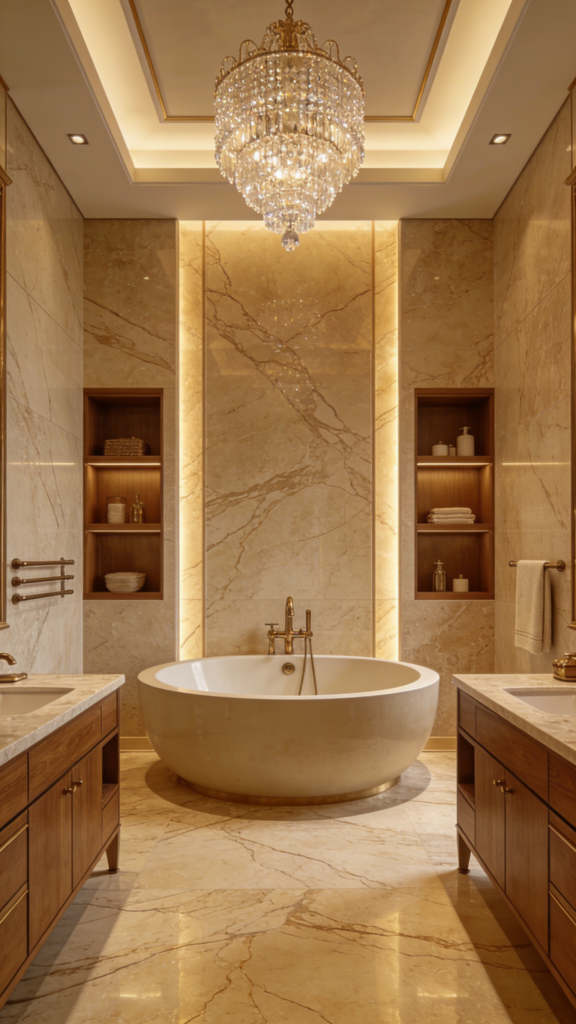

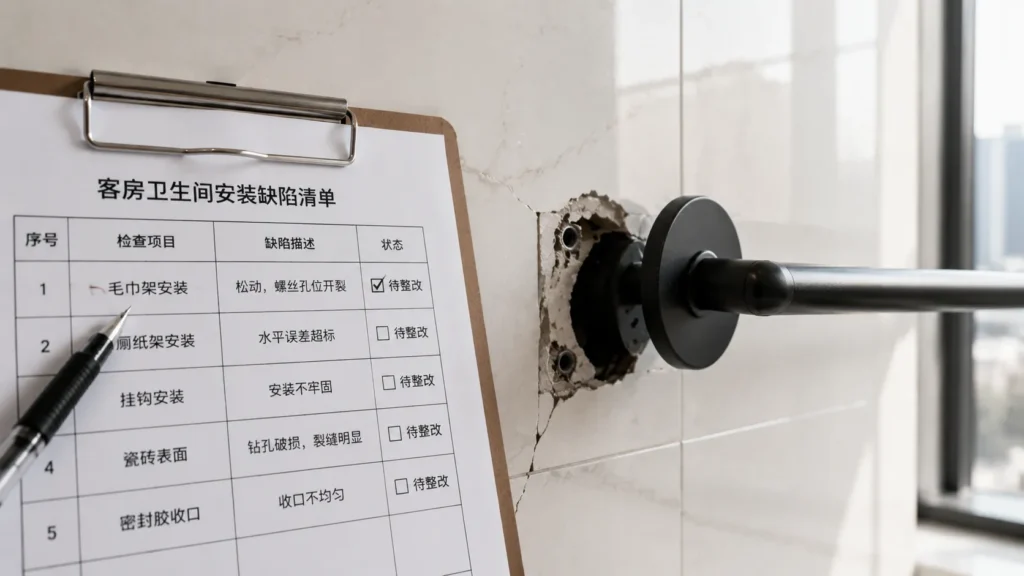
I once walked a recently completed hotel project with a frustrated facilities manager. The guest bathrooms looked immaculate. The tile work was flawless, the basins sat perfectly level, and the lighting was warm and inviting. Then he pointed to a towel bar. It was already loose, pulling away from the wall after less than three months of guest use. Next, he showed me a toilet paper holder where the chrome plating had begun to pit and cloud. These were not expensive fixtures, but replacing them across 200 rooms meant 200 service calls, 200 patched walls, and 200 guests who noticed something was wrong. The entire bathroom experience was diminished by bathroom accessories that cost a few dollars each.
In commercial construction, bathroom accessories often arrive on site as an afterthought. They get specified late, ordered last, and installed in a hurry during final fit-out. When they fail—and they do fail, frequently—they generate callbacks that are disproportionately expensive relative to the hardware cost. A $15 towel bar that pulls out of the wall requires a maintenance visit, a wall patch, paint matching, and reinstallation. The labour cost exceeds the hardware cost by an order of magnitude. This playbook explains how to specify, order, and install bathroom accessories that stay on the wall, hold their finish, and stay off the defects list.
1. Why Bathroom Accessories Cause Disproportionate Callbacks
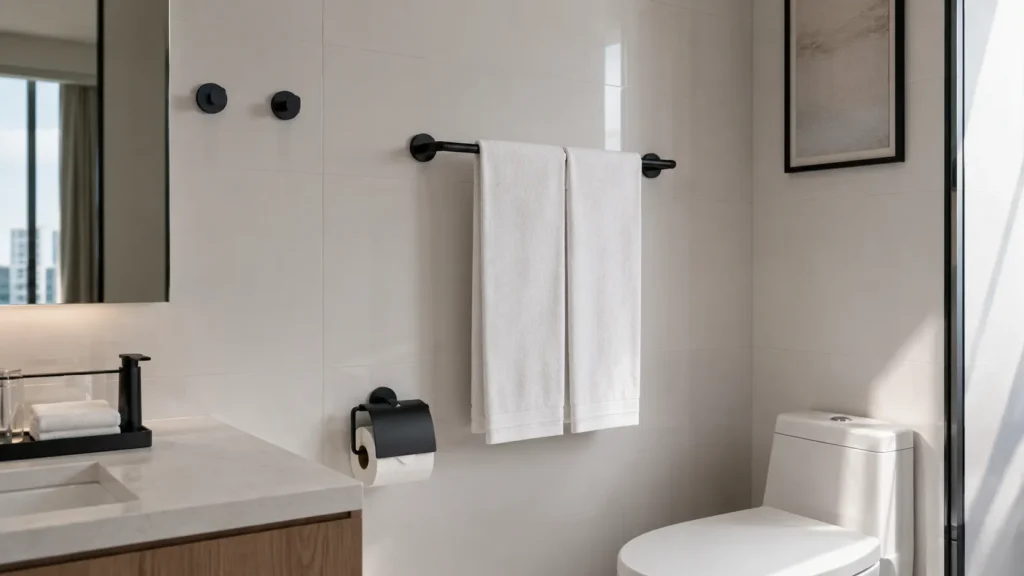
Bathroom accessories sit at the intersection of several risk factors that larger sanitary ware items avoid. Understanding these risks is the first step to mitigating them.
The Mechanical Load Problem
A wall-hung basin weighs 15 to 25 kg, so contractors take its structural support seriously. A towel bar weighs less than a kilogram, so nobody thinks about the forces acting on it. But users lean on towel bars. They pull down on them. They hang wet towels that can weigh several kilograms when saturated. A towel bar fixed with plastic wall plugs into plasterboard will fail under these loads, usually within the first year of occupancy. Meanwhile, grab rails—which are designed for full body weight and receive proper structural attention during specification—rarely fail. The lesson is clear: apply the same thinking to all wall-mounted bathroom accessories as you do to grab rails.
The Corrosion Accelerator
The bathroom environment is chemically aggressive. Chlorine-based cleaning products, hard water minerals, and constant humidity cycles attack surface finishes. A chrome-plated accessory that lasts a decade in a powder room may pit within eighteen months in a hotel bathroom where housekeeping teams clean daily with strong disinfectants. The finish technology that works in one environment fails in another. Furthermore, the cost difference between a finish that survives and one that doesn’t is typically small.
The Coordination Gap
Architects or interior designers specify basins, toilets, and bathtubs, and the main contractor procures them. Bathroom accessories, however, often fall between the sanitary ware package and the ironmongery package, with no single party taking clear responsibility. As a result, nobody checks the backing, nobody verifies the fixing specification, and nobody coordinates the delivery schedule. The accessories arrive last and get installed by whichever trade is available. This coordination gap is a process problem, not a product problem, and it is entirely fixable.
2. Material Selection: Matching the Finish to the Environment
The single most important decision in specifying bathroom accessories is the finish material. It determines corrosion resistance, scratch resistance, and how the accessory looks after five years of daily cleaning.
The Four Finish Tiers
Tier 1: PVD (Physical Vapor Deposition) is the gold standard for commercial bathroom accessories. The color layer deposits at the molecular level inside a vacuum chamber, bonding to the substrate rather than sitting on top of it. A quality PVD finish achieves a surface hardness exceeding 2,000 HV on the Vickers scale. It resists scratching, chemical attack, and corrosion in ways that electroplating cannot match. For hospitality projects, healthcare facilities, and any high-traffic commercial bathroom, PVD-finished accessories are the lowest-risk specification. The premium over electroplated alternatives is typically 30% to 50% per unit—a small absolute cost that eliminates a significant source of callbacks.
Tier 2: Grade 316 Stainless Steel offers inherent corrosion resistance without a coating. It is the preferred material for coastal installations where salt-laden air attacks plated finishes regardless of quality. Brushed stainless steel hides fingerprints and water spots better than polished surfaces. For projects within five kilometers of a coastline, 316 stainless is not an upgrade; it is the baseline specification. Grade 304 stainless costs less and performs adequately in inland environments, but it will show tea-staining over time in coastal or chemically aggressive conditions.
Tier 3: Quality Electroplated Chrome on a brass or zinc substrate remains the most common finish for mid-range commercial bathroom accessories. When manufacturers execute it properly—with a semi-bright nickel underlayer, a bright nickel layer, and a chromium top layer of at least 0.3 µm thickness—chrome electroplating delivers 200+ hours of corrosion resistance in standard testing. The challenge is that specifying “chrome” does not guarantee quality electroplating. An accessories supplier may source from a factory that applies a thin, single-layer chrome plate directly over zinc, bypassing the nickel layers entirely. That product will look identical out of the box and begin failing within a year. The safeguard is to request a CASS (Copper-Accelerated Acetic Acid Salt Spray) test report showing a minimum of 48 hours without visible corrosion. Reputable manufacturers provide this documentation; commodity suppliers often cannot.
Tier 4: Powder Coating is the most economical finish and the most vulnerable to failure in bathrooms. Powder coating is essentially a baked-on paint layer. It is an organic polymer film. Under sustained humidity and chemical exposure, it eventually softens, micro-cracks, and delaminates from the substrate. Powder-coated accessories are acceptable in powder rooms and guest bathrooms with light use and good ventilation. However, they are not appropriate for commercial bathrooms where cleaning staff use strong chemicals daily.
Finish Selection by Project Type
| Project Type | Recommended Finish | Acceptable Alternative |
|---|---|---|
| Luxury Hotel / High-End Residential | PVD (brushed nickel, matte black, brass) | Grade 316 Stainless Steel |
| Mid-Range Hotel / Office / Retail | Grade 304 Stainless Steel | Quality Electroplated Chrome |
| Healthcare / Aged Care | Grade 316 Stainless Steel | PVD |
| Coastal Installations (within 5 km) | Grade 316 Stainless Steel | PVD |
| Budget / Short-Term Rental | Quality Electroplated Chrome | — |
3. Wall Fixings: The Part Nobody Checks Until It Fails
A bathroom accessory is only as secure as the fixing that holds it to the wall. The accessory itself almost never fails structurally—the fixing does.
The Backing Requirement
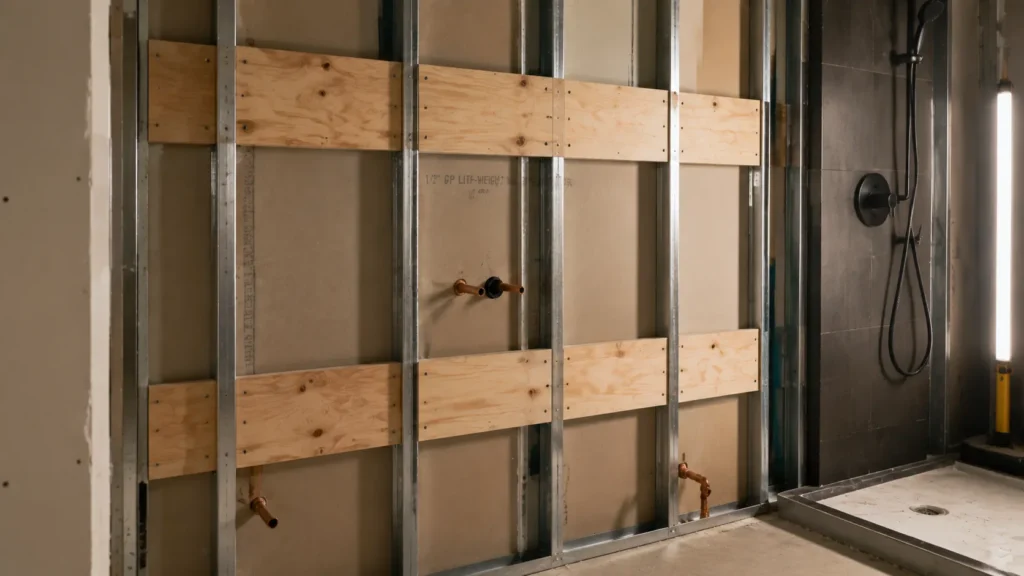
Any wall-mounted bathroom accessory that will bear weight—towel bars, grab rails, robe hooks that hold heavy robes, shelves that hold toiletries—requires solid backing behind the finished wall surface. In masonry or concrete walls, expanding anchors or chemical anchors handle the load. In stud walls, you must install plywood blocking between the studs at the accessory position before the wall is closed.
The most common failure I see involves towel bars that installers fix to plasterboard with plastic toggle anchors. The manufacturer’s installation instructions may even suggest that this is acceptable. It is not, not in a commercial bathroom where the bar will be pulled, tugged, and loaded with wet towels hundreds of times. The specification should explicitly call for blocking behind every towel bar, grab rail, and shelf position. In addition, the blocking must be dimensioned to allow the fixings to land fully on solid material with edge distance to spare.
The Fixing Specification
The screws supplied with many bathroom accessories are barely adequate for residential use and wholly inadequate for commercial service. Manufacturers often make them short, from low-grade steel, and finish them with a thin zinc plate that rusts. Replace them as a matter of specification. Stainless steel screws—grade 304 minimum, grade 316 for coastal—in a gauge and length appropriate for the backing material should appear in the ironmongery schedule. A towel bar fixed with two M5 stainless steel screws into plywood blocking will not pull out. The same bar fixed with the supplied M3.5 zinc-plated screws into plastic plugs will fail, and it will fail soon.
Grab Rails: The Separate Standard
Grab rails are in a different category from other bathroom accessories. They are safety devices, and they must support the full body weight of a person—typically rated for 150 kg or more. The structural engineer must verify the fixing specification for grab rails and the installation team must follow the same quality control as the rest of the structural works. In accessible bathrooms, prescribed codes govern the grab rail positions, dimensions, and load ratings—ADA in the US, Doc M in the UK, EN standards in Europe. These requirements are non-negotiable.
4. High-Risk Accessories and How to Specify Them Correctly
Some bathroom accessories generate more callbacks than others. These deserve extra attention during specification.
Towel Bars and Towel Rings
Towel bars are the single most common source of accessory-related defects in commercial bathrooms. Users pull down on them. They hang heavy, water-laden towels. They install them at a height that maximizes leverage on the wall fixings. A single-bar towel rail fixed at both ends performs better than a double-bar design where the bars act as levers against the mounting posts. For hotel bathrooms, I recommend specifying towel bars with a minimum of three fixing points—two wall brackets and a central support—for any bar longer than 600 mm. The additional fixing point is invisible to the guest and prevents the slight sag that develops over time with two-point fixings.
Toilet Paper Holders
Toilet paper holders fail in two ways. The first is mechanical: the spindle or the pivot wears out, and the holder no longer retains the roll. The second is chemical: the finish corrodes because the holder sits in the splash zone near the toilet, where housekeeping teams apply cleaning chemicals liberally. For commercial bathrooms, a commercial-grade toilet paper holder with a solid metal spindle and a PVD or stainless steel finish is the correct specification. Avoid holders with plastic spindles, spring-loaded mechanisms with exposed springs, and any design where you cannot access the moving parts for cleaning or replacement.
Robe Hooks and Coat Hooks
Robe hooks appear simple, but they carry the heaviest single load of any bathroom accessory. A wet bathrobe weighs several kilograms, and a user may hang other items on the same hook. The hook itself must be robust—solid brass or stainless steel, not hollow cast zinc—and the fixing must land on blocking. A single hook that pulls out of the wall leaves an ugly hole in a tiled surface that is difficult to repair invisibly.
Shower Shelves and Corner Caddies
A recessed shower niche is the preferred storage solution in new construction because it eliminates the wall-mounted shelf entirely. Where you must specify a wall-mounted shelf or corner caddy, the fixing method is critical. Adhesive-mounted shelves are not acceptable in commercial bathrooms; they will fail. Mechanical fixings into solid backing are required. For glass shelves, tempered glass of at least 8 mm thickness prevents shattering if something drops onto the shelf. The shelf brackets should be stainless steel or PVD-finished brass to resist the constant moisture of the shower zone.
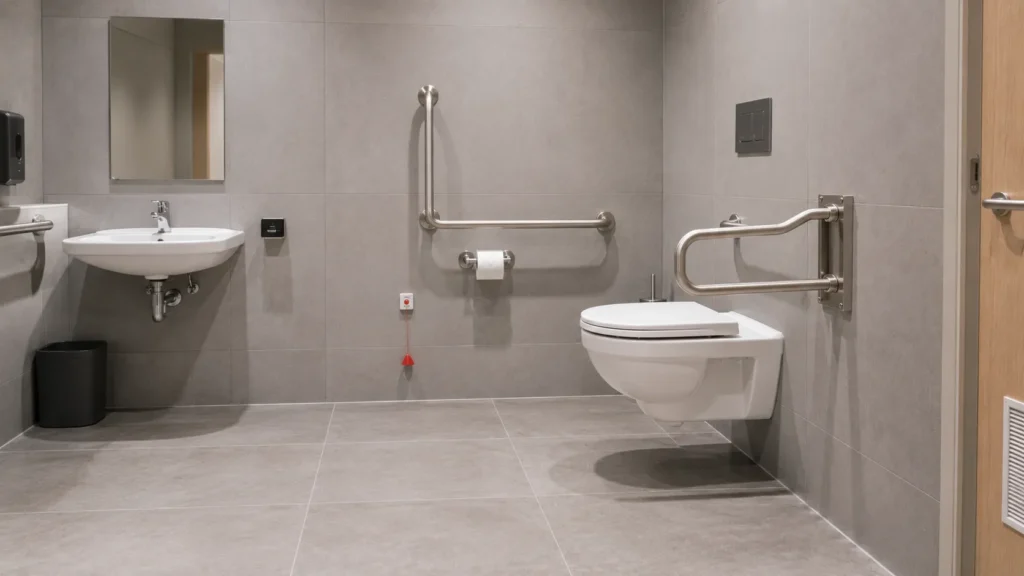
5. Accessibility Compliance: Bathroom Accessories Under the Code
Accessible bathroom accessories are not simply smaller or lower versions of standard accessories. They have specific dimensional, load, and operational requirements that you must verify against the relevant code.
The Key Requirements
In most international codes, accessible bathroom accessories must meet several benchmarks. These include grip force requirements—operable with one hand and without tight grasping or twisting. They also include reach range requirements, with accessories mounted between specified heights from finished floor. In addition, protrusion limits apply: accessories must not project more than 100 mm from the wall if mounted below 2,100 mm in circulation paths. Grab rails are the most heavily regulated accessory, with specific diameters (32 mm to 38 mm), wall clearance (38 mm to 50 mm), load ratings, and positional requirements.
The most common compliance error I see on commercial projects involves specifying an accessible toilet paper holder that requires two hands to operate. Another frequent mistake is a towel bar mounted outside the reach range specified by the code. These are not installation errors; they are specification errors. The team ordered the accessory without checking the compliance requirements, and the issue surfaces only during the accessibility audit.
Verification Before Ordering
Request compliance documentation from the accessories manufacturer. The documentation should state clearly which code the product complies with and provide the relevant test reports. A manufacturer that cannot provide this documentation is either not testing to the required standard or is relying on the specifier to verify compliance independently. In either case, the risk sits with the project team. For projects targeting LEED, BREEAM, Estidama, or Green Mark certification, the accessories specification must align with the credits being pursued. A single non-compliant accessory can fail an accessibility inspection and delay project handover.
6. Procurement: Packaging, Delivery, and Site Storage
Bathroom accessories are small items that are easily damaged, easily lost, and easily installed incorrectly because the instructions were missing from the box.
The Packaging Problem
A basin arrives on site in a timber crate. A towel bar arrives in a thin cardboard box with plastic window. The packaging reflects the value of the contents, but it also reflects the expected handling. Accessory packaging is designed for retail shelves, not construction sites. If the accessories order is part of a bulk sanitary ware delivery, specify that the accessories must be packaged in consolidated cartons with internal dividers, not individual retail boxes. Loose accessories in a mixed pallet will be crushed, scratched, and lost.
Delivery Timing
Bathroom accessories should be among the last items delivered to site, arriving after the tiling, painting, and sanitary ware installation are complete. Accessories delivered early sit on site for weeks or months. They get moved, opened, scavenged for parts, and damaged. Accessories delivered late hold up final completion. The ideal window is the final fit-out phase, when the bathrooms are clean and the finishing trades are working through the rooms. Coordinate the delivery with the finishing schedule, not the main sanitary ware delivery.
Site Storage and Security
Accessories are portable, resellable, and easily pocketed. On a busy construction site, a carton of towel bars and toilet paper holders will disappear if left unsecured. Store accessories in a locked container or a secured area until the day of installation. Issue them to the installation team room by room, not pallet by pallet. Count the items out and count them back in at the end of each day. The small additional labour cost of controlled distribution is offset by the reduction in replacement orders and site theft.
7. Regional Supply and Standards for Bathroom Accessories
Europe
European commercial bathrooms favor minimalist bathroom accessories in brushed nickel, matte black, and chrome. Designers often integrate wall-mounted soap dispensers and hand dryers into a single accessory system for a clean visual line. The EU Construction Products Regulation requires CE marking for certain categories of bathroom accessories, particularly grab rails and accessibility products. WRAS approval applies to accessories that connect to the water supply.
Middle East
The Gulf luxury market demands bathroom accessories in gold, rose gold, and brushed brass PVD finishes that match the faucets and shower fixtures. Clients expect cohesive finish matching across all bathroom fittings; a mismatched towel bar finish becomes a snag-list item. High humidity and daily cleaning with strong chemicals mean that only PVD and high-grade stainless steel finishes survive. Chrome-plated accessories pit quickly. For coastal projects in Dubai, Abu Dhabi, and Doha, grade 316 stainless steel is the baseline.
Southeast Asia
The dominant commercial specification in the region favors brushed stainless steel bathroom accessories for their corrosion resistance and availability. Chrome-plated accessories appear frequently in budget projects but carry higher long-term maintenance risk. In Singapore, accessibility compliance under the BCA code drives grab rail and accessory specifications in all commercial and public buildings. High humidity and inconsistent indoor climate control mean that accessories must resist corrosion throughout, including the fixings, not just on the visible surface.
Americas
North America is the largest market for bathroom accessories by volume, with ADA compliance as the primary regulatory driver for commercial projects. The trend toward matte black and brushed nickel finishes in residential bathrooms is crossing into hospitality and commercial design. In Latin America, chrome-plated accessories dominate the volume market, with stainless steel specified in higher-end projects. Local supply chains for replacement parts vary; you should verify accessories that rely on proprietary components for local availability before specification.
8. The Bathroom Accessories Specification Checklist
- Finish specified by project type and environment. PVD or 316 stainless for hospitality and coastal. Chrome for dry inland with verified CASS test reports.
- Blocking installed at every towel bar, grab rail, and shelf position. Verify before the wall is closed. Photograph for the quality assurance record.
- Fixings upgraded from manufacturer-supplied to specified stainless steel. Confirm screw gauge, length, and material for the backing type.
- Accessibility accessories verified against the project code. Receive compliance documentation from the manufacturer before ordering.
- Accessories packaged for site delivery, not retail. Use consolidated cartons with internal dividers. No loose individual boxes.
- Delivery scheduled for final fit-out phase. Store accessories in a locked, secure area until the day of installation.
- Controlled distribution to installation teams. Count out and count back. Issue room-by-room to prevent loss and damage.
- One-year appearance warranty included in the supplier contract. Cover finish degradation, not just structural failure. Align with the typical defects liability period.
Final Thoughts
Bathroom accessories are the smallest-ticket items in a commercial bathroom fit-out, but they generate the highest rate of callbacks per dollar spent. A loose towel bar or a pitted toilet paper holder in a brand-new hotel room tells the guest that the property is cutting corners, even if the rest of the bathroom is flawless. The guest doesn’t know about the marble vanity or the imported tile. They see the one thing that doesn’t work.
The fix is not more expensive accessories. It is more intentional specification. Choose the finish for the environment. Put blocking in the wall. Upgrade the screws. Time the delivery for final fit-out. These are small decisions that cost almost nothing during construction and prevent expensive, repetitive failures during operation. In a 200-room hotel, a single callback per room for a failed bathroom accessory represents 200 maintenance visits and 200 guest complaints that you could have avoided entirely. That is the return on getting the specification right. It is not a product cost. It is an avoided cost, and it is very real.