A procurement director for a Dubai hotel group once ordered 1,200 bathroom vanity units from three different suppliers to spread risk. Eight weeks later, two containers were stuck at Jebel Ali Port. The paperwork did not match the Dubai Municipality approval list. A third container arrived with the wrong drain configuration for UAE plumbing standards. Rework cost more than the fixtures themselves.
Choosing a bathroom supplier UAE projects can rely on is a decision that shapes budgets, schedules, and inspection outcomes. This guide explains how to vet one properly.
That story repeats across the Emirates every quarter. The problem is rarely product quality. It is almost always a gap between how suppliers sell and how UAE projects actually procure. This guide explains how to select and work with a reliable bathroom supplier UAE contractors trust. It covers Dubai Municipality approvals, ESMA and GSO standards, product specifications, lead times, and MOQs. These are the details contractors need before placing an order.
Why the UAE Bathroom Market Is Different from Neighboring Markets
The UAE is the region’s re-export hub and the largest premium hospitality market in the Middle East. Dubai alone operates more than 800 hotels. The pipeline under Vision 2031 adds thousands of rooms plus residential towers, hospitals, and retail complexes. Every one of those projects needs bathrooms specified to international standards.
Three factors make the UAE distinct from other GCC markets:
First, the approval chain is layered. Dubai Municipality, the Emirates Authority for Standardization and Metrology (ESMA, now part of MoIAT), and the free-zone authorities each have a say in what can be installed. A fixture approved for Abu Dhabi is not automatically approved for Dubai, and free-zone projects sometimes follow different rules from mainland projects.
Second, the market is design-led. Developers in Dubai and Abu Dhabi spec European-look fixtures: wall-hung toilets, brushed gold and matte black finishes, stone-look vanities, and smart bathroom packages. A supplier who only offers basic white sanitary ware will not win hospitality tenders.
Third, speed matters more than price. Construction schedules in the UAE are aggressive. Lead time reliability is often the deciding factor between two suppliers whose prices differ by only a few percent.
The practical takeaway: a bathroom supplier UAE must combine compliance documentation, premium product ranges, and dependable lead times. Price alone is rarely the differentiator.
Regulatory Framework: ESMA, GSO, and Dubai Municipality
ESMA / MoIAT and GSO Standards
The UAE follows Gulf Cooperation Council (GCC) standardization through the Gulf Standardization Organization (GSO). Ceramic sanitary ware and bathroom fittings are covered by GSO/ESMA technical regulations, including UAE.S 5021:2018 for sanitary appliances. Importers and contractors should confirm that fixtures carry the relevant conformity markings and that test reports come from accredited laboratories.
Dubai Municipality Approvals
For projects inside Dubai, products installed in buildings must be listed on the Dubai Municipality approved materials list where applicable. The approval process requires:
- Valid test reports from accredited labs
- Product technical datasheets in English
- Declared country of origin
- Manufacturer registration where required
A common contractor mistake is assuming that a CE marking alone is enough for a Dubai project. CE is a European conformity mark and does not replace Dubai Municipality approval or GSO certification. Always ask the supplier for the specific approval documents for the emirate where the project is located.

ESMA / GSO Certification Checklist
| Item | Requirement | Who Issues |
|---|---|---|
| Sanitary ware standard | UAE.S 5021:2018 / GSO equivalent | MoIAT (formerly ESMA) |
| Test reports | Accredited laboratory | ISO 17025 labs |
| Product registration | As required by emirate | Dubai Municipality / Abu Dhabi DMT |
| Conformity marking | GSO Conformity Mark where applicable | GSO / MoIAT |
How to Vet a Bathroom Supplier in UAE
Vetting a bathroom supplier UAE is different from vetting a local distributor. A local distributor holds stock but has limited control over manufacturing quality. A manufacturer or direct factory representative can control production, but you must verify their compliance documentation yourself.
Factory Audit Checklist
Before committing to an order, verify these four areas:
Production capacity. Ask for the factory’s monthly output in pieces, not just annual revenue. A factory claiming high capacity should be able to show production lines, kiln capacity for ceramics, and finishing lines for faucets.
Quality control. Review the QC process: incoming material inspection, in-process checks, and final inspection before packing. Ask what the defect rate target is and what happens to rejected pieces.
Certification validity. Confirm that CE, cUPC, WaterMark, GSO, or other certifications are current and match the exact product models you intend to order. Certification documents tied to discontinued models are a red flag.
Reference projects. Request photos and purchase orders from completed UAE or GCC projects. A supplier with real hotel or villa project references in the Emirates is easier to trust than one with only generic marketing materials. For a deeper factory evaluation framework, see our guide on how to choose a bathroom manufacturer in China.
Product Specifications for UAE Projects
Wall-Hung Toilets Dominate Commercial Specs
Wall-hung toilets are the default choice for UAE hotels and premium residential projects. They simplify floor cleaning and support modern bathroom designs. Key specifications to confirm:
- Concealed cistern: 6/3L dual flush is standard; confirm the cistern frame brand (e.g., Geberit, Grohe, or compatible)
- Carrier frame: In-wall carrier frames rated to 400 kg are typical for commercial projects
- Bowl projection: 530–560 mm from finished wall is the common range
- Flush valve compatibility: Confirm whether the project needs dual-flush or sensor options
Finishes: Gold, Matte Black, and PVD
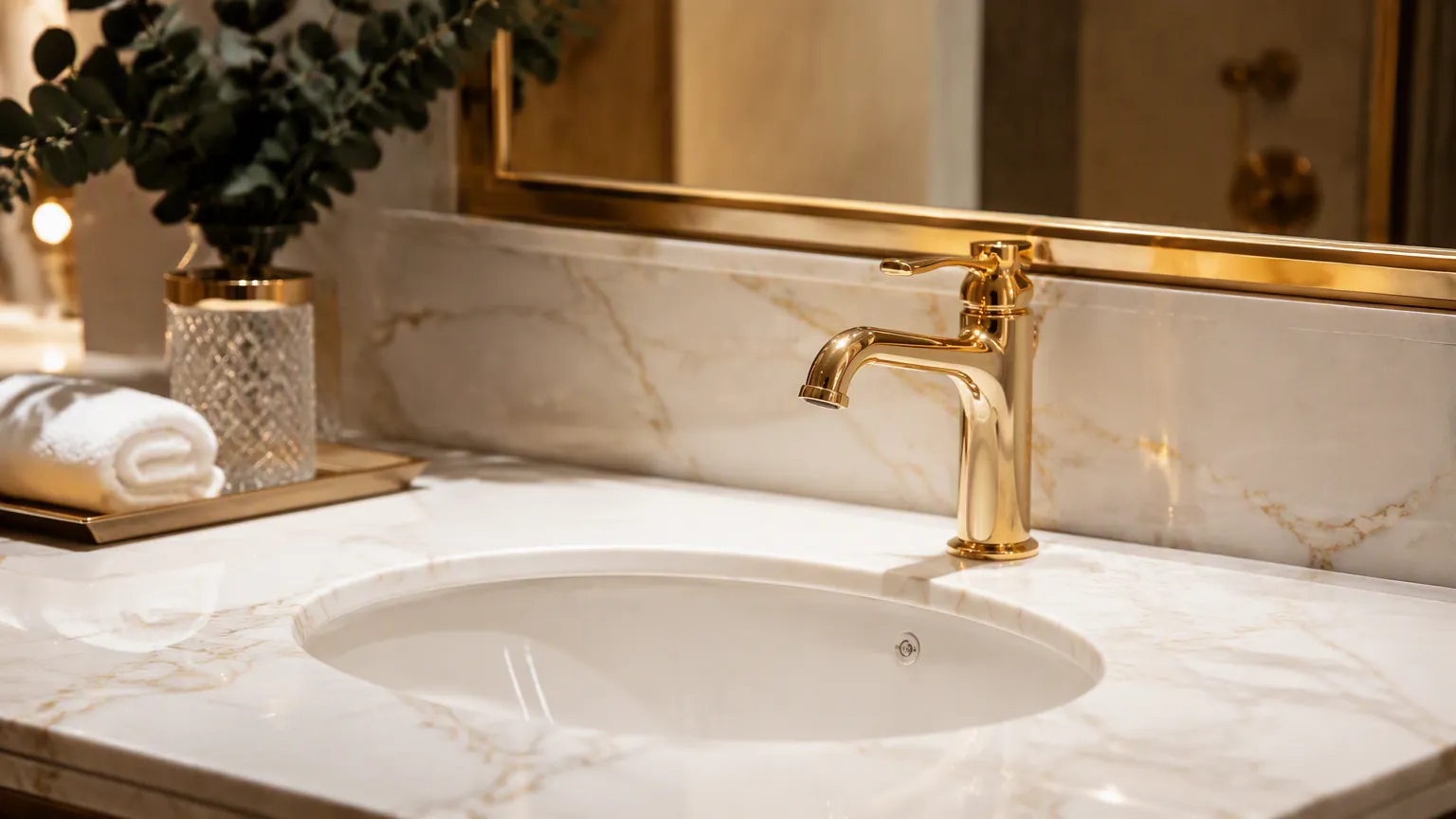
UAE design trends favor brushed gold and matte black finishes, especially in hospitality. Specify PVD (Physical Vapor Deposition) finishes for faucets and shower fittings. PVD coatings resist tarnishing and scratching far better than electroplated finishes, which matters in high-use hotel bathrooms.
Vanity Units: Stone-Look and Floating Styles
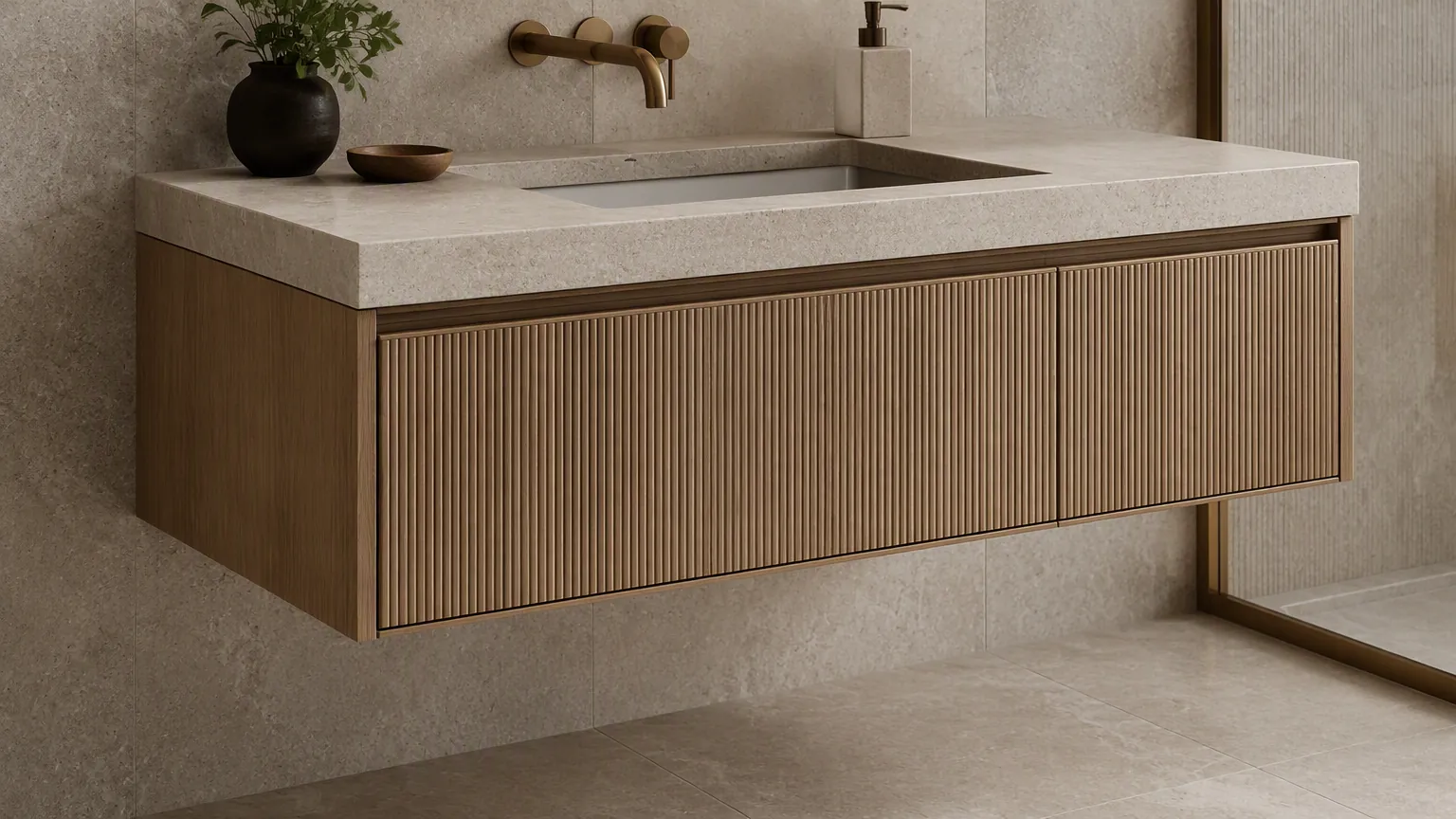
Slate and stone-look vanity units are strong sellers in the UAE market. Floating (wall-hung) vanity units are popular in hotel rooms and serviced apartments. The 900mm wall-hung floating vanity unit in UAE is a common choice. These units maximize floor space and match the clean lines of modern interiors. For a wider selection, browse our bathroom vanities collection.
Smart Bathroom Packages
Smart toilets and bidet seats are moving from luxury to standard in UAE four- and five-star hotels. Confirm that smart toilet models are compatible with local voltage (220V) and water pressure (typically 0.5–5 bar). Also confirm that installation teams are trained for the electrical rough-in requirements. For an overview of what commercial projects actually specify, read our smart bathroom market report.
MOQ, Lead Times, and Payment Terms
| Parameter | Typical Range | Notes |
|---|---|---|
| MOQ (ceramic) | 100–500 units per model | Lower for mix-and-match programs |
| MOQ (faucets) | 200–500 pieces per finish | PVD finishes may require higher MOQ |
| Production lead time | 25–45 days | Depends on kiln capacity and finish |
| Sample lead time | 7–15 days | Pre-production samples recommended |
| Sea freight | 25–35 days | China → Jebel Ali / Khalifa Port |
| Payment terms | 30% deposit, 70% against B/L | Letter of credit for larger orders |
A bathroom supplier UAE that offers a mix-and-match program across models can be more valuable than one with the lowest unit price. Such a program lets contractors consolidate containers and cut freight cost per piece.
Shipping and Customs: Jebel Ali and Khalifa Port
Documentation Alignment
The most common customs delay is a mismatch between the commercial invoice, packing list, and certificate of origin. Ensure all three documents describe the same product codes and quantities.
HS Codes
Ceramic sanitary ware falls under HS Chapter 69 (ceramic products). The typical code is HS 6910 for ceramic sinks, wash basins, and similar fixtures. Confirm the correct HS code with your freight forwarder before shipment.
Packing for the GCC Climate
UAE summers exceed 45°C. Standard export cartons can weaken during long sea transit and warehousing in high heat. Request:
- Moisture-resistant packing with vapor barrier liners
- ISPM-15 compliant wooden crates for heavy items
- Container desiccants for ceramic and metal products
Project Example: 300-Room Hotel, Dubai Marina
A contractor we worked with was sourcing bathroom fixtures for a 300-room hotel near Dubai Marina. The original specification called for European-branded fixtures, but the budget required a 35% cost reduction without compromising the look.
The solution combined three moves:
The result: the project met the budget target, approvals cleared without rework, and the hotel opened on schedule. The contractor now routes all UAE projects through the same supplier. If you are comparing sourcing routes, our Saudi Arabia procurement guide covers the parallel compliance landscape across the Gulf.
Common Mistakes When Sourcing Bathroom Fixtures for UAE
- Wall-hung toilets with concealed cisterns from a Chinese OEM factory with GSO test reports, saving roughly 40% versus the European brand
- Brushed gold PVD faucets specified to match the hotel’s design language, at a fraction of the branded price
- Stone-look floating vanities from the factory’s UAE-specific product line, which already carried the required approvals
- Assuming one certification covers all emirates. Dubai Municipality approval, Abu Dhabi requirements, and free-zone rules can differ. Confirm per project.
- Accepting CE as sufficient. CE is not a substitute for GSO certification or local approvals.
- Ignoring voltage and water pressure. Smart toilets and bidet seats must match UAE electrical and plumbing conditions.
- Choosing price over lead time reliability. A delayed container in Dubai can cost more in penalties than the price difference between suppliers.
- Skipping pre-production samples. Samples verify finish quality and dimensions before full production. For basin and vanity sourcing, our double wash basin vanity guide shows the product details worth checking.
Procurement Checklist
- [1] Confirm Dubai Municipality / emirate approval requirements for each product
- [2] Verify GSO / UAE.S 5021 test reports from accredited labs
- [3] Match product certifications to exact model numbers
- [4] Confirm MOQ and mix-and-match options
- [5] Agree on production and shipping lead times with buffer
- [6] Specify PVD finishes for faucets and fittings
- [7] Verify 220V compatibility for smart toilet products
- [8] Request pre-production samples and approve before production
- [9] Align invoice, packing list, and certificate of origin
- [10] Confirm ISPM-15 and moisture-resistant packing for sea freight
FAQ
Are bathroom fixtures in the UAE required to have GSO certification?
Yes. Ceramic sanitary ware and bathroom fittings imported into the UAE must comply with GSO technical regulations. This includes UAE.S 5021:2018 for sanitary appliances. Test reports must come from accredited laboratories. Every serious bathroom supplier UAE importer works with should be able to provide these documents.
Is CE certification enough for Dubai projects?
No. CE is a European conformity mark. Dubai Municipality and GSO requirements are separate. Products must carry the relevant conformity documentation for the emirate where they are installed.
What is the difference between ESMA and GSO?
ESMA was the UAE’s national standards body and is now integrated into the Ministry of Industry and Advanced Technology (MoIAT). GSO is the Gulf-wide standardization organization that issues common technical regulations across GCC member states.
Which finishes are most popular in UAE hotels?
Brushed gold and matte black finishes with PVD coating are the current standard in UAE hospitality projects. They resist tarnishing and match the design language of premium interiors.
How long does shipping take from China to the UAE?
Sea freight from China to Jebel Ali Port or Khalifa Port typically takes 25–35 days. The exact time depends on the departure port and service. Air freight is possible for samples or urgent items.
What are typical MOQs for bathroom fixtures from Chinese factories?
Ceramic products typically require 100–500 units per model. Faucets and fittings usually need 200–500 pieces per finish. Some suppliers offer mix-and-match programs to consolidate orders.
Do I need pre-production samples?
Yes. Pre-production samples verify finish quality, dimensions, and compliance details before you commit to full production. This is especially important for PVD finishes and smart toilet electronics.
Can I use a UAE distributor instead of importing directly?
Yes, but distributors add a margin and may not carry the full product range. Direct factory sourcing with a supplier experienced in UAE compliance usually delivers better pricing and customization options for larger projects.