You’ve decided to source bathroom fixtures from China. The price gap compared to local distributors is hard to ignore — often 40–60% lower. But you’ve also heard the cautionary tales: inconsistent quality, missed deadlines, and language barriers that turn into costly mistakes.
Choosing the right partner isn’t about finding the cheapest quote. It’s about identifying a factory whose production capability matches your product requirements, whose quality standards align with your market’s certification demands, and whose communication style fits the way you manage projects.
After helping contractors and importers evaluate dozens of Chinese sanitary ware factories, here’s what genuinely matters in the selection process — and what doesn’t.
1. Start With Your Product Requirements, Not a Supplier List
Most importers begin by searching for a bathroom manufacturer in China on Alibaba or at the Canton Fair. That approach quickly leads to information overload — hundreds of suppliers, thousands of product variations, and no clear way to compare them.
A more effective approach starts with documentation. Before you contact any factory, write down your specifications:
Product specifications:
- Product type (toilet, basin, faucet, shower enclosure, bathtub)
- Material requirements (ceramic, brass, acrylic, tempered glass)
- Dimensions and tolerances (±2 mm or ±5 mm?)
- Finish and color (gloss white, matte black, brushed nickel, PVD gold)
- Packaging requirements (export carton, wooden crate, palletized)
Volume and timeline:
- Initial order quantity (sample only, 1 container, multi-container)
- Annual projected volume
- Target delivery timeline
- Preferred port of loading (Shanghai, Ningbo, Shenzhen, Guangzhou)
Market requirements:
- Destination country and its certification needs
- Labeling and language requirements
- Warranty expectations (1 year, 5 years, 10 years?)
- After-sales support needs
Having these details written down serves two purposes. It helps you quickly eliminate candidates who can’t meet your requirements before you invest time in negotiations. It also signals to a serious supplier that you are a professional buyer, not a casual inquirer.
2. The Four Tiers of Bathroom Manufacturers in China
Not all factories operate at the same level. Understanding the tier system helps you match your project to the right type of supplier.
Tier 1: Large Export-Focused Manufacturers
These top-tier factories have ISO 9001 certification, dedicated R&D teams, and export sales staff who speak fluent English. They typically produce 500,000+ units annually and serve international brands and large distributors.
Best for: Large-volume orders, private label programs, projects requiring multiple certifications (CE, CUPC, WaterMark, SASO).
Minimum order quantity: Usually 500–1,000 units per model.
Price level: Medium to premium (10–20% above Tier 2).
Lead time: 35–50 days for standard products.
Tier 2: Mid-Size Specialized Factories
These manufacturers focus on 2–3 product categories and have solid export experience. They may not have extensive R&D capabilities, but production quality is consistent, and communication is reliable.
Best for: Medium-volume orders, specific product lines (for example, only toilets or only faucets), buyers who want better pricing than Tier 1.
Minimum order quantity: 100–500 units per model.
Price level: Competitive (baseline).
Lead time: 25–40 days.
Tier 3: Small Domestic-Focused Factories
These factories primarily serve the domestic Chinese market and have limited export experience. Their pricing is attractive, but quality control and packaging may not meet international standards.
Best for: Experienced buyers who can provide detailed specs and arrange their own quality inspection.
Minimum order quantity: 50–200 units.
Price level: Low (15–25% below Tier 2).
Lead time: 20–30 days, but delivery reliability varies.
Tier 4: Trading Companies
These are not manufacturers. They source from multiple factories and add a margin. Some trading companies provide valuable services like quality control, consolidation, and logistics. Others simply pass orders without adding value.
How to tell: Ask for a factory visit. A legitimate manufacturer will arrange one without hesitation. A trading company that makes excuses is likely a middleman only.
3. Certifications: What Actually Matters for Your Market
Importers often ask every supplier for all possible certifications. That approach wastes time and adds cost. Instead, focus on what your target market actually requires.
By Destination Market
North America (USA & Canada):
- Toilets: cUPC or UPC (Uniform Plumbing Code) — non-negotiable for most states
- Faucets: NSF 61 (lead content), cUPC
- Showers: ANSI Z97.1 (glass safety)
- General: ISO 9001 (quality management system)
Europe:
- CE marking with appropriate standards (EN 997 for toilets, EN 200 for faucets, EN 14428 for shower enclosures)
- Water Label Scheme (UK) or similar national schemes
Middle East:
- SASO (Saudi Arabia), ESMA (UAE)
- ISO 9001 is widely expected
- Some projects require additional fire safety or water efficiency standards
Australia & New Zealand:
- WaterMark certification (mandatory for plumbing products)
- WELS rating (water efficiency labeling)
Southeast Asia & Africa:
- Local standards vary, but ISO 9001 + CE provides a solid baseline
Red Flags Around Certifications
Not all certifications are created equal. When a factory claims to have a certification:
- Ask for the certificate number and the issuing body
- Verify it on the issuing body’s website
- Confirm the certification covers the specific model you are ordering, not just the factory
- Check the expiration date — some certificates lapse and are not renewed
A buyer in Dubai once placed an order for 2,000 toilets with a supplier who claimed SASO certification. When the shipment arrived, customs rejected it. The certificate they showed was for a different model from a different year. The cost of return and rework exceeded the value of the entire order.certificate that was for a different model from a different year. The return cost exceeded the value of the entire order.
4. Evaluating a Manufacturer: Factory Visit Checklist
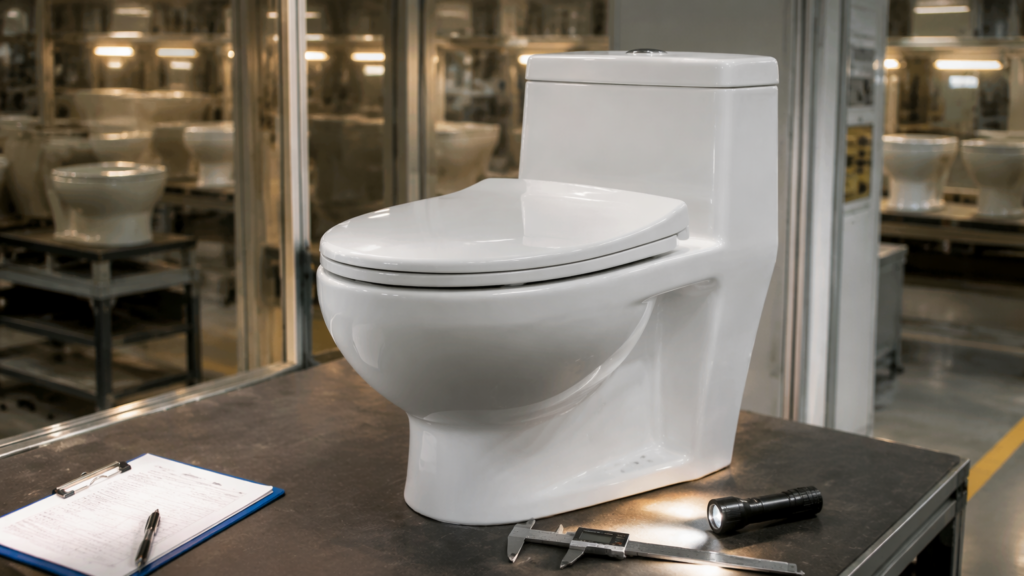
If you can visit the factory in person, these five areas tell you more than any certificate:
1. Raw Material Storage
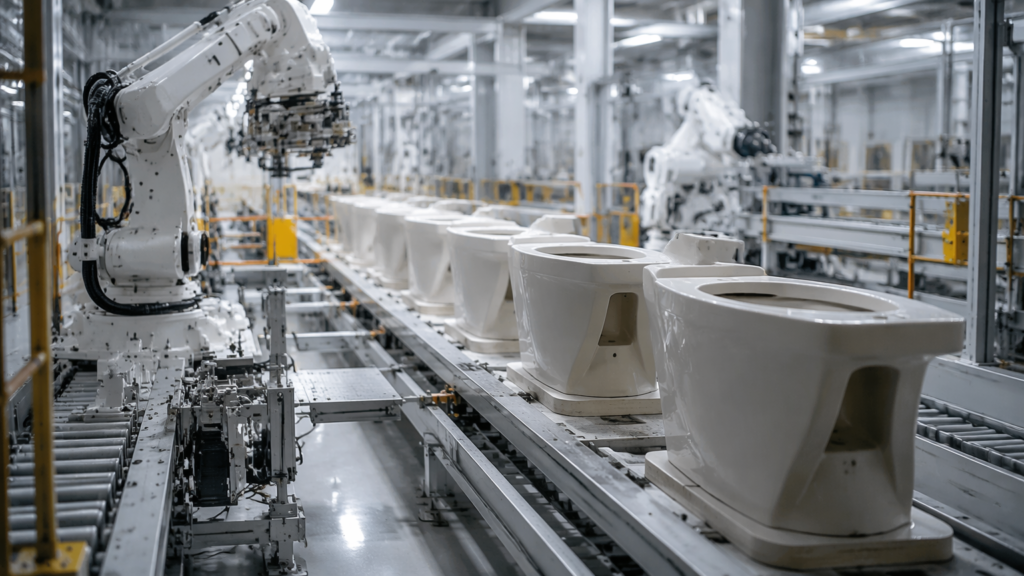
Are materials stored properly off the ground and away from moisture? Ceramic bodies need consistent humidity during storage. Brass ingots should be segregated by alloy grade. Poor material storage leads to inconsistent finished products.
2. Production Line Organization
Look for clear workflow from raw material to finished product. Are workstations organized? Is there visible quality checkpoints between stages? An organized production line produces more consistent output.
3. Quality Control Laboratory
A serious factory will have a lab with water pressure testing equipment, glaze thickness measurement, scratch/abrasion testers, and dimensional measurement tools. If the “lab” is a table with a ruler, that tells you something.
4. Finished Goods Storage
How are finished products stored before shipping? Are they wrapped properly? Stacked without damage? Separate from production dust? Storage conditions directly affect the condition of goods on arrival.
5. Employee Working Conditions
This is not just about ethics — it affects quality. Factories with high staff turnover produce inconsistent products because experienced workers leave. Clean, well-lit working conditions with proper safety equipment indicate a well-managed operation.
Remote evaluation option: If travel isn’t feasible, hire a third-party inspection company (SGS, Bureau Veritas, TÜV, QIMA) to conduct a factory audit. Cost ranges from $500 to $2,000 depending on scope, and it’s money well spent.
5. Understanding Pricing: What the Numbers Actually Mean
Knowing how a factory builds its price helps you negotiate more effectively. A transparent supplier will break down the cost structure for you.
For a typical ceramic toilet priced at $45 FOB China:
| Component | Approximate Share | Notes |
|---|---|---|
| Raw materials (ceramic body + glaze) | 25–30% | Varies with material quality |
| Labor | 15–20% | Higher for hand-finished products |
| Firing/Energy | 10–15% | Gas-fired kilns produce better results |
| Packaging | 5–8% | Export-grade packaging costs 2–3x domestic |
| Factory overhead | 10–15% | QC, equipment depreciation, management |
| Factory margin | 15–25% | This is where negotiation happens |
| FOB price | $45 | Includes loading to container at Chinese port |
What FOB Does Not Include
- Certifications and testing ($500–$3,000 per model depending on market)
- Mold/tooling costs ($2,000–$15,000 for a new toilet mold)
- Custom packaging design ($200–$800)
- Shipping and freight ($1,500–$4,500 per 20-foot container)
- Customs duties and taxes (varies by country, typically 5–25%)
- Destination port handling
A Smarter Negotiation Strategy
Instead of simply demanding a lower price, ask: “What would need to change to get the price closer to $X?” This invites the supplier to show you trade-offs — a different material, lower-cost packaging, or a simpler design — rather than just cutting their margin.
For example, switching from a full wooden crate to a reinforced carton pallet can save $3–5 per unit. Reducing glaze thickness by 0.1 mm saves a small amount but may affect surface quality. Understanding these trade-offs helps you make informed decisions.
6. Quality Control Throughout the Process
Many importers treat quality control as a last-minute inspection. A more effective approach is to build it into every stage.
Pre-Production
- Approve samples before production starts
- Confirm all specifications in writing, including dimensional drawings
- Agree on acceptable quality limits (AQL) for visual defects
During Production
- Request photos or video of the production run at key stages
- For large orders ($50,000+), consider a mid-production inspection
- Ask for firing records (for ceramic products) to verify kiln temperatures
Pre-Shipment
- Third-party inspection using AQL sampling (typically AQL 2.5 for major defects, 4.0 for minor defects)
- Check packaging quality — this is a common failure point
- Verify markings, labels, and documentation match the destination market
After Arrival
- Inspect a sample of units within 7 days of arrival
- Document any issues with photos immediately
- Report defects to the supplier within the warranty claim window (typically 15–30 days for transit damage, longer for manufacturing defects)
A reliable partner will address legitimate quality issues. How they respond to a problem often reveals more about their reliability than a smooth first order.
7. Communication: The Real Differentiator
The single biggest source of problems in cross-border sourcing isn’t product quality — it’s miscommunication.
Common Communication Gaps
Vague specifications: “Standard quality” means different things to different factories. Document everything in millimeters, grams, and specific standards.
Unspoken assumptions: The supplier assumes you know the quoted price is based on a minimum of 300 units. You assume the price is per unit regardless of quantity. Neither party states the assumption, and a dispute arises when the order is placed.
Time zone delays: When you send a question at 9 AM your time, it arrives at 10 PM in China. You get a reply the next day. A question that would take a 5-minute phone call stretches into 3 days of emails.
Better Communication Practices
- Use written communication for specifications and confirmations
- Use video calls for discussions and relationship building
- Confirm every decision in writing after verbal agreements
- Assign a single point of contact on each side
- Set response time expectations — 24 hours for routine matters, 4 hours for urgent issues
Relationship Beyond the Transaction
Suppliers who view you as a long-term partner will prioritize your orders, offer better pricing over time, and proactively resolve issues. Those who see you as a one-time buyer will optimize for margin on a single transaction. Small gestures — regular check-ins when there are no active orders, periodic factory visits, and treating problems as shared challenges — make a significant difference.
8. Special Considerations by Product Category
Different product categories require different evaluation criteria.
Ceramic Products (Toilets, Basins, Urinals)
- Firing temperature matters: 1,200°C+ produces denser, less porous ceramic
- Glaze quality determines stain resistance and long-term appearance
- Verify water consumption meets destination market regulations (1.28 GPF for USA, 4.5L/6L dual flush for many markets)
- Check flushing performance standards (MaP score for USA, EN 997 for Europe)
Brass Products (Faucets, Mixers, Valves)
- Ask for the specific brass alloy (H59, H62, H65 — higher copper content = better corrosion resistance)
- Verify lead content meets NSF 61 (USA) or REACH (EU) standards
- Check plating thickness — cheap suppliers use micron-level plating that wears off within months
- Request salt spray test results for corrosion resistance (48–72 hours minimum, 200+ hours for premium)
Glass Products (Shower Enclosures, Mirrors)
- Tempered glass only — never accept annealed glass for shower applications
- Verify ANSI Z97.1 (USA) or EN 12150 (EU) certification
- Check edge work quality — rough edges indicate poor manufacturing
- Ask about the nickel-sulfide inclusion test to prevent spontaneous breakage
Acrylic Products (Bathtubs, Shower Trays)
- Verify fiberglass reinforcement thickness — thin reinforcement leads to cracking
- Check the gel coat layer — thicker gel coat resists yellowing longer
- Test for even heating in the mold — uneven heating creates weak spots
- Ask about the warranty on the surface finish (crazing or yellowing)
9. Sample Orders: The Most Important Test
Before committing to a full container, order samples. This is the single best investment you can make in evaluating a supplier.
What Samples Tell You
- Actual product quality (not just catalog photos)
- Packaging quality — how well the product survives shipping
- Responsiveness — how quickly the factory processes sample orders
- Accuracy — does the sample match your specifications exactly
Sample Order Best Practices
- Order 3–5 units minimum (not 1) to assess consistency
- Request standard production samples, not hand-polished showroom pieces
- Test the samples as if they were installed — measure dimensions, check water connections, verify function
- Inspect for defects under normal lighting conditions, not ideal showroom lighting
- Document everything with photos
When to Walk Away
If a candidate cannot deliver samples within 15 days, cannot match your specifications on the first attempt, or sends samples with obvious defects, these are reliable early warning signs. Poor performance on a sample order almost always predicts poor performance on a production order — at a much higher cost.
10. Summary Checklist
- □ Product specifications documented in writing
- □ Target tier identified (Large export / Mid-size specialized / Small domestic)
- □ Certification requirements confirmed per destination market
- □ Factory shortlist of 3–5 candidates
- □ Samples ordered and evaluated
- □ Factory audit completed (in person or third-party)
- □ Pricing structure understood (FOB + excluded costs calculated)
- □ Quality control plan agreed (AQL levels, inspection points)
- □ Communication protocols established
- □ Payment terms negotiated (typically 30% deposit, 70% against BL copy)
- □ Shipping logistics arranged (freight forwarder confirmed)
- □ Contingency plan documented (defect handling, warranty process)
Sourcing from China doesn’t have to be a gamble. With proper evaluation, clear communication, and systematic quality control, a well-chosen bathroom manufacturer can become one of your most valuable business partners.
FAQ
How do I find a reliable bathroom manufacturer in China?
Start with B2B platforms like Alibaba and Global Sources, then narrow down based on certifications, export experience, and customer reviews. Always require samples and a third-party factory audit before committing.
What certifications should I look for?
It depends on the destination market: cUPC for North America, CE for Europe, SASO for Saudi Arabia, WaterMark for Australia. Always verify that the certificate covers the specific model you’re ordering.
What is the typical minimum order quantity?
Tier 1 factories usually require 500–1,000 units per model. Tier 2 factories accept 100–500 units. Tier 3 may go as low as 50–200 units. Trading companies often have no minimums but add their own margin.
How much does custom product development cost?
Mold and tooling costs range from $2,000–$15,000 depending on complexity. Sample development adds another $200–$1,000. The overall investment varies by product type and material.
How long does production and shipping take?
Standard production takes 25–50 days. Ocean freight adds 15–30 days for the USA, 20–35 days for Europe, 10–20 days for the Middle East, and 15–25 days for Australia.
Can I visit the factory before placing an order?
Yes, most factories welcome visitors. If travel isn’t possible, hire a third-party inspection company for a factory audit.
What payment terms are common?
The standard is 30% deposit with the order and 70% against a copy of the bill of lading. New relationships may start with a 50% deposit. Established partners can often negotiate better terms.
How should I handle quality issues?
Address problems immediately with documented photos. Most legitimate suppliers will resolve manufacturing defects. Transit damage should be claimed through the freight forwarder. Agree on a warranty process before placing the order.
Internal Links
- Browse our product catalogue: https://www.yidabath.com/catalogue/
- View our certifications: https://www.yidabath.com/certificate/
- Read about our quality control process: https://www.yidabath.com/about-us/
- Check our best-selling product sets: https://www.yidabath.com/sets/toilet/
- See our CE, CUPC, and SASO certified toilet collection: https://www.yidabath.com/sets/toilet/
External Links
- ISO 9001 quality management standard: https://www.iso.org/standard/62085.html
- CUPC certification overview (IAPMO): https://www.iapmo.org/iapmo-north-america/pacific/cupc/
References
“Sourcing from China: A Practical Guide.” China-Britain Business Council, 2023.
ISO 9001:2015 Quality Management Systems. International Organization for Standardization.
Uniform Plumbing Code (UPC), IAPMO, 2024 Edition.
ANSI Z97.1-2020 Safety Glazing Materials Used in Buildings.
European Standard EN 997:2018 Ceramic WC Pans with Integral Trap.
SASO Saudi Standards, Metrology and Quality Organization requirements for sanitary ware.
WaterMark Certification Scheme, Australian Building Codes Board.