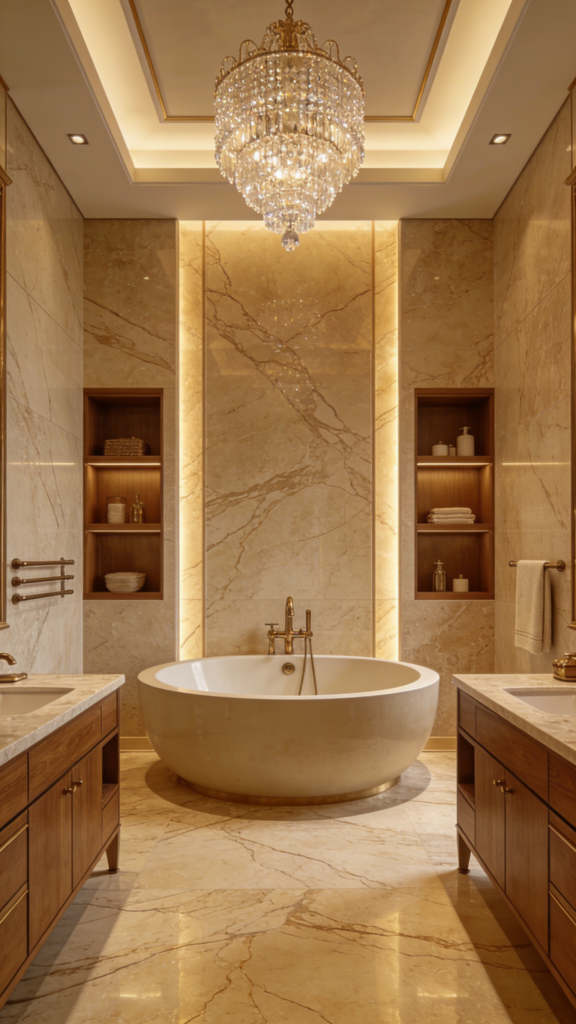

A smart toilet can save a hotel more water in a year than its purchase price. A touchless faucet can cut bathroom cleaning time by a measurable percentage. A digital shower can eliminate the most common guest complaint in mid-range hotels—”the water temperature kept changing.” These are not hypotheticals. They come from operational data collected across hospitality, healthcare, and commercial office projects that adopted smart bathroom technology early and have now lived with it long enough to separate the spreadsheet savings from the showroom promises.
The smart bathroom market crossed USD 9 billion globally in 2025, with projections of sustained double-digit growth through the early 2030s. But procurement managers who have actually specified and maintained smart bathroom fixtures will tell you that market size is the wrong number to focus on. The number that matters is the gap between a smart feature that works on a showroom display and a smart feature that still works after three years of commercial use, daily chemical cleaning, and guests who treat bathroom technology with the same gentleness they apply to a rental car. This article is about closing that gap. It covers what commercial projects in 2026 genuinely need from the smart bathroom market, and what belongs in the marketing brochure rather than on the purchase order.
1. What’s Driving the Smart Bathroom Market in Commercial Projects
The smart bathroom market is not growing because guests demand it. Most hotel guests and office workers do not specifically book or choose a building because of the bathroom technology. The market is growing because developers and operators have realized that smart fixtures reduce operational costs, improve hygiene compliance, and provide data that helps manage buildings more efficiently.
The Real Drivers
Water conservation sits at the top of the list. A smart faucet with an occupancy sensor turns off when not in use. A smart toilet with a leak detection system alerts maintenance before a running flush valve wastes thousands of liters. In a 300-room hotel, the water savings from properly specified smart bathroom fixtures can reach millions of liters annually. For projects targeting green building certification—LEED, BREEAM, Estidama, Green Mark—the water efficiency credits that smart fixtures enable are often the difference between one certification level and the next.
Hygiene compliance is the second driver. Touchless faucets, touchless soap dispensers, and touchless hand dryers reduce surface contact in public and semi-public bathrooms. In healthcare facilities, this is a genuine infection control measure. In airports and commercial offices, it is a user expectation that has hardened since 2020. A commercial bathroom that still requires users to touch multiple surfaces is perceived as outdated, regardless of how well it is cleaned.
Operational efficiency is the third and most underappreciated driver. Smart bathroom fixtures that report usage data—how many flushes per day, how many handwash cycles, how much soap is remaining in the dispenser—allow facility managers to schedule cleaning based on actual usage rather than fixed intervals. A bathroom that is cleaned three times a day on a schedule may be over-cleaned in the morning and under-cleaned by evening. A bathroom cleaned based on usage data is cleaned when it needs to be, which reduces labor costs and improves the user experience simultaneously.
2. Smart Toilets: The Category That Defines the Market
Smart toilets are the most visible, most specified, and most expensive category in the smart bathroom market. They are also the category where the gap between specification and user satisfaction is widest.
The Features Commercial Projects Actually Use
Not every feature on a smart toilet belongs in a commercial specification. The most useful features for hotels, healthcare, and high-end offices are the ones that reduce housekeeping workload, improve hygiene, and prevent maintenance issues.
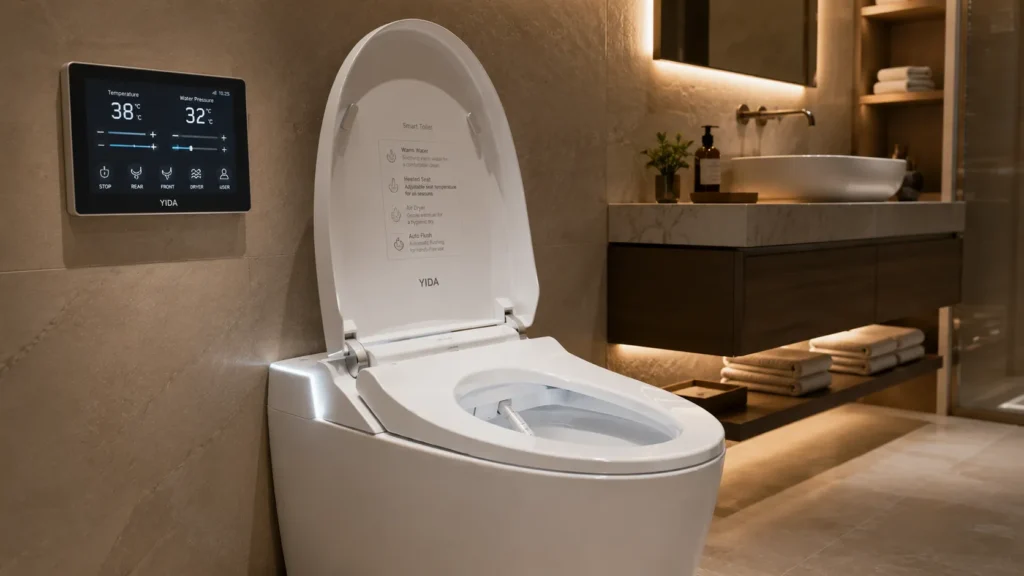
Automated flushing is the baseline smart toilet function. A sensor detects when the user leaves and triggers the flush. This eliminates the problem of unflushed toilets in public and semi-public bathrooms, and it reduces the spread of germs from manual flush handles. However, the sensor logic matters. A toilet that flushes when a user leans forward slightly, or that fails to flush when a user stands up quickly, generates complaints. The sensor’s detection zone, sensitivity, and delay settings must be adjustable, and they must be tested with actual users during the commissioning phase, not just with a technician standing in front of the bowl.
Heated seats and warm water bidet functions are standard in luxury hospitality and high-end residential but are not yet expected in mid-market commercial bathrooms. The operational cost—electricity for the heated seat, maintenance of the water heating element, cleaning of the bidet nozzle—must be weighed against the guest experience benefit. In a five-star hotel, a smart toilet without a heated seat and bidet function is a missed expectation. In a budget hotel, it is an unnecessary operating expense.
Self-cleaning functions—UV sterilization of the bowl and nozzle, electrolyzed water systems that reduce bacteria, automatic bowl cleaning cycles—are the smart toilet features that deliver the clearest operational benefit. A toilet that cleans itself between users reduces housekeeping time per room and improves guest perception of cleanliness. For hotels, where housekeeping labor is a significant operating cost, self-cleaning smart toilets can generate a measurable return on investment over the fixture’s lifespan.
3. Touchless Faucets and Soap Dispensers: The Tried-and-Tested Workhorses
Touchless faucets are the most mature technology in the smart bathroom market. They have been installed in commercial bathrooms for over two decades, and the technology has evolved to a point where it is reliable, affordable, and well-understood by maintenance teams.
What Commercial Projects Need from Touchless Faucets
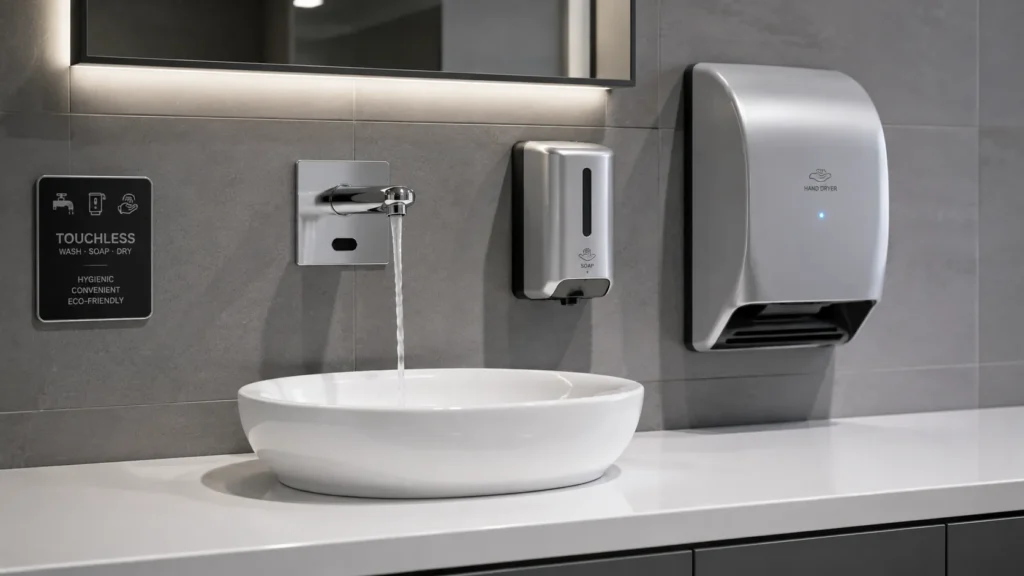
The sensor is the critical component. Infrared sensors remain the most common, but capacitive sensors—which detect proximity rather than motion—are gaining share because they are less prone to false triggers from passing foot traffic. A touchless faucet in a busy airport bathroom that turns on every time someone walks past the basin wastes water, drains the battery faster, and creates unnecessary noise.
Power source is the operational decision that affects maintenance the most. Battery-powered sensors avoid the need for electrical rough-in at each faucet position, which simplifies installation and reduces upfront cost. But batteries need to be replaced on a schedule, and a faucet with a dead battery in a busy bathroom is effectively broken until maintenance reaches it. Hardwired sensors cost more to install but eliminate the battery replacement burden. For high-traffic bathrooms, hardwired is the lower-maintenance choice over the fixture’s lifespan. For low-traffic bathrooms or retrofit projects where running wiring is impractical, battery-powered is the practical alternative.
The faucet must also pair correctly with the basin. A touchless faucet with a high flow rate installed over a shallow basin will splash water across the countertop and onto the floor, regardless of how good the sensor logic is. The faucet flow rate, the basin depth, and the basin width must be coordinated during specification. A supplier who offers matched faucet and basin pairs designed to work together at the specified flow rate removes a common source of post-installation problems. (Explore our faucet collection for touchless options designed for commercial projects.)
Soap Dispensers and Hand Dryers
Touchless soap dispensers and hand dryers complete the hands-free bathroom experience. The key specification point for commercial projects is not the sensor technology—which is now standard across most suppliers—but the refill mechanism and the maintenance access. A soap dispenser that requires a special tool to open, or that takes five minutes to refill, adds to housekeeping time. A hand dryer with a filter that is difficult to access will eventually blow dirty air onto clean hands.
4. Digital Showers and Smart Water Controls
The smart shower category is growing faster than any other segment of the smart bathroom market, but it is also the category where the gap between residential and commercial specifications is widest.
Digital Shower Systems
A digital shower allows the user to set a precise temperature on a control panel or app, and the system maintains that temperature regardless of pressure fluctuations in the building. For hotels and healthcare facilities, where water temperature safety is both a liability concern and a guest experience priority, digital showers with thermostatic control and anti-scald protection are a genuine functional upgrade over manual mixers.
The challenge for commercial projects is the user interface. A shower control panel with a complex menu of pre-set temperatures, spray patterns, and lighting options is intimidating to a first-time user who simply wants a warm shower. The most successful commercial digital shower specifications use a simple interface—a single dial or two clearly labeled buttons—with the complexity of the system hidden behind the wall. The hotel guest turns the dial to the desired temperature. The system does the rest. The technology should be invisible to the user.
Water Temperature Safety
In healthcare and aged-care facilities, water temperature control is regulated by code—typically a maximum outlet temperature of 43°C to prevent scalding. A digital shower can be programmed to enforce this limit, which is more reliable than relying on manual adjustment. In hotel bathrooms, the same technology prevents the sudden temperature spike that occurs when someone flushes a toilet or starts a washing machine elsewhere in the building. This is a genuine safety and comfort feature, and it is one of the few smart bathroom investments that directly reduces liability risk.
Water Usage Monitoring
Smart shower systems that track water usage per session are valuable in hotels and serviced apartments where water costs are allocated to the operator rather than the guest. The data helps identify abnormal usage patterns—a running shower left on by a departing guest, a slow leak in the shower valve—before they translate into significant water bills. The monitoring capability adds minimal cost to a digital shower system and provides operational visibility that a manual system cannot. (For more on shower system specification, see our shower guide.)
5. Smart Mirrors and Integrated Lighting
Smart mirrors are the most visible symbol of a smart bathroom, but they are also the category where commercial projects are most likely to over-specify features that users never actually engage with.
What Works in Commercial Settings
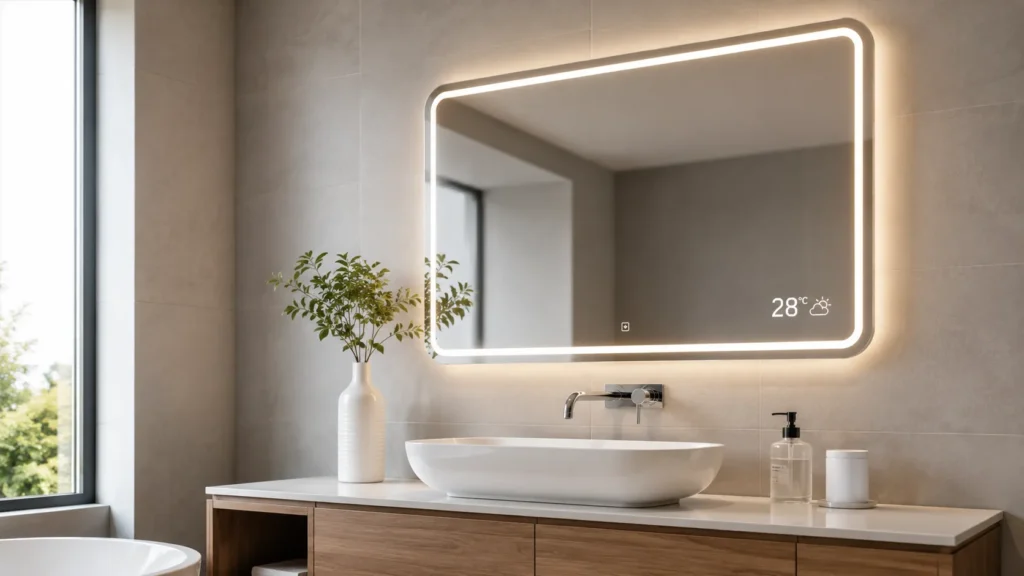
Integrated LED lighting with adjustable color temperature is the smart mirror feature that adds the most value in hotel and residential bathrooms. A mirror that provides warm light for a relaxing bath and cool, bright light for makeup application or shaving replaces the need for separate task lighting. Anti-fog functionality, which uses a heated pad behind the mirror glass, is a practical feature that guests appreciate and that requires no user interaction.
Touchscreen interfaces on the mirror—showing news, weather, calendar, or streaming content—are widely specified in luxury hotel bathrooms but rarely used by guests. The bathroom is not a room where most people want to consume information. A smart mirror that displays the time and the current water temperature is useful. A smart mirror that requires a tutorial is not.
Maintenance and Longevity
Smart mirrors are electronic devices in a humid environment. The sealed enclosure, the ingress protection rating, and the warranty on the electronic components matter more than the feature list. A smart mirror that fails after two years of bathroom humidity leaves a hole in the wall and an electrical connection that must be safely terminated. For commercial projects, specifying a smart mirror with an IP44 rating or higher, a manufacturer warranty of at least three years, and a modular design that allows the electronic components to be replaced without removing the entire mirror from the wall, reduces the long-term maintenance liability.
6. The Smart Bathroom Market by Region: Who Is Buying What
The global smart bathroom market exceeded USD 9 billion in 2025, with projections of sustained growth through the early 2030s. But the market is not one market. Different regions are adopting different technologies at different speeds, driven by different regulatory and cultural priorities.
Asia Pacific: The Technology Leader
Japan and South Korea lead the global smart bathroom market in technology maturity and consumer adoption. Bidet seats with heated water, warm air drying, and self-cleaning nozzles are installed in more than 75% of Japanese households and are standard in hotels across all tiers. China is the fastest-growing market for smart toilets and smart bathroom systems, driven by a combination of urbanization, rising disposable income, and a domestic manufacturing base that has brought smart toilet prices down significantly in the past five years.
For commercial specifiers, the implication is that the Asia Pacific supply chain for smart bathroom components is the most developed and the most cost-competitive globally. A smart toilet spec’d from a Chinese or Korean manufacturer typically costs 30% to 50% less than a European equivalent with similar features. The quality gap has narrowed significantly, though after-sales support and spare parts availability outside Asia remain considerations for importers.
Europe: Energy Efficiency First
European smart bathroom adoption is driven primarily by energy and water efficiency regulations. The EU Energy Label and Water Label schemes create a regulatory framework that rewards smart fixtures with measurable efficiency gains. Touchless faucets and low-flow digital showers are widely accepted in commercial projects. Smart toilets, however, have been slower to gain share in Europe than in Asia, partly because European bathroom sizes are smaller and the cultural preference for bidet functions is weaker than in Asia or the Middle East.
North America: Smart Home Integration
The North American smart bathroom market is driven by smart home integration. Consumers who already control their lighting, thermostat, and security system from a smartphone app expect the same from their bathroom. Voice-activated shower controls, app-based toilet settings, and integrated bathroom audio are features that resonate in the North American market. For commercial projects—particularly high-end hotels and luxury residential—smart bathroom fixtures that integrate with the building’s broader automation system are increasingly expected.
Middle East: Luxury and Water Conservation
The Gulf smart bathroom market is pulled in two directions. On one hand, luxury hospitality projects demand the most advanced smart fixtures available—toilets with every automated function, digital showers with chromotherapy lighting, smart mirrors with embedded displays. On the other hand, tightening water conservation regulations under Estidama and Dubai Green Building Regulations create a practical case for smart fixtures that reduce consumption. The ideal Gulf specification delivers both: a fixture that looks and feels luxurious, and that demonstrably uses less water than the standard alternative.
7. Six Questions to Ask Before Specifying Smart Bathroom Fixtures
- Does this feature reduce operational cost or just add to the purchase price? A self-cleaning toilet that reduces housekeeping time has a measurable return. A voice-activated mirror that no guest uses does not.
- Can the building’s maintenance team support this technology? A smart toilet that requires a manufacturer-trained technician for routine maintenance is a liability if that technician is not available locally.
- Does the user interface require a learning curve? If a guest or a public bathroom user cannot figure out how to flush the toilet or turn on the tap within a few seconds, the smart fixture has failed its basic purpose.
- Is the technology hardwired or battery-powered? Hardwired eliminates battery replacement but adds installation cost. Battery-powered simplifies installation but creates an ongoing maintenance task. The right choice depends on the project’s maintenance resources.
- Has the fixture been tested with the actual basin, water pressure, and user profile of the project? A faucet that works beautifully in a showroom may splash water across the countertop when installed over a shallow basin at a different pressure.
- What is the warranty and what does it cover? Smart fixtures contain electronics. The warranty should cover the electronic components for at least three years. The after-sales support structure—who responds, how quickly, and whether they are local—matters more for smart fixtures than for standard sanitary ware.
Final Thoughts
The smart bathroom market has matured past the point where adding a sensor to a faucet or a heated seat to a toilet qualifies as innovation. The technology is now stable enough, and the track record is long enough, that commercial projects can specify smart bathroom fixtures based on evidence rather than marketing. The evidence says that self-cleaning functions, touchless operation, water temperature safety, and usage monitoring deliver genuine operational value. The evidence also says that complex user interfaces, features that require a manual, and smart capabilities that are not connected to a maintenance plan generate frustration that outweighs any benefit.
The smart bathroom is not a product category. It is a design discipline that integrates electronic controls with plumbing fixtures in a way that serves the user, reduces operational cost, and withstands the humidity and chemical exposure of a real bathroom environment. The suppliers who understand this discipline, and who support their products with documentation, local service, and proven reliability data, are the ones who will define the next phase of the commercial smart bathroom market. For the project procurement manager, the question is not whether to include smart features in the bathroom specification. It is which smart features, from which supplier, with which maintenance plan—and whether anyone has tested them with real users before the first guest walks in.