
يعتمد طلب شراء خزانة مرآة الحمام على أربعة عوامل: عرض الهيكل، ومستوى مقاومة دخول الماء، وقوة جهاز إزالة الضباب بالواط، ومسافة فتح الباب. وإذا تم تجاهل أي واحد منها، فستصل الوحدة كحالة مطالبة بدلاً من أن تكون قطعة تجهيز جاهزة.
The Three Lines Missing From a Bathroom Mirror Cabinet Quotation
A typical quotation reads like this: 1000 mm cabinet, white gloss, LED top light, 240 units. That description covers maybe half of what the specification needs to say. Three lines are in fact missing every single time.
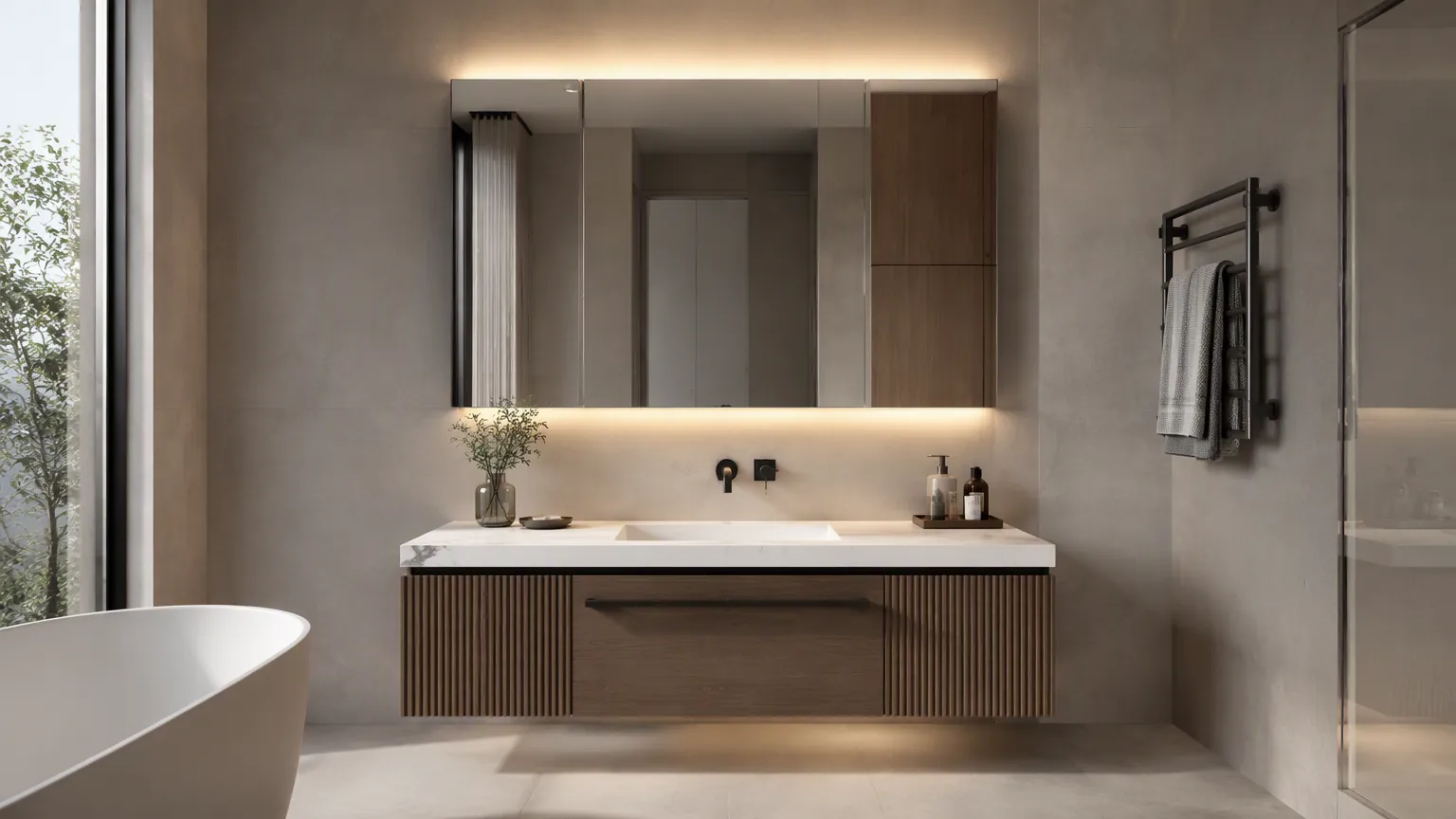
The first missing line is damage liability. Mirror glass breaks in transit, and everyone knows it. Yet nobody writes down how much breakage counts as acceptable, who photographs it, or how quickly replacement glass ships. Therefore the loss lands on whoever holds the container at the moment it opens, which is usually the contractor.
The second missing line is the power route. LED and the heating pad both need a feed. A hardwired cabinet wants a cable in the wall at a fixed height. A plug-in version wants a socket behind the carcass. Decide this after tiling, however, and somebody will cut the wall open again.
The third missing line is spares. Drivers and touch sensors fail long before the glass does. Ask for two spare drivers per hundred cabinets, and the hotel has parts on the shelf. Skip it, and the maintenance team replaces a whole illuminated mirror to fix a twenty-dollar component.
Sizing: How a Bathroom Mirror Cabinet Meets Its Vanity
Start with width, because everything else follows it. A bathroom mirror cabinet normally ships at the same nominal width as the vanity below it, so a 1000 mm basin unit takes a 1000 mm cabinet. Some designers prefer 100 mm narrower on each side, which reads lighter on the wall. Either works, provided the drawing says which one.
Height then decides whether people can actually use it. Most hotel specifications set the bottom edge of the cabinet between 1100 mm and 1250 mm above the finished floor. Below that range, taller guests see only the top of their head. Above it, shorter guests cannot reach the lower shelf at all.
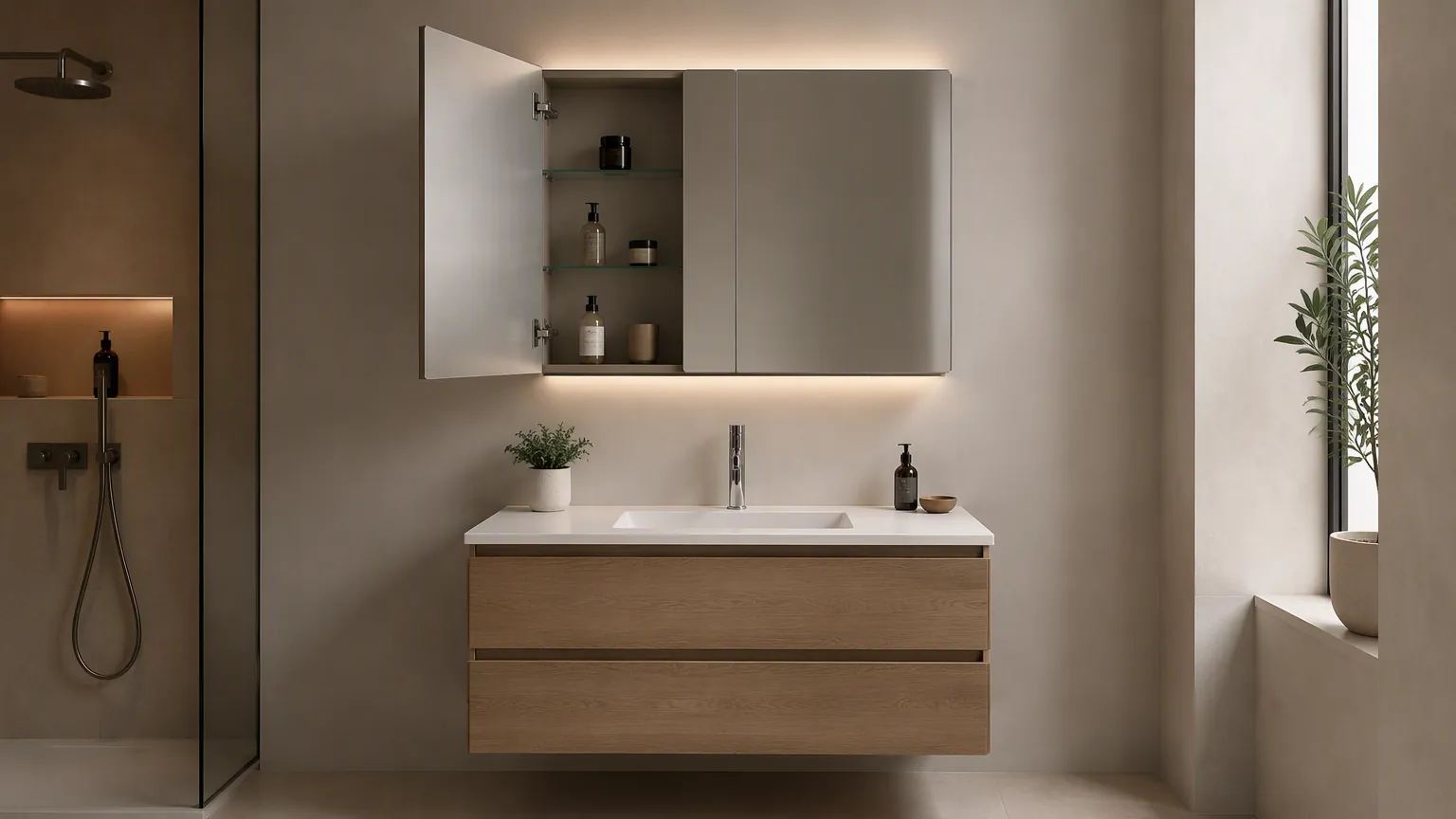
Depth, however, causes quiet trouble. Cabinets run from about 120 mm to 180 mm deep. A deeper carcass stores more, yet it also eats headroom above the basin. Put a tall mixer under a 180 mm cabinet, and guests will hit their forehead every morning. Check the mixer height against the carcass depth before approving the sample, not after the rough-in.
Public projects add an accessibility layer. In the United States, the ADA Standards for Accessible Design set the bottom of the reflecting surface at no more than 1015 mm above the floor for mirrors above lavatories. That rule applies to the mirror surface, not the cabinet. Because a cabinet hangs as a box, the whole unit has to move down to satisfy it. The NKBA publishes planning guidance that lands close to the same range for residential work, so the two rarely conflict.
The Glass Itself: Silvering, Thickness and Edge Sealing
The mirror panel, in practice, decides how long the unit looks new. Quality flat mirrors are silvered float glass, and the relevant product standard describes coating, adhesion and resistance testing. Ask which thickness the factory uses. Four-millimetre glass is common and adequate in a framed door. Five millimetre resists flexing better on a large single panel.
Then ask how the back is protected. Moisture attacks from the edge inwards, so the visible failure always starts as black speckle creeping in from the border. That is edge corrosion, and no amount of wiping prevents it. The only real defence is a sealed and painted back with a humidity test behind it.
Ask one more question on the finish. Copper-free and lead-free silvering exist now, and they hold up better in a humid coastal bathroom. Gulf projects benefit most here, because air conditioning runs hard and doors open onto humid air all summer.
Safety backing also matters. A film on the rear holds the pane together if it shatters. Without it, a broken panel drops plate glass into a basin. With it, the panel stays in one piece and the housekeeping team can lift it out.
Lighting: Colour Temperature, CRI and Where the Driver Sits
Lit cabinets look identical in photographs and indeed behave very differently on site. Three variables therefore separate them.
Colour temperature comes first. Warm light near 3000 K reads comfortable in a residential suite, and it flatters skin. Neutral light around 4000 K suits hotel bathrooms where guests put on makeup. Above 5000 K, the room turns clinical, and guests complain about looking tired.
Colour rendering comes next. A CRI of 90 or better keeps tones honest. Below 80, faces look grey and tile colours shift. The colour rendering index explains the scale, and the test report should state both CRI and the lumen output at the stated wattage.
Driver location decides the maintenance cost. An internal driver hides inside the carcass, so replacing it means opening the box on the wall. An external driver sits above the ceiling or in a nearby cupboard, and a technician swaps it in ten minutes. Therefore ask where it lives, and then ask whether it is replaceable alone.
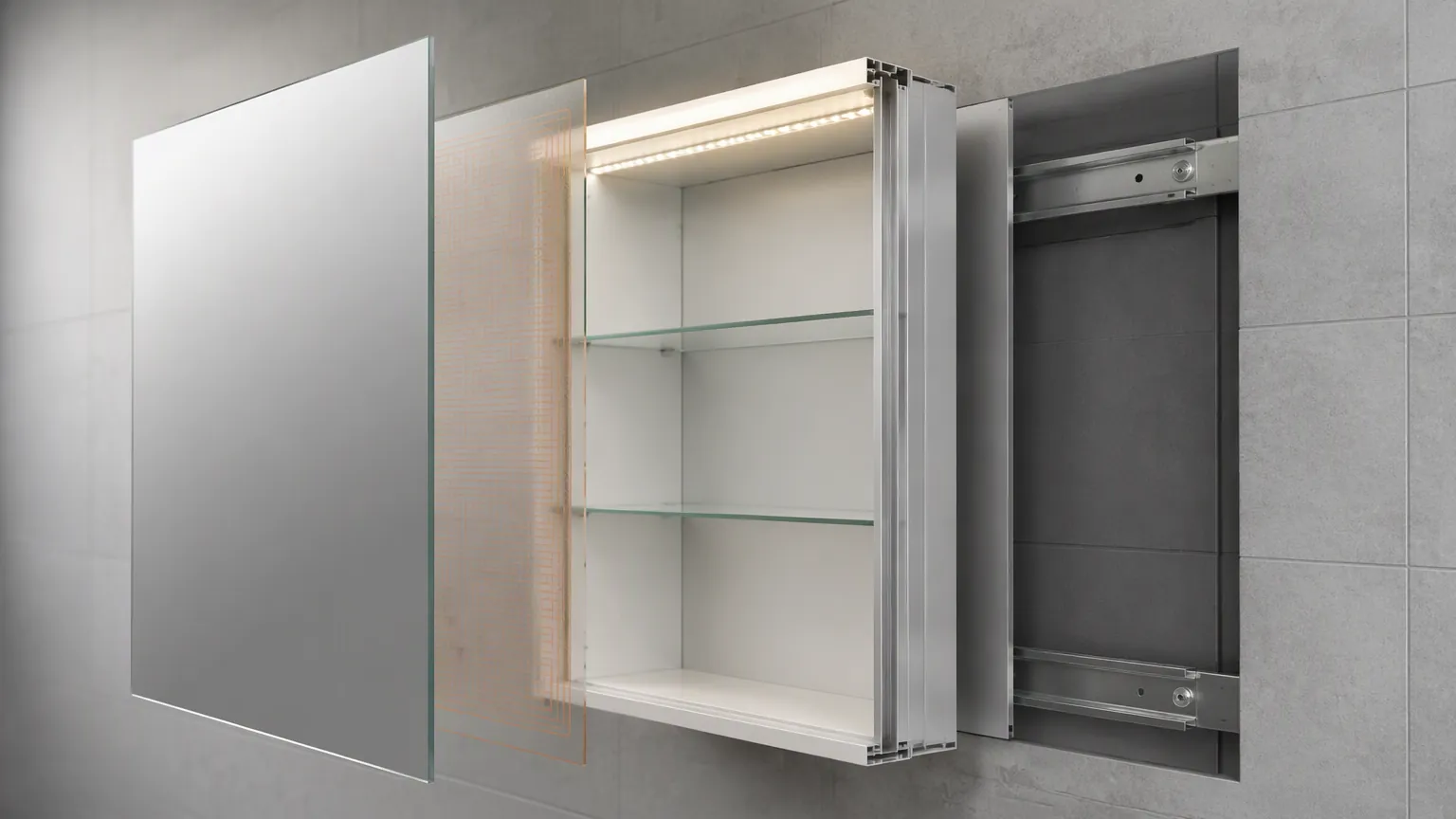
Switching style completes the picture. Touch sensors look clean and fail in humid rooms. Infrared sensors behave better, yet they trigger accidentally when someone walks past. A plain hard switch costs more in labour and almost nothing in callbacks. Choose it deliberately.
Defogging: The Pad, the Wattage and Nobody’s Switch
A demister pad is a thin resistive film bonded behind the glass. Typical units draw roughly 15 to 40 watts depending on panel area, and they warm the mirror enough to stop condensation in normal use. The film itself rarely fails. The wiring does.
Hotel rooms usually wire the pad to the bathroom lighting circuit, so the mirror clears whenever the light is on. That works, provided the electrician knows the pad exists. Leave it off the drawing, and every cabinet arrives as a plain box with a dead film behind the glass. Worse, nobody notices until the first winter.
Alternatively, wire the pad on its own loop with a timer or a separate switch. Guests then choose when to run it, and the hotel stops heating sixty mirrors all night for no benefit. Either way, the decision belongs on the electrical drawing.
Bonding quality deserves a check at sample stage. Bubbles behind the pad show up as pale clouds under strong light. Ask the factory to run every pad through a visual check under a raking light, because a trapped bubble never disappears.
Ratings: IP Zones and What Each Market Wants
Water needs a number, and the number follows a standard. The IP code sets Ingress Protection ratings, so IP44 means splash resistance from any direction, and higher figures mean stronger protection. Bathroom electrical installations divide the room into zones by distance from water, and the zone decides the minimum rating.
Zone 1 covers the area directly above a bath or shower up to 2250 mm, in practice. Zone 2 extends 600 mm beyond it. A cabinet mounted over a basin, away from the shower, usually sits outside both zones. A wall-mounted bathroom mirror cabinet inside a wet room or beside an open shower does not.
Destination markets, moreover, layer their own requirements on top. European and many Middle Eastern specifications ask for CE marking with the low voltage and electromagnetic compatibility directives behind it. North American projects ask for a UL or ETL listing on the complete luminaire, not on the LED chip alone. Saudi consignments clear through SASO, where the declared product has to match what physically ships.
Ask for one document set, not three. A cabinet described as IP44 while the test report covers only the LED strip leaves a gap at handover. Match the certificate to the exact model number on the packing list.
Six Questions Engineers Ask About a Bathroom Mirror Cabinet
Can it ship separately from the vanity? Yes, and it often should. A separate shipment means the cabinets arrive with the joinery package instead of riding with the ceramics. Colour matching becomes the risk instead, so order both from one production batch.
Which way do the doors swing? Hinging is reversible on most carcasses, yet the change has to happen before packing. A left-hand door on a cabinet mounted beside a side wall will hit that wall. Sliding doors solve the problem in tight rooms, and they cost more.
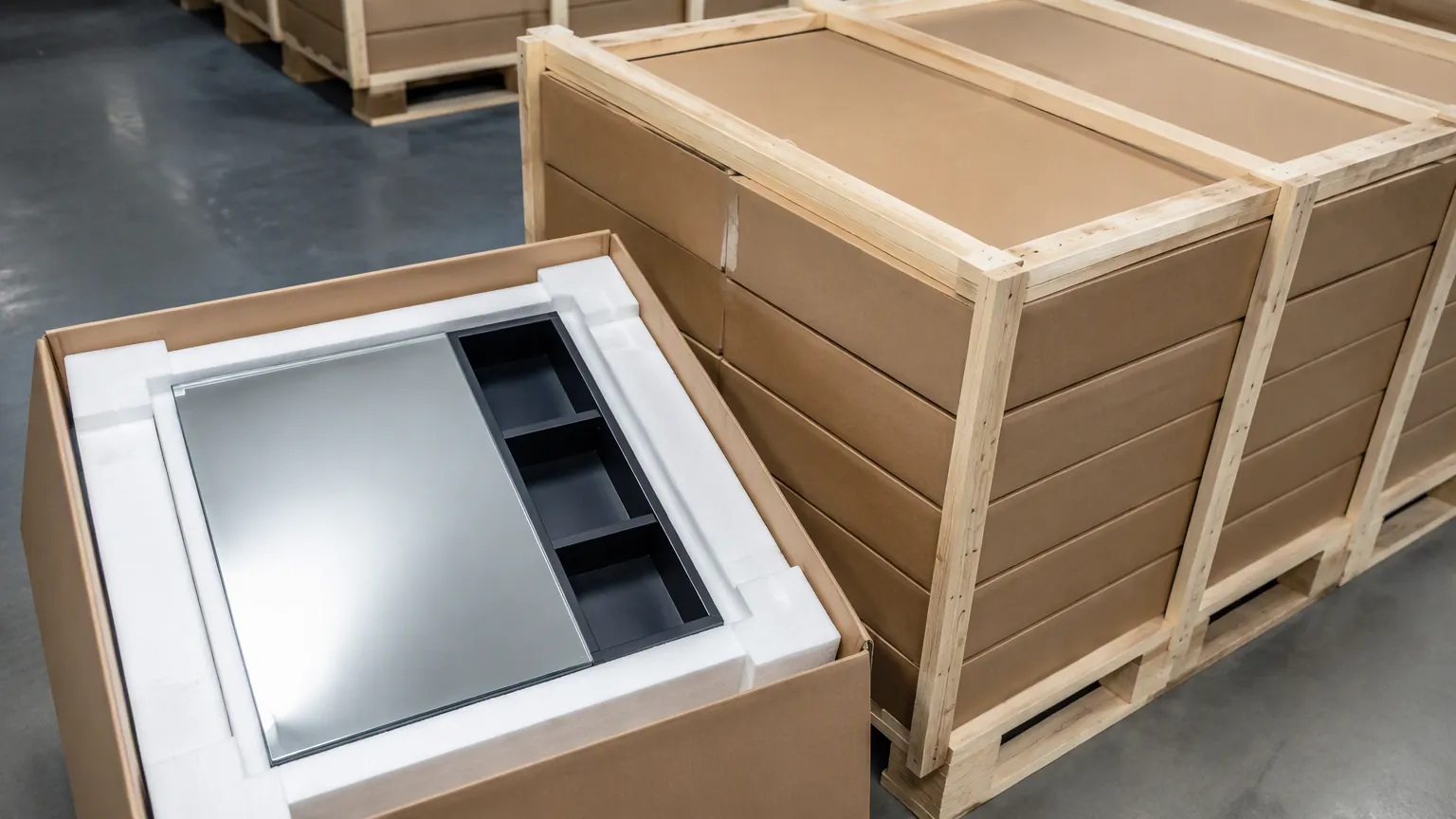
What happens if glass arrives broken? Ask for the packing method in writing. One carton per cabinet with corner protection and a wooden crate for the pallet costs more upfront. It also cuts claims dramatically, because loose containers in a shared box crack each other.
How long does the demister last? The pad itself usually runs for years. The adhesive behind it is the weak link in hot, humid rooms. Ask for the storage and bonding conditions, then check a sample after a heat test.
Can we order it without the light? Certainly, and some contractors do. Remember to tell the electrical team, because the wall feed becomes unnecessary and the wall stays closed.
What fails first? The driver, then the touch sensor, then the LED strip. None of them needs a new mirror. Insist that all three are replaceable separately, and stock the first two.
Where Bathroom Mirror Cabinet Orders Go Wrong on Site
The same handful of mistakes repeats across projects. Most cost nothing to prevent and a great deal to repair.
Wiring comes late far too often. Rough-in happens before the cabinet arrives, so the cable has to sit exactly where the carcass expects it. Guess wrong and someone chases the wall. Fix it by marking the cable height and offset on the reflected ceiling plan.
Hanging also goes wrong on uneven tile. A cabinet mounted proud of the surface leaves a shadow gap that collects dust. Set the mounting rail first, then the box onto it, then check with a level in two directions.
Finally, teams forget how much depth a door needs when open. A 500 mm door onto a narrow return wall blocks the light switch behind it. Plan the swing on plan, not in the showroom.
Project Example: 240 Units, Two Defects, One Fix
A Gulf hotel ordered 240 illuminated cabinets for a renovation. The specification gave width, finish and light colour, and nothing else. Two defects appeared within six weeks.
First, eleven units arrived with cracked glass. Nobody had agreed a packing method, so the factory had nested two cabinets per carton with thin corner protection. The claim settled at a partial credit, yet the replacement glass still took eleven weeks.
Second, thirty cabinets had demister pads with no feed behind them. Those thirty rooms sent every guest complaint straight to the front desk on humid mornings. In the end, the electrical contractor retrofitted switched spurs to those rooms at his own cost.
The project recovered because the contractor published an eight-line specification for the remaining phases. One line about padded corner packing dropped the damage rate to almost nothing, and another line about the switched spur prevented a repeat. The lesson was not about price. It was about writing things down.
What a Bathroom Mirror Cabinet Costs to Land
Unit price tells only part of the story. The table below separates the lines that move the landed figure for a container-sized order.
| Cost Item | Typical Impact on Landed Cost | Where It Usually Hides |
|---|---|---|
| Cabinet unit price | Reference figure for the whole order | Nowhere, everyone quotes it openly |
| Export packing per piece | Small per unit, large per container | Often excluded by default |
| Sea freight by volume | Depends on carton cube, not weight | Quoted only after packing is agreed |
| Glass breakage allowance | Usually one to three percent of value | Silently absorbed by the buyer |
| Installation labour per unit | Grows with wiring complexity | Owner’s own budget |
| Driver and sensor spares | Around two percent of unit value | Discovered after the first failure |
| Market certification and listing | Fixed cost per model family | Spread across the order silently |
Notice what the cheap quotation leaves out. A lower unit price with thin packing often lands above a higher price with proper crating, because one broken mirror cancels the saving several times over.
The PO Line That Prevents the Argument
One paragraph removes most disputes. Adapt this wording to the project.
“Supply and install illuminated mirror cabinet, 1000 mm wide by 700 mm high by 150 mm deep, five-millimetre copper-free silvered mirror glass with safety backing and sealed painted edges, 4000 K LED at CRI 90 or better, demister pad switched with the bathroom lighting, IP44 minimum, external replaceable driver, two spare drivers and two spare sensors per hundred units, one carton per unit with corner protection inside a wooden export crate.”
That sentence covers size, glass, light, heat, rating, spares and packing. It takes one minute to write and removes about nine tenths of the arguments that follow.
Pre-Shipment Checklist for Bathroom Mirror Cabinets
Check each item before the container seals. Check them again before installation.
- Confirm carcass width against the vanity drawing now
- Match bottom edge height to the accessibility rule
- Verify mixer height against declared carcass depth
- Record colour temperature and CRI on the report
- Read the IP rating against the bathroom zone plan
- Test one demister pad under a raking light
- Open one packed carton and photograph the protection
- Note driver location and confirm it is replaceable
- Count spare drivers and sensors into the shipment
- Match certificate model numbers to the packing list
Frequently Asked Questions
What size should a bathroom mirror cabinet be above a 1000 mm vanity?
Either match the 1000 mm width exactly, or step down to 800 mm for a lighter look. Both work as long as the drawing fixes one option before production.
Is IP44 enough for a mirror cabinet?
For a cabinet over a basin outside the shower zones, yes. Inside a wet room, or beside an open shower, ask a higher rating and confirm it against the zone drawing.
Can the demister pad run continuously?
It can, yet running it all night shortens adhesive life and adds energy cost. Wire it to the lighting circuit or give it its own switch.
Why do some cabinet mirrors develop black edges?
Moisture attacks the silvered layer from the unprotected edge inwards. Sealed and painted backs with humidity testing slow this down considerably.
How many spare parts should a hotel keep?
Two drivers and two sensors per hundred cabinets covers the first year comfortably. After that, order spares with the next furniture shipment.
Can damaged glass be replaced without changing the cabinet?
Usually yes, provided the factory still holds the mould and the finish. Ordering spare panels with the original shipment avoids the batch difference later.
Does a cabinet without lighting still need a wall feed?
No, and that saves labour. Say so clearly on the electrical drawing so nobody leaves a cable behind the wall.
Do these cabinets suit coastal projects?
They do with the right specification. Copper-free silvering, sealed edges and tested coastal packing matter more there than anywhere else.
What the Missing Lines Were Worth
Back to those three missing lines on the quotation. Damage liability became a packing clause, and it removed almost all of the breakage. The power route became a drawing note with a height and an offset, and the team stopped chasing walls. Spares became two drivers in every hundredth carton, and year six stopped being a problem.
None of those three lines cost money. They cost attention, which is the same thing a specification is for. Add the four numbers – carcass width, ingress rating, defogger wattage and door swing clearance – and the cabinet stops being a commodity line on a spreadsheet. It becomes something that arrives, works and stays working.
Whether the next project needs one cabinet or two hundred, the bathroom vanity buying guide covers the unit below it, and the wall hung vanity installation guide covers what happens behind the wall. For the cabinet itself, start with the size range in the 1000 mm vanity mirror cabinet series and the wider combinations in the 1200 mm vanity sink mirror cabinet combo. The round LED mirror vanity series shows how light and storage share one wall, while the single sink vanity series covers compact rooms.
Send the drawing and the room count to our team, and we will price the packing, spares and certification into the first quotation rather than the first claim.
References
- International Electrotechnical Commission. IEC 60529, Degrees of protection provided by enclosures (IP Code).
- U.S. Access Board. 2010 ADA Standards for Accessible Design. https://www.ada.gov/law-and-regs/design-standards/2010-stds/
- National Kitchen & Bath Association. Planning guidelines for bathroom layouts and clearances. https://www.nkba.org/
- Saudi Standards, Metrology and Quality Organization. Technical regulations and conformity procedures. https://www.saso.gov.sa/en/
- Ingress Protection rating reference. https://en.wikipedia.org/wiki/IP_code
- Colour rendering index definition and measurement method. https://en.wikipedia.org/wiki/Color_rendering_index