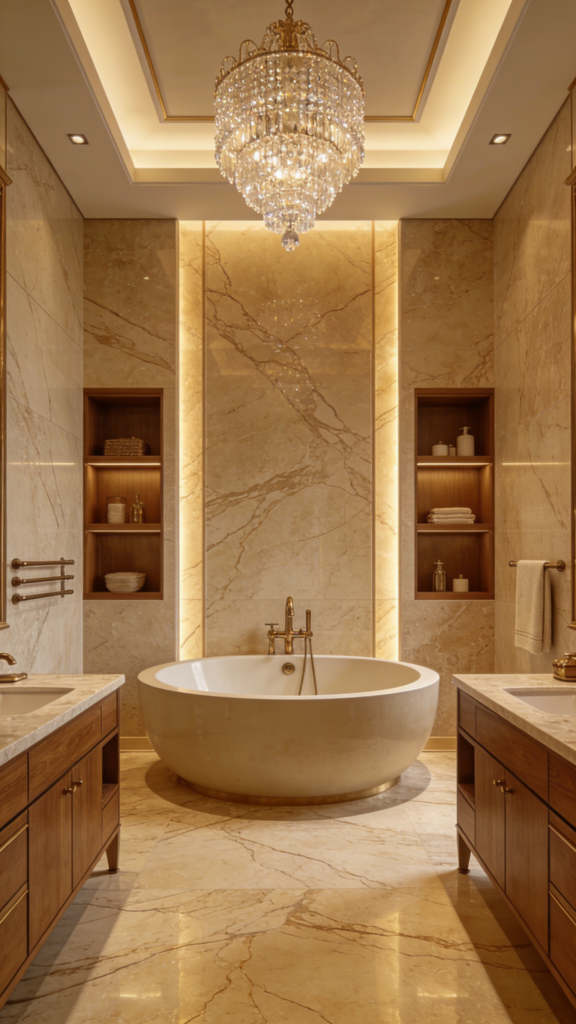

Bei der Bestellung eines Badezimmerschranks in den Vereinigten Arabischen Emiraten kommt es auf vier Entscheidungen an: Untergrund, Waschbeckenanschluss, Verkabelung und Formalitäten. Wählt man den falschen Untergrund, quillt der Korpus bereits im zweiten Jahr auf. Versäumt man die Formalitäten, bleibt die Lieferung in Jebel Ali liegen.
Decide those four first. Everything else on the specification – colour, handle, door profile – can in fact change late without costing anything. The substrate cannot change late, and neither can the certificate number. A bathroom vanity UAE specification that names all four rarely comes back as a claim.
That is the whole argument, and the rest of this guide is the evidence behind it. It therefore follows the order a contractor meets these decisions on a real project. Carcass first, then the basin joint, then services, paperwork, packing and cost.
Why Bathroom Vanity UAE Orders Fail Differently
A vanity that survives ten years in a temperate apartment can fail in eighteen months on the Gulf coast. The reason is not quality. The reason is the building.
Air conditioning, in practice, runs almost year round. Interiors therefore swing between cooled air near 22°C and outside air above 40°C. Showers add humidity on top of that swing, and the air handler removes it again within the hour. That cycle repeats several times a day in an occupied room.
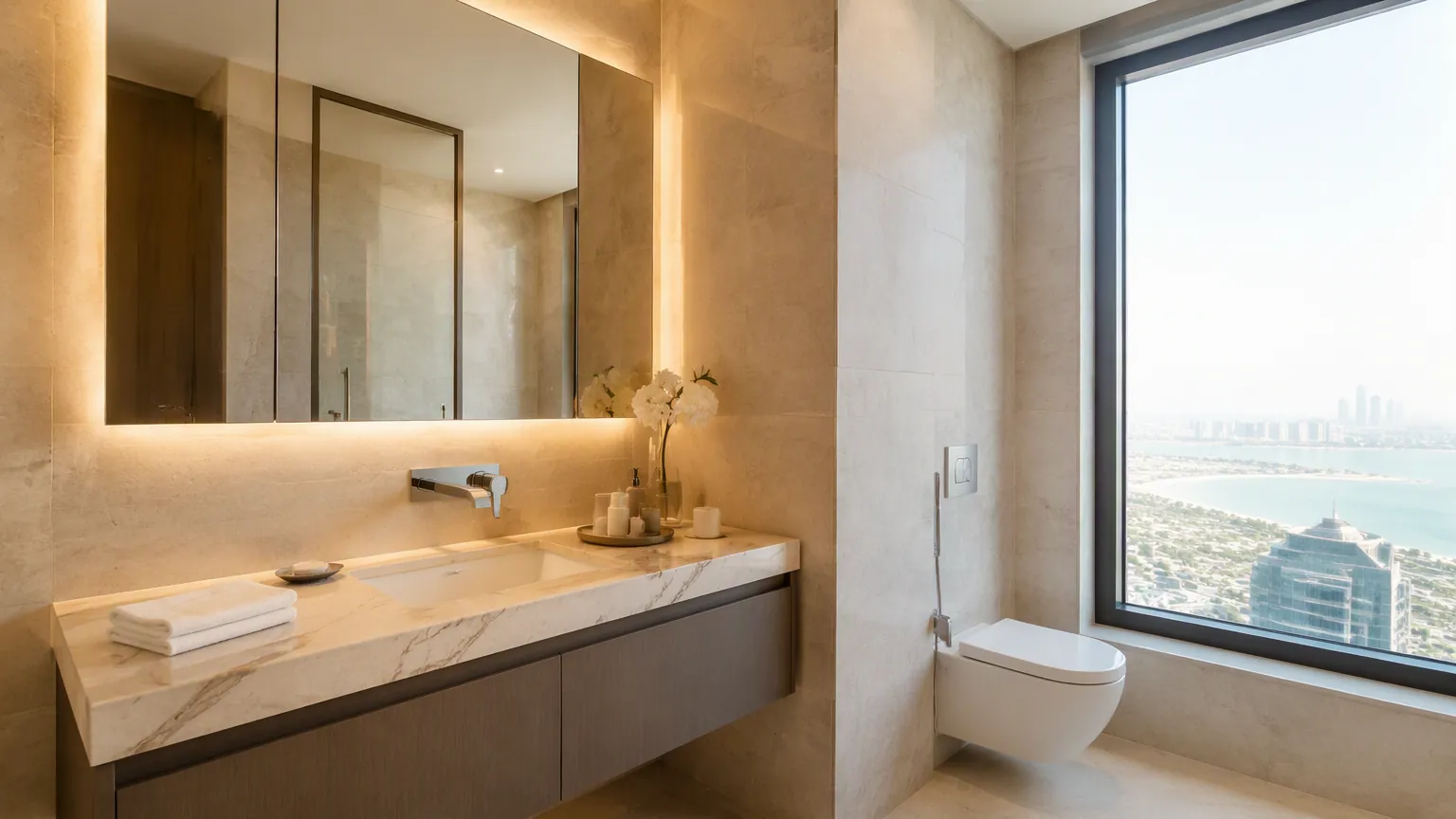
Three physical failures follow from that cycle, and they account for most vanity callbacks in the region.
The first is swelling at the plinth. Water first reaches the floor from overspray, a mop or a leaking valve. It then wicks up into the bottom edge of the carcass. The board then swells two to three millimetres. The door drops out of alignment, and the hinges pull at their screws.
Edge banding lift is the second one. Adhesive that holds well in a dry climate, however, softens under repeated humidity cycling. The band lifts at the door bottom first, and water then has a direct route into the board.
The third is the seal line between basin and countertop. Silicone also blackens within a year under housekeeping chemicals. That dirty line is what a guest sees first.
A fourth failure is not physical at all. The bathroom vanity UAE shipment then sits at the port. The certificate names one product, and the packing list describes another. Nobody plans for it, and it costs more than the first three combined.
Bathroom Vanity UAE Substrate: A Decision Tree
Substrate is the carcass board, and it is in practice the single decision that determines whether the unit survives. Run the following four questions in order, and stop at the first one that applies.
Does the room contain a shower or a bath? If yes, standard MDF is out. Go to marine plywood or PVC board. Shower humidity is the dominant load here, and MDF therefore absorbs it fastest at any exposed edge.
Does the unit stand on the floor? If yes, use PVC board or a PVC plinth. A floor-standing vanity sees the most water at its base, and a timber plinth is the first part to swell.
Is it a dry powder room with mechanical extraction? Then MDF with PUR edge banding is the correct economic choice. There is no reason to pay for marine plywood in a room that never gets wet.
Is the top stone or solid surface? Then the carcass matters less. The underside of the cut-out matters more, because stone is impervious and the cut edge is not. That edge has to be sealed by the fabricator, not by the installer.
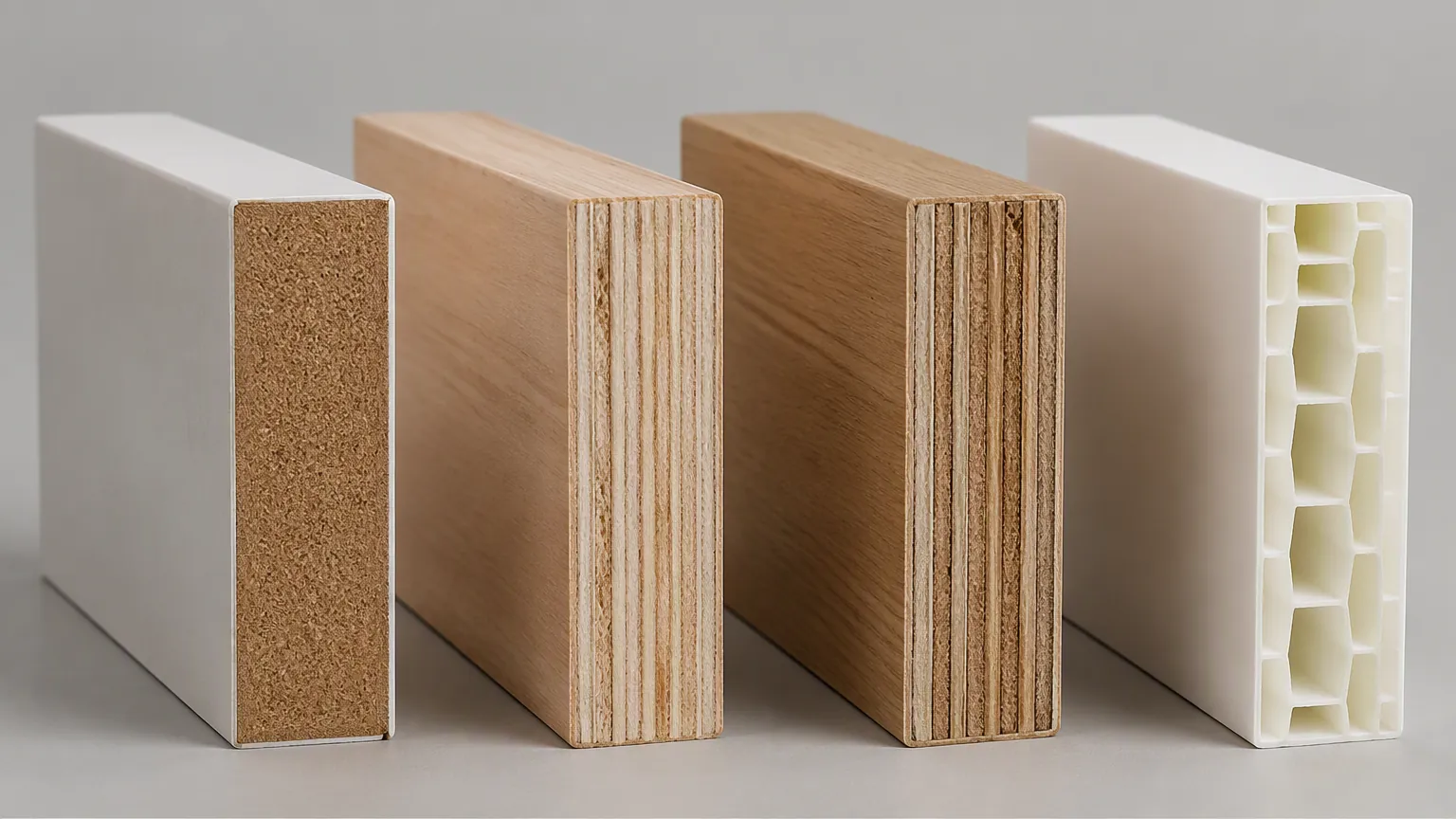
Four materials dominate the market, and each one still has a clear place.
Marine plywood uses waterproof glue throughout, so the whole panel resists water rather than relying on a surface treatment. It costs more than furniture plywood and is worth it in any wet room.
Medium-density fibreboard machines beautifully and takes paint better than anything else. It also swells irreversibly once water reaches the core, which is why it belongs in dry rooms only.
Hardwood plywood, meanwhile, sits between the two. It handles occasional water better than MDF, and it costs less than marine grade. Many mid-market hotel specifications land here for rooms with extract fans and no direct shower exposure.
PVC foam board instead ignores water entirely. It cannot swell, it cannot rot, and it takes a screw less well than timber. Back-of-house washrooms, staff areas and poolside changing rooms are where it earns its price.
| Substrate | Where It Belongs | Relative Cost | Watch Out For |
|---|---|---|---|
| Marine Plywood | Guest bathrooms with showers | High | Glue grade must be stated on the PO |
| Hardwood Plywood | Rooms with extraction, no direct wetting | Medium | Face veneer quality varies by batch |
| MDF With PUR Edge | Powder rooms, offices, dry areas | Low | Any unsealed edge fails fast |
| PVC Foam Board | Staff areas, poolside, wet rooms | Medium | Screw holding strength is lower |
Why it matters is simple arithmetic. A swollen carcass, moreover, cannot be repaired on site. It has to be replaced, which means a room out of service and a colour match against an aged batch.
Basin Interface: Undermount, Countertop or Integrated
The basin decides the cleaning routine for the next decade, and the choice is really between three details.
An undermount basin sits below the countertop, so the housekeeper wipes water straight off the stone into the bowl. Guests read it as the premium option, and it is in practice the standard in four and five star Gulf projects. The cut-out, however, has to be templated from the actual basin, not from a drawing dimension.
A countertop basin sits proud of the surface. It looks striking in a powder room. It also creates a dirt line at the base that housekeeping works around. The mixer then has to clear the rim, so allow for a tall basin mixer.
An integrated basin is moulded into the top itself, so there is no joint to fail at all. It is the cheapest to own over ten years and the least forgiving of damage. Crack the top and the whole assembly goes.
Three details decide whether any of the three works on site. Tap hole configuration – none, one or three – has to match the mixer already bought. The waste outlet has to line up with the P-trap in the wall. A 60 mm offset then turns into a flexi hose and a smell complaint. An overflow, where one exists, changes the basin mould.
Sizing, Wall Fixing and the Plumbing Void
Width comes from the room schedule, and the market has settled on a small set of numbers. Single basin units run 600 mm, 800 mm and 1000 mm. Double basin units start at 1200 mm and commonly run to 1500 mm. Anything outside that range is a custom mould with a custom lead time.
Depth is where drawings go wrong. A standard vanity needs 450 mm to 500 mm of projection. Tight guest bathrooms often have only 380 mm to 420 mm. A shallow unit then has to be ordered deliberately, not discovered on site.
Height is measured to the finished floor, and 850 mm to 900 mm covers most work. Hotels with a mixed guest profile sometimes drop to 820 mm for accessibility. Decide that before the tile is set.
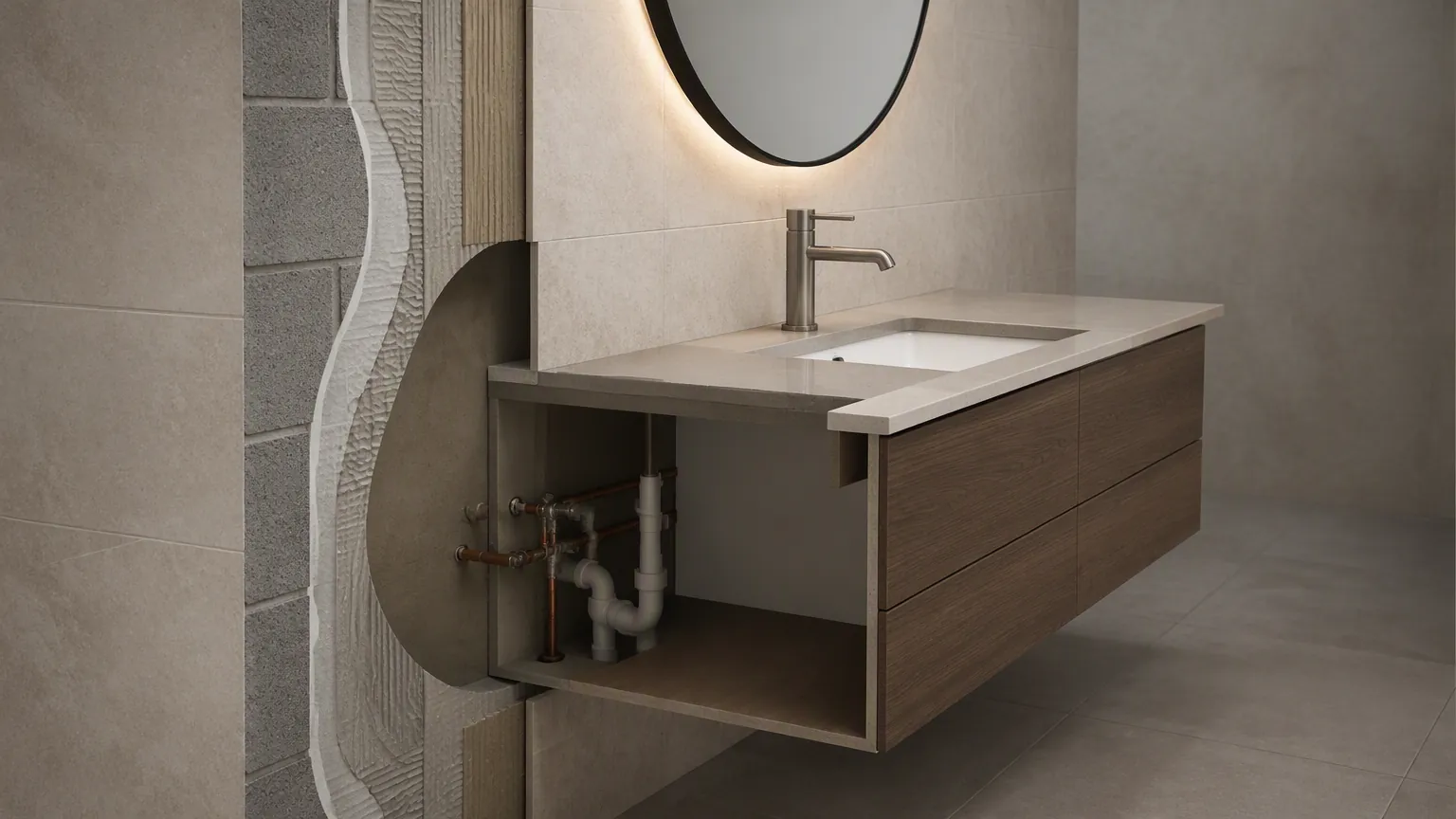
Wall fixing deserves more attention than it gets. A wall-hung vanity carries its whole load on two or three fixings. The wall behind it has to be declared. Blockwork takes a heavy anchor well, and a stud partition does not. A stud wall needs a plywood backing panel built in before the board goes on.
Behind the unit, a service void of roughly 100 mm to 150 mm hides the trap and the supplies. Supply valves normally sit between 500 mm and 600 mm above the finished floor, centred on the basin. The waste outlet sits lower, usually between 400 mm and 500 mm. Both numbers belong on the coordination drawing, because tilers work from the drawing rather than the catalogue.
Die wall hung vanity installation guide covers the fixing and void detail at greater length. The vanity and basin combination guide covers whether to buy the two as one line or two.
Bathroom Vanity UAE Lighting and Mirror Wiring
Gulf projects run on 230 V at 50 Hz, and the plug is the British Type G. That sounds obvious. Yet plenty of lighting still arrives rated for 110 V, because catalogues are often written for other markets.
Lighting changes the vanity from furniture into an electrical item, and electrical items carry a heavier paperwork load. A lit mirror cabinet needs a feed position, a rating and a maintenance plan.
The feed position comes first and is the cheapest thing to get right. A hardwired unit wants a cable at a declared height and offset. A plug-in unit wants a socket behind the carcass, which then adds depth to the void. Decide this after tiling, and somebody opens the wall again.
The rating follows the IP code. IP44 covers splash resistance from any direction and suits a cabinet over a basin outside the shower zones. A wet room, where the shower has no screen, asks for more, and the zone drawing settles it.
Maintenance is the part nobody prices. LED drivers fail long before the glass does. The driver therefore has to be reachable without taking the cabinet off the wall. Two spare drivers per hundred units cost very little and turn a room outage into a five minute swap. The bathroom mirror cabinet specification guide covers the wiring, rating and driver questions in detail.
Bathroom Vanity UAE Certification and Customs Paperwork
This section decides whether the container moves. It is also the one most often left to the last week.
Saudi consignments clear through SASO. The practical route is a product conformity certificate plus a shipment certificate from SABER. Both have to be raised before the vessel sails, not after. The declared product has to match what physically ships, down to the model number.
UAE consignments are lighter on furniture registration. The electrical parts inside a lit cabinet still need their own documents. Regional standards come from the Gulf Standardization Organization, and many tender documents simply reference GSO or an equivalent national standard.
Classification causes the most arguments. The Harmonized System puts a wooden bathroom cabinet under one heading and a plastic one under another. Ceramic basins sit in a different chapter, as does mirror glass. One carton holding vanity, basin and mirror raises a classification question. A vanity alone does not.
A bathroom vanity UAE consignment needs its documents raised early, because three mismatches appear again and again. Certificates name MDF while the shipment is plywood. Commercial invoices describe furniture while the packing list includes a ceramic basin. Mirror cabinets then carry a lighting component that nobody declared. Each one is cheap to prevent in week one and expensive to fix in week twelve.
Packing, Container Loading and the Breakage Window
Vanities ship either assembled or flat packed. That choice moves the landed cost per unit more than any negotiation does.
An assembled 1000 mm vanity occupies roughly 0.35 m³ to 0.5 m³ once cartoned. A 40 ft high cube container offers about 68 m³ of usable volume. A full container therefore lands between 130 and 190 units, depending on how the cartons stack. Flat packing cuts the carton volume by about two thirds. It roughly triples the count, at the cost of site labour.

Assembly on site is not free. A two person team installs roughly eight to twelve flat pack units a day. Assembled units run at fifteen to twenty, and on a 240 unit tower that gap is a week.
Packing detail decides the claim rate. Use foam corner protectors on every carton, plus edge guards and a moisture barrier. Add desiccant bags, and palletise rather than floor load anything with a stone top.
The claim window is the part to write down. Photograph the container on arrival. Open one carton from the middle of the stack, then report damage within the stated window. A reasonable target is under half a percent of units. Anything above that points at the packing, not the handling.
Lead Time: Ramadan, Summer and Chinese New Year
Production time for a project run typically lands between 25 and 45 days, depending on how much is custom. Custom widths, special veneers and integrated tops push it toward the long end.
Three calendar effects matter more than the factory schedule. Ramadan shortens working hours across the supply chain, including freight and customs. Chinese New Year stops production for roughly three to four weeks. High summer slows site installation in the Gulf, which quietly moves delivery dates.
Transit from South China to Jebel Ali runs about 18 to 25 days. Booking space needs three weeks of lead time in peak periods. Those run August to September and January to February.
What a Bathroom Vanity UAE Order Actually Costs
Every line below moves the landed number, and two of them are routinely left out of the first quotation.
| Cost Item | What It Covers | What Moves It Most |
|---|---|---|
| Carcass Material | Board, edge banding, hardware | Substrate grade and board thickness |
| Countertop | Stone, solid surface or ceramic | Material and cut-out count |
| Basin | Ceramic or solid surface bowl | Mounting type and overflow |
| Mirror Cabinet | Glass, lighting, demister pad | Driver quality and rating |
| Packing | Cartons, protectors, pallets | Assembled versus flat pack |
| Freight And Insurance | Ocean leg to Jebel Ali | Container utilisation |
| Certification | Conformity documents and testing | Number of declared product lines |
| Duty And VAT | Import duty plus local VAT | Classification and declared value |
| Inland Delivery | Port to site, including unloading | Access and lift availability |
| Spares And Wastage | Spare doors, drivers, repair stock | Project size and room count |
Spares and wastage is the line that disappears first when a buyer squeezes the price. It is also the line that decides whether year three is quiet.
A 240-Unit Project in Abu Dhabi
A contractor ordered 240 wall-hung vanities for a serviced apartment tower. All were 1000 mm, with stone tops and undermount basins. The first phase used MDF carcasses with a standard edge band. The rooms had extract fans, and the drawings showed no direct shower exposure.
Eighteen units swelled at the plinth within the first summer. Housekeeping mopped the floor daily, and that water found the bottom edge every time. The replacement cycle cost more than the substrate upgrade would have.
Phase two switched to marine plywood with PVC plinths. It added a sealed cut-out edge around every basin and a 48 hour claim window. Unit price rose about seven percent, and callbacks on the second phase came to one hinge adjustment.
The lesson was not that MDF is bad. The lesson was that the room schedule, not the sample board, decides the substrate.
Seven Questions Bathroom Vanity UAE Buyers Ask
What size suits a Gulf hotel bathroom?
A 1000 mm single basin unit covers most mid-market rooms. Tight rooms drop to 800 mm, and suites usually take a 1200 mm or 1500 mm double basin run.
Is MDF acceptable in the UAE?
Yes, in dry rooms with mechanical extraction. It is a poor choice where a shower sits, and marine plywood or PVC is safer there.
Which HS code applies?
It depends on the carcass material and on what ships inside the carton. A wooden cabinet and a plastic one fall under different headings, and a ceramic basin under a third.
Does the mirror cabinet need its own certificate?
The lighting component inside it usually does. Electrical items carry a heavier documentation load than furniture, and the certificate has to name the complete luminaire.
How much breakage is normal?
Under half a percent of units, with corner protection and pallet loading. Anything above that points at the packing specification, not the stevedores.
How long to Jebel Ali?
Plan 25 to 45 days to build, then 18 to 25 days on the water. Add three weeks for space booking in peak periods, and avoid running production across Chinese New Year.
Can one container serve two towers?
Yes, if the packing list separates the models and counts. Mixing them without that separation is the fastest route to a customs query.
Pre-Shipment Checklist for Gulf Vanity Orders
Work through these before the container seals, then work through them again before installation starts.
- State the substrate grade on the purchase order
- Confirm carcass width against the room schedule
- Match basin cut-out to the delivered basin
- Record tap hole count and mixer height
- Fix supply and waste heights on the drawing
- Declare wall type behind every unit
- Verify voltage and plug type for lighting
- Match certificate models to the packing list
- Open one carton and photograph the protection
- Count spare doors and drivers into the shipment
Which Specification Fits Your Project
If the rooms have showers and daily housekeeping, specify marine plywood or PVC. Add a PVC plinth, a stone top and an undermount basin. That combination removes the commonest callback in the region.
If the rooms are powder rooms or offices, MDF with PUR edge banding is the right economic decision. Spend the saving on a better top, because that is what guests touch.
If the units serve staff areas, poolside changing rooms or any floor that stays wet, go straight to PVC board. It is the only one of the four that cannot swell. Any bathroom vanity UAE order that names the substrate early avoids this whole argument.
Whether the next project needs twenty units or two hundred, the bathroom vanity buying guide covers the full selection route. Gulf sourcing follows its own rules, and the UAE bathroom supplier guide covers certification and freight market by market. Standard configurations are listed in the double wash basin vanity unit for UAE projects.
Send the room schedule and the drawing to our team. We will return a substrate recommendation, a loading plan and the certificate list with the first quotation.
Literaturverzeichnis
- Saudi Standards, Metrology and Quality Organization. Product conformity and the SABER platform for regulated imports.
- Gulf Standardization Organization. GSO standards for furniture, wood based panels and sanitary products.
- International Electrotechnical Commission. IEC 60529, Degrees of protection provided by enclosures (IP Code).
- World Customs Organization. Harmonized Commodity Description and Coding System, explanatory notes for furniture and ceramic headings.