
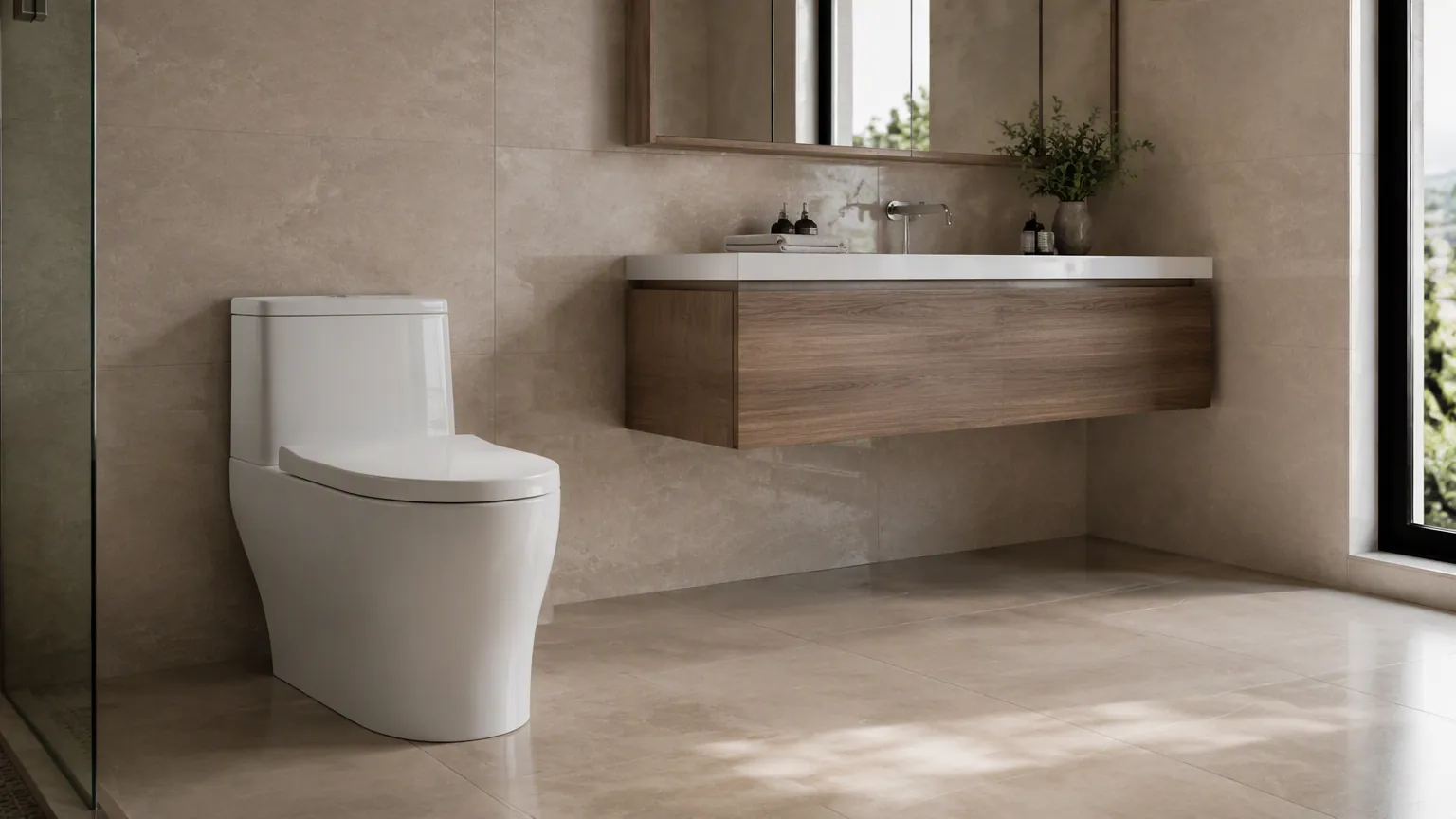
A project manager in Riyadh picked one-piece toilets for a 420-room hotel because the render looked cleaner. Nobody asked how those units would reach the twenty-second floor. A one piece vs two piece toilet decision made in a showroom quietly committed that project to two extra containers. It also bought nine weeks of replacement lead time and a demolition plan for every cracked unit. The staff block got two-piece toilets from the same factory. Those have run for three years with nothing more than a flapper valve change. Same maker, same glaze, same water label, completely different ownership cost.
This is not a question of taste. Volume contractors care about freight cube and breakage rate. They also watch install minutes, housekeeping labour, and what fails in year five. On every one of those axes the two constructions behave differently. This article works through the difference the way a spec meets it. Then it hands you a decision matrix and the spec lines that prevent the usual failures.
Where the One Piece vs Two Piece Toilet Split Really Begins
A one-piece toilet has its cistern and bowl fired and finished as a single body. The tank and the pan form one continuous piece of vitreous china. Makers usually skirt that body to the floor, so no seam shows. A two-piece toilet has a separate cistern that bolts to the pan with a gasket between them. One factory, two constructions, and every downstream cost follows from that single joint.
The joint is the whole story. A two-piece unit splits into two boxes. It therefore stacks better, ships denser, and crosses a doorway on one shoulder. In contrast a one-piece unit arrives in one carton weighing 40 kg to 55 kg. Its centre of mass sits high and off-axis. That shape drives handling risk in a way a spec sheet never mentions.
There is also a marketing layer on top of the physical one. Buyers read one-piece as premium because the render is cleaner and the showroom lighting flatters it. Yet nothing about the single-body construction improves flush performance, trap seal depth, or glaze quality. Those follow the hydraulic design and the firing process. So when a supplier quotes a premium for the one-piece form, you are buying logistics risk, not better hydraulics.
Freight Cube and Breakage in a One Piece vs Two Piece Toilet Order
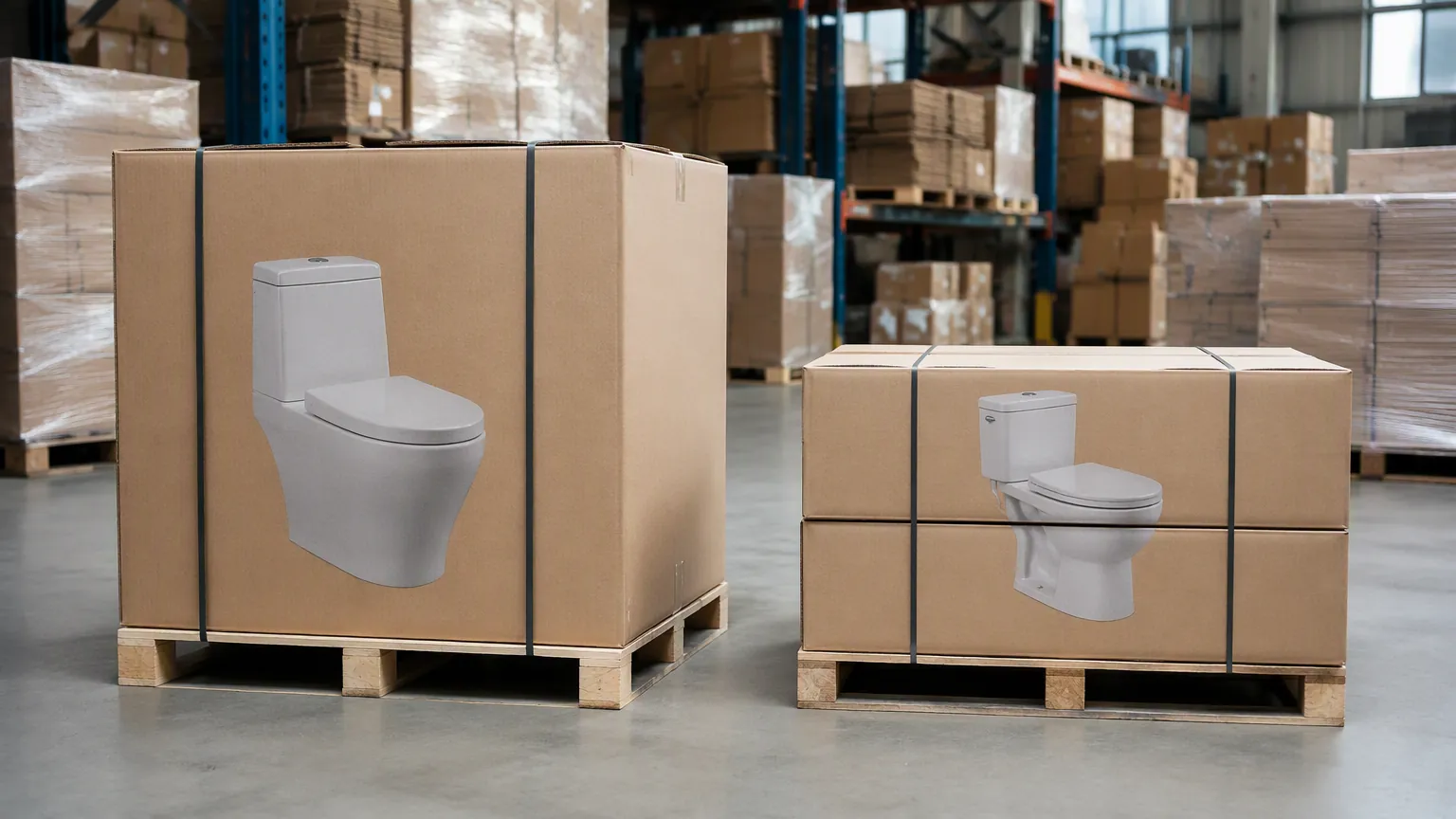
Freight is where the one piece vs two piece toilet argument stops being aesthetic. Start with the container, because this is where the first real money moves. A 40 ft high-cube container has a fixed payload and a fixed volume. Ceramic almost always hits the volume limit first. Two-piece cartons stack flat, so a factory can nest cistern boxes into the voids left by the pan boxes. Typical loading lands around 130 to 160 sets per 40HQ depending on the pan shape. One-piece cartons are tall and awkward, so the same holds roughly 80 to 100 units.
That gap alone can double your freight per fixture. Suppose pan sets land at USD 62 FOB and freight allocates USD 34 per unit on a two-piece run. The same product in one-piece form may allocate USD 55 per unit because the container carries fewer pieces. Before any quality discussion, the delivered cost moved about 30 percent, and nothing about the ceramic improved.
Breakage then compounds it. Shipping insurers and factory QA teams agree on one point. Big single-body ceramic breaks more often than two smaller boxes. Two-piece damage usually means one cracked cistern lid, which is a cheap spare that ships in days. A cracked one-piece body means a whole fixture scrapped, because you cannot replace half of it. Most experienced importers therefore budget 1.5 to 3 percent loss on one-piece shipments. Two-piece runs usually stay under 1 percent. Our own bulk buying guide for volume orders builds that allowance into the landed cost model. It matters more than any unit price discount.
Ask your factory three questions before you book. How many pieces fit per 40HQ for this exact model? What is the declared breakage allowance in the contract? Where does title transfer if a unit arrives cracked? If the answers are vague, the allowance is about to become your problem.
Doors, Stairs, and Lift Cores: Can Your Crew Carry It In?
Site logistics kill more one-piece specs than any other factor. A standard apartment door leaves about 800 mm of clear opening. A one-piece carton commonly measures 700 mm by 500 mm by 800 mm. It also weighs over 40 kg. Two people can move it, but only upright, and slowly. Take a tower project with 400 units spread over thirty floors. Those extra minutes per unit add a full labour gang-week.
Two-piece units split into two cartons of roughly 25 kg and 14 kg. One installer carries each part alone. That changes crew sizing on every floor you pour. Refurbishment work punishes the one-piece form even harder. Old service lifts are often only 900 mm deep. A tall one-piece carton simply will not stand up inside one. In practice crews tip the unit on its side, which risks stress fractures. Or they hand-carry it up the stair core.
Then there is injury exposure. Manual handling of awkward loads above 40 kg is a recognised risk on any site with a safety officer. Some Gulf contractors now refuse one-piece fixtures outright on high-rise work for this reason alone. So do not let the architect fall in love with a skirted silhouette. First walk the route from kerb to rough-in with a tape measure. If it does not fit through the smallest door on the route, the drawing fails, not the product.
Installation Hours: The One Piece vs Two Piece Toilet Gap on Site
Two-piece installation takes longer per unit, and that is the honest cost of this option. The installer sets and levels the pan, then lifts the cistern onto it. Then comes two bolts to align and a tank gasket to compress. Skilled crews finish in about 15 extra minutes per unit versus a one-piece. Over 400 rooms that is 100 labour hours, and you can price it.
Leak risk sits in those additional steps. Under-torqued bolts crush the gasket unevenly, and over-torqued bolts crack the china. Either failure only appears once the room is handed over and a slow drip stains the ceiling below. That callback is the most common complaint on two-piece projects, and it is entirely procedural. Good site practice fixes it. Torque to the factory Newton-metre figure, fit a new gasket, and water-test every unit for four hours.
One-piece units remove that joint entirely. There is no tank gasket to fail, fewer bolts to torque, and no alignment problem between pan and cistern. Installation is genuinely faster and less dependent on installer skill. In markets where contractors rotate unskilled labour through finishing trades, fewer assembly steps means fewer defects. This is the strongest argument on the one-piece side, and it deserves to be weighed honestly. When your labour pool is thin and your schedule is tight, those saved minutes count. They cut defect risk more than any other factor.
Housekeeping: Where the One Piece vs Two Piece Toilet Gap Shows Daily
Hotel housekeeping managers will tell you the same thing within thirty seconds of looking at either unit. Two-piece toilets have a seam where cistern meets pan. That seam collects dust, splash, and cleaning chemical residue, and it sits where a cloth does not naturally sweep. Over a year the seam yellows, then the housekeeping supervisor writes it into the defect list.
A one-piece body has no seam at all. One wipe runs from the tank top down to the floor. The skirted base also removes the exposed trapway that collects dust. Picture a 400-room property with a six-minute room turn. Those saved seconds add up to real labour hours per month. This is why hospitality designers keep favouring the one-piece form, and on pure cleaning economics they are right.
That said, the cleaning argument has limits. A well-designed two-piece with a close-coupled cistern leaves a shallow, easily wiped joint. Poorly executed ones hide a 15 mm recess that becomes a permanent stain line. So the daily difference depends on design quality, not on the category. Always ask for the actual junction detail rather than trusting marketing photography. Surrounding fixtures also shape hygiene perception in that same room.
Flush Performance, Noise, and the Water Label
Buyers often assume one construction flushes better. Neither does, mechanically. Flush performance follows trapway geometry, jet design, and rim configuration. None of those care whether the tank bolts on. A mediocre one-piece flushes worse than a well-engineered two-piece, and vice versa. For hydraulic evidence, read our siphonic and wash-down comparison. Do not trust arguments about shape.
Noise behaves differently, and here the one-piece genuinely wins. The fill valve mounts inside the cistern in both cases. Yet a one-piece body damps that noise inside a heavier mass of ceramic. Occupants in a hotel room notice the difference at night, particularly where the bathroom shares a wall with the bed. Bedroom-adjacent bathrooms therefore favour one-piece on acoustic grounds.
Water consumption sits with the valve and the bowl, not the construction. Both forms can meet the same label. In the United States the EPA WaterSense programme caps flush volume for labelled units. Most green rating systems borrow that figure. Projects targeting certification under LEED typically reference WaterSense or a local equivalent for the water efficiency credit. Both configurations can comply, so the water credit does not decide this question. If a supplier claims otherwise, ask which test report supports the claim.
Spare Parts in Year Five: The One Piece vs Two Piece Toilet Reckoning
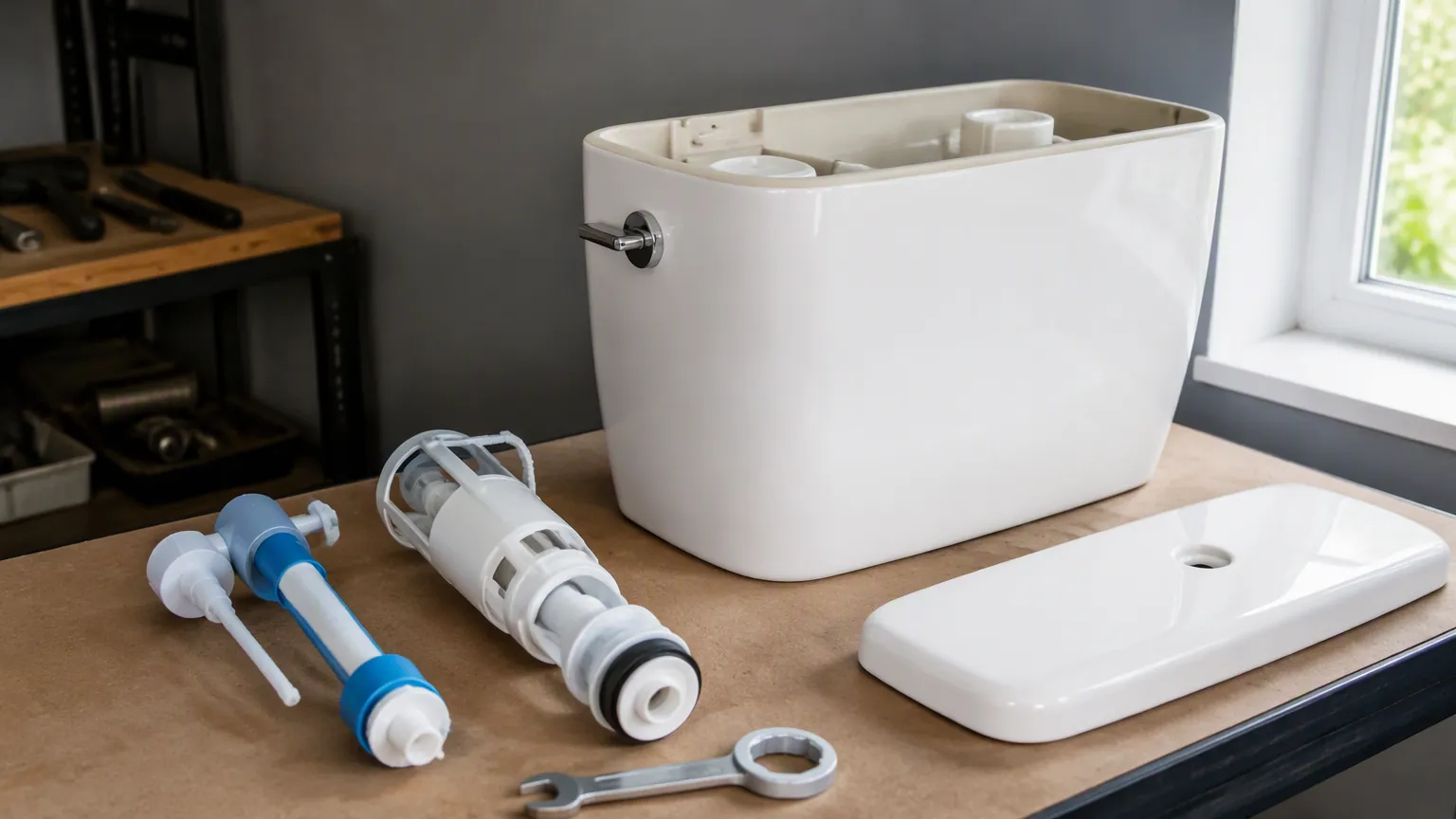
Here is where contractors lose money quietly, five years after handover. Every mechanical part inside a toilet lives in the cistern. Those are the fill valve, the flush valve, the flapper or seal, and the lever or button actuator. These parts fail long before ceramic does, and every one of them sits above the joint.
Ask any maintenance team after year five and the one piece vs two piece toilet answer is obvious. Two-piece toilets use standard cistern internals almost universally. A facilities manager in Dubai orders a generic replacement kit for under USD 15. It fits because tank geometry follows a de facto standard. Even ten years later our CE and cUPC two-piece range keeps those dimensions. Most competing lines share them too. Consequently room downtime is one hour and one visit.
One-piece internals are usually model-specific. Low-profile cisterns need short-body valves, and side actuators use proprietary linkages. The access panel can be narrower than standard. Every four to six years this industry drops a model. When that happens, the owner faces a genuine fork. Either they stock spares now at their own cost, or the matching seat and lid are gone too. Then the whole fixture must go.
That is the brutal arithmetic of the form. A cracked cistern on a two-piece costs one replacement box. A failed valve on a discontinued one-piece can cost the whole fixture. Add reinstallation labour and a room outage on top. So the correct time to think about year five is year zero, at specification. Insist that the supplier commits in writing to ten years’ spare availability, then name the specific internal parts covered. If they will not commit, the model is a consumable, and you should price it as one.
What the Certification File Does Not Cover
Both constructions must meet the same national standards, and buyer teams often over-trust the certificate. In North America and several Gulf markets that means listing to a recognised scheme. IAPMO maintains certification listings that any buyer can check directly by model number. Gulf projects may additionally reference GSO conformity for plumbing fixtures. A one-piece and a two-piece from the same factory typically appear on the same assessment.
What the certificate never covers is transport survival or handling ergonomics. It certifies the ceramic against a hydraulics standard and a material standard. It says nothing about whether your crew can carry the unit through a service lift, and nothing about replacement availability. Those gaps are exactly where project losses accumulate. For that reason the certificate alone should never settle this argument.
Also check what happens when the tested sample differs from the delivered product. Some factories submit their most conventional two-piece to testing, then quote adjacent one-piece models under the same file. That practice is questionable at best. Therefore always match the certificate model number to the model on your quotation line by line. If the numbers do not agree, you have no compliance evidence at all.
Unit Price Is the Smallest Number on the Page
| Line item | Two-piece set | One-piece unit |
|---|---|---|
| Typical FOB unit price | Lower | 15-35% higher |
| Units per 40HQ | 130-160 | 80-100 |
| Freight allocation per unit | Lower | Higher |
| Typical breakage allowance | 0.5-1% | 1.5-3% |
| Install labour per unit | Baseline +15 min | Baseline |
| Movers required | One person per carton | Two persons |
| Cleaning time per room turn | Slightly longer | Shorter |
| Cistern spares availability | Widely standardised | Often model-specific |
| Fit through 800 mm door | Yes | Sometimes |
Read that table as a landed-cost model, not a shopping list. The one piece vs two piece toilet line rarely appears on a quotation anyway. The sticker gap between the two forms looks like maybe USD 18 per unit at the factory gate. After freight allocation and realistic breakage, the same comparison often widens past USD 35 before anything is installed. Over 400 rooms that difference reaches roughly USD 14,000. That exceeds a year of saved housekeeping labour. This is the arithmetic behind our wholesale toilet pricing model. It always surprises buyers who negotiate unit price alone.
Volume buyers should also consider mixing. Nothing in a project requires one answer everywhere. Guest rooms can carry the one-piece form where acoustics and cleaning matter most. Meanwhile back-of-house toilets, staff facilities, and rental units can run two-piece and keep your spares pool standardised. Mixed specs complicate the purchase order slightly, but they frequently beat a single answer on total cost.
Spec Lines That Stop the Common Failures
Add these lines to your specification. Most of the failure modes above will then disappear.
| Spec line | Why it matters |
|---|---|
| State the construction explicitly: close-coupled two-piece or one-piece, never “toilet” alone | Removes catalogue substitution before quote stage |
| State the rough-in: 305 mm or 400 mm, measured to the finished wall | The single most expensive omission on any order |
| State outlet direction and trap type: S-trap with dimension, or P-trap | Prevents the wrong-box scenario entirely |
| Require 10-year spare parts availability in writing, listing named internal parts | Protects the owner after the model is discontinued |
| Require two spare cassettes per 20 units delivered | Removes the maintenance visit problem at handover |
| Require a packing method declaration: corner foam, carton drop test figure | Directly targets the one-piece breakage exposure |
| Require the certificate model number to match the quoted model | Stops borrowed certificate submissions |
| Require the delivered loading quantity per 40HQ in the quotation | Makes freight allocation visible before you commit |
Le rough-in dimension guide covers the second line in detail. Circulate it to whoever marks up the drawings. Rough-in and outlet errors stay the two most common reasons a container cannot be installed. That holds whatever construction you picked.
Also note where this decision interacts with the mounting decision. A one-piece is by definition a floor-mounted unit. Wall-hung and back-to-wall forms sit outside this comparison entirely. Rooms where you want a concealed cistern have already answered this question by another route. Civil drainage adds one more layer. S-trap versus P-trap decides whether the unit can meet the floor outlet at all.
Frequently Asked Questions
Do one-piece toilets flush better than two-piece toilets?
No. Flush performance depends on trapway geometry, jet design, and rim configuration. None of those depend on how the tank attaches. Judge the hydraulics from a MaP-style test report, not from the silhouette.
Why do hotels prefer one-piece toilets even though they cost more to ship?
Because daily operations favour them. A seamless body wipes clean faster, which matters on a six-minute room standard. The heavier ceramic also damps fill-valve noise in bedrooms. Those recurring savings can outweigh the one-time freight penalty.
Which is better for a high-rise apartment tower?
Usually two-piece, for access reasons alone. Split cartons travel through service lifts and standard doors, and one installer can move each part. Always measure the tightest route from kerb to rough-in before specifying either form.
Is a one-piece toilet harder to repair?
Yes, in practice. Cistern internals often use model-specific valves and proprietary linkages. So a discontinued model can leave no repair path. Two-piece units mostly accept generic, widely stocked replacement kits.
Verdict: Which One Piece vs Two Piece Toilet Failure Can You Absorb?
Every construction choice is a bet about which failure you can absorb. A one-piece vs two-piece toilet bet comes down to two different failure shapes. The one-piece bet assumes it survives shipping and handling. Then it pays you daily with faster cleaning and quieter rooms. Yet it risks a dead-end repair path once the model ends. The two-piece bet assumes you accept a seam to clean and a gasket to torque. In exchange it delivers cheap freight, easy access, and generic spares.
For most volume work our recommendation is clear. Specify two-piece as the project default. Freight, breakage, handling, and year-five spares all favour it on landed cost. Then upgrade selectively to one-piece in guest rooms and master bathrooms. Any wall shared with a bedhead also qualifies. That approach captures the operational benefits where they matter. Meanwhile it keeps your spares pool and freight budget standardised.
Whatever you choose, write three things into the order before you release it. Name the construction explicitly, and name the rough-in and outlet together. Then make the supplier commit to ten years of spares. Those three lines prevent almost every expensive outcome in this article. North American builders association resources reinforce the same point from the housing side. Most callbacks trace back to decisions nobody wrote down at specification stage. That habit is worth more than any argument about which form looks better in a render.