
A facilities manager at a hospital in Doha walked our team through her cleaning protocol last spring. At that point, she was weighing a standard pan against a rimless toilet for 90 rooms. Every washroom still received eleven minutes of housekeeping time per day. In fact, most of that time went into the bowl, and most of the bowl time went into one place: under the rim. So her staff scrubbed a surface they could not see, using a brush that reached perhaps two thirds of it. When the hospital replaced 90 pans during a phased refurbishment, the revised specification called for a rimless toilet on every floor. Measured cleaning time per washroom fell to roughly seven minutes. On that site, the labour saving recovered the price difference inside the first year.
That result does not mean rimless wins everywhere. However, a labour camp in Jubail cleans each pan far less often, and a 12% unit price delta across 600 units changes the maths completely. Therefore, this comparison sets both designs side by side. It also names the four differences that surface on a live project, and gives you a test protocol to run before the fixture schedule is signed.
Quick Verdict: Rimless Toilet vs Rimmed at a Glance
| Factor | Rimless pan | Box rim pan |
|---|---|---|
| Bowl top | Open rim, water distributed from a channel | Hollow rim with jet holes underneath |
| Hidden ledge | None | Yes, under the rim |
| Surface wetted per flush | Full bowl wall | Partial, dry patches are common |
| Cleaning time per fixture | Lower, no under-rim scrubbing | Higher |
| Splash behaviour | Depends on distributor aim and pressure | Common at the jet holes |
| Unit price | Typically 8–15% higher, FOB China | Baseline |
| Seat availability | Often model-specific | Widely generic |
| Best fit | Healthcare, hotels, airports, schools | Low-cost housing, tight retrofits |
| Main risk | Wrong seat, wrong pressure window | Under-rim biofilm, higher chemical use |
What the Rim Actually Does Inside the Bowl
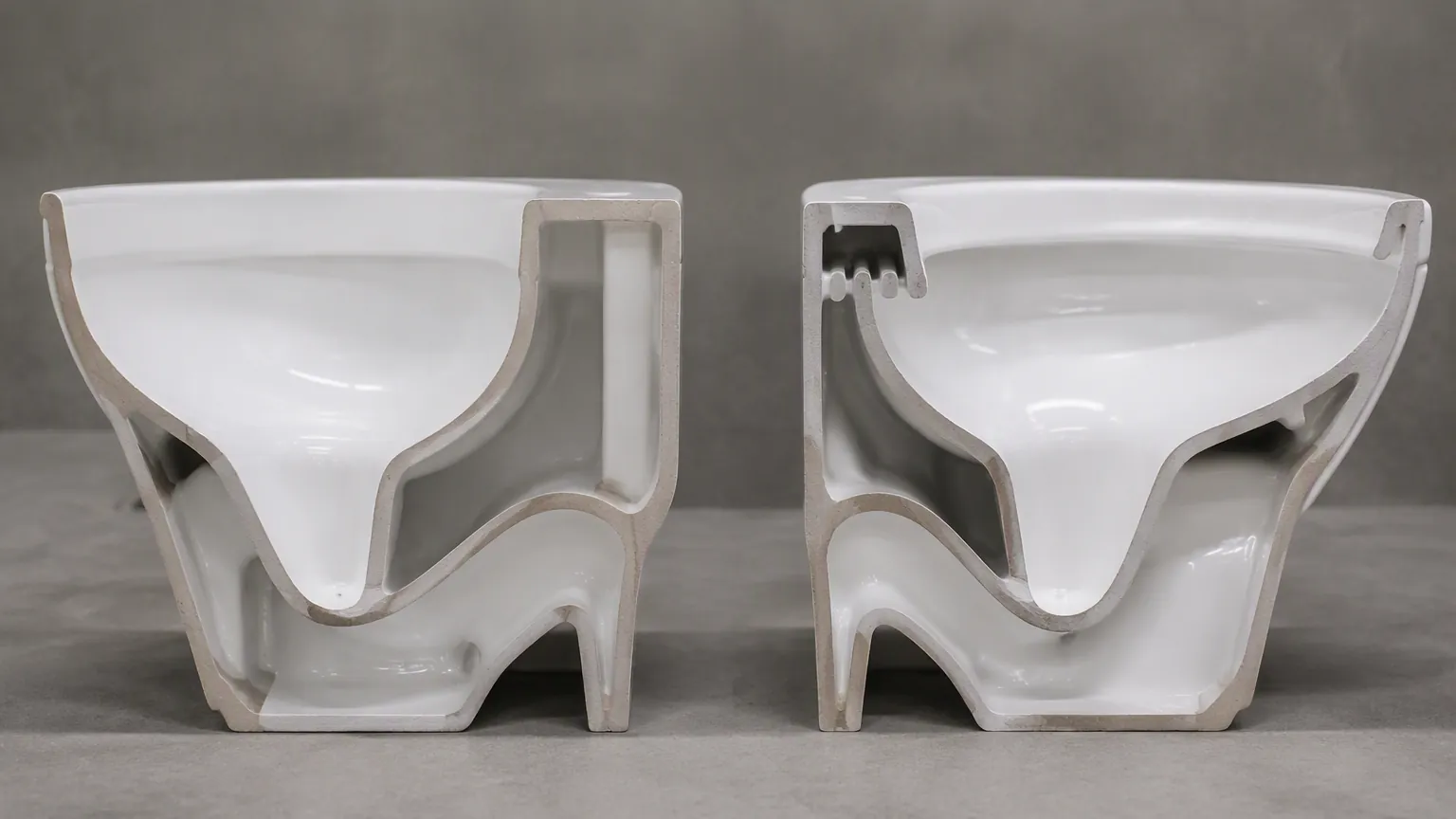
Still, a conventional box rim hides a hollow channel around the top of the pan. Water leaves the cistern, enters that channel, and then exits through a ring of small holes or jets. In short, those holes do two jobs at once. They start the siphon quickly, and they push water down the bowl wall in a spiral. That design solved a real problem for low-pressure gravity cisterns, because the jets concentrate flow where the trap needs it most.
Yet the trade-off sits directly underneath. In addition, a box rim creates a shadowed, permanently damp ledge that no brush fully reaches. So scale, biofilm, and cleaning residue collect there. Consequently, the dirtiest part of the pan is the part the guest never sees and the auditor always finds. For background on how flushing mechanisms developed, see the flush toilet reference.
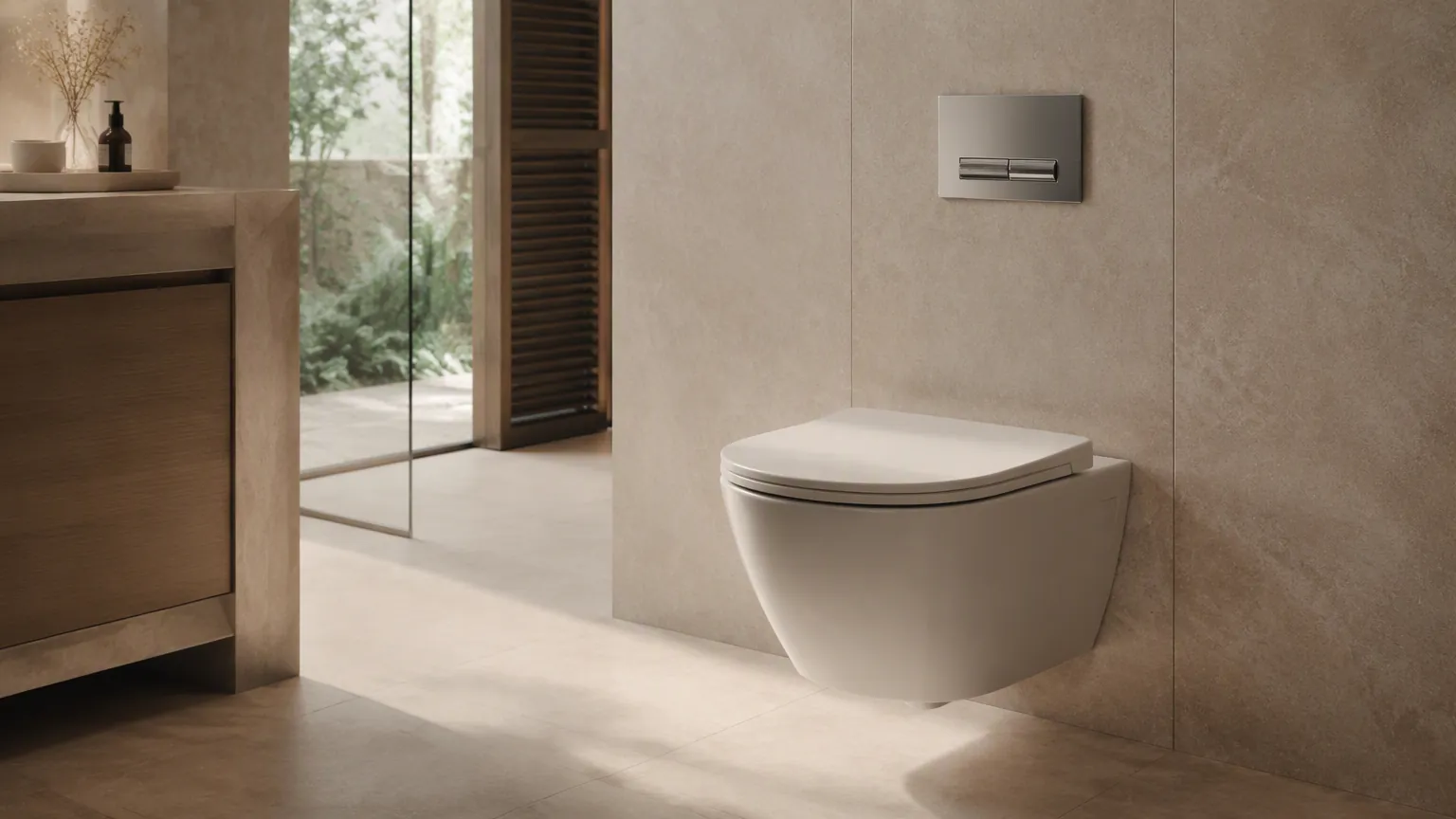
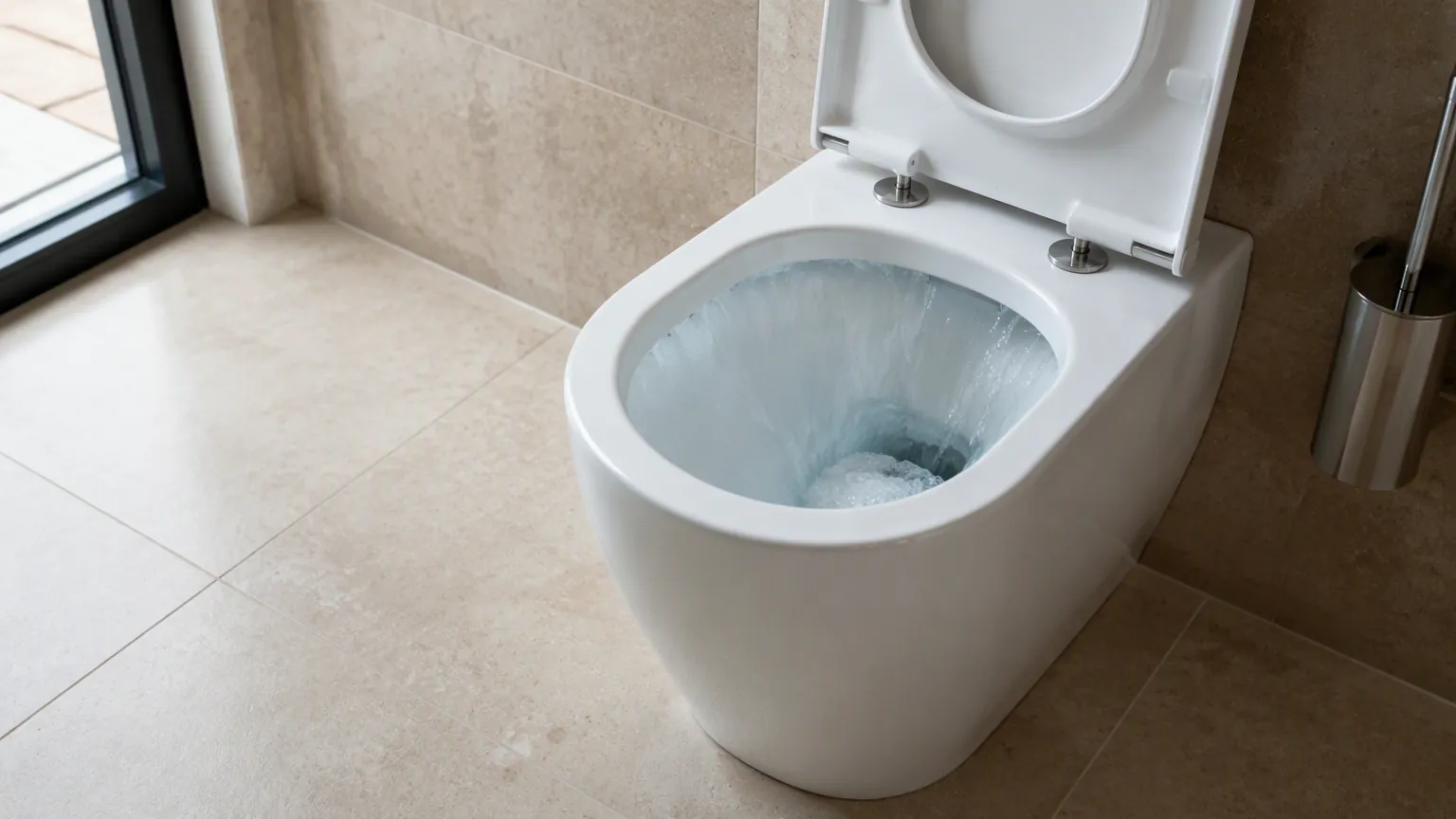
A rimless pan removes the ledge instead. Meanwhile, the top of the bowl stays open. A distributor channel at the back releases a sheet of water, and that sheet travels across the whole visible surface before it drops into the trap. Because nothing is hidden, one wipe covers every square centimetre.
Glaze quality interacts with this choice more than most schedules admit. After all, a weak glaze holds staining on any pan, rimmed or not. Therefore, a rimless pan simply makes that staining visible sooner. So ask for the glaze specification at the same time as the bowl design.
Why it matters: the rim is not decoration. Rather, it is a hydraulic component, and changing it changes flush behaviour, cleaning method, and seat geometry together.
Four Rimless Differences That Show Up on Site
1. Flush coverage and splash
Rimless distributors wet the full bowl wall, so stains are less likely to sit. For instance, box rims frequently leave a dry arc near the back of the pan, and that is exactly where complaints start. However, rimless is not automatically splash-free. If the distributor is poorly aimed, or if supply pressure exceeds the working window, a rimless pan can throw water upward and out. Crews blame the design, yet the real cause is usually a pressure mismatch.
Watch out for: flushometer retrofits. Indeed, a valve delivering above the rated pressure will splash on any rimless model.
2. Cleaning labour and chemical load
First, labour is the largest line item in washroom operations, not chemicals. On high-frequency sites, removing the under-rim scrub typically saves two to four minutes per fixture per day. So over 180 rooms, that becomes a headcount conversation. Chemical use usually falls at the same time, because staff stop dosing a surface they cannot inspect. In practice, most sites see the saving within the first month.
3. Biofilm where a brush never reaches
The under-rim ledge stays damp between cleanings, and damp ceramic grows biofilm. For example, in healthcare and food-handling facilities, that condition draws audit findings. Public guidance treats hard-to-clean surfaces as a priority for exactly this reason (CDC environmental infection control guidance). A rimless pan removes the surface instead of asking staff to clean it better.
4. Cost, spare parts, and replacement risk
A rimless pan also carries an 8–15% premium over the equivalent box rim model. That figure assumes comparable glaze and trap configuration, FOB China, and it moves with order volume. In addition, rimless pans often need a specific seat profile. After all, the seat must meet an open bowl edge cleanly. Generic seats leave a gap, and that gap collects dirt and generates complaints.
Why it matters: the premium is small. Rather, the seat and pressure risks are what generate callbacks.
Where a Rimless Toilet Earns Its Money
A rimless toilet earns its premium in four project types, and each one shares the same condition: somebody cleans the pan often.
Healthcare. Cleaning frequency is high, audits are formal, so infection prevention teams write the specification. Removing an unreachable ledge answers an audit point directly.
Hotels. Guest perception drives reviews, while housekeeping minutes drive payroll. A rimless pan helps both, and it pairs naturally with wall hung pans and concealed cisterns, where the floor area wipes clean in one pass.
Airports, stadiums, and transport hubs. Cleaning windows are short, whereas traffic is relentless. As a result, fewer minutes per fixture means more fixtures covered per shift.
Schools and staff accommodation with centralised housekeeping. Whenever one team cleans many pans on a fixed schedule, minutes per fixture compound quickly. As a result, the premium returns faster than the budget review expects.
Where the Box Rim Still Beats a Rimless Toilet
A rimless toilet is not a default. Four situations still favour a box rim.
First-cost-dominated projects. For instance, on worker housing or site accommodation, cleaning frequency is low. Then the unit price, multiplied by hundreds of units, dominates the decision. Spend the delta on a better trap or a stronger seat instead.
High-pressure flushometer retrofits. Some existing valves deliver pressure outside the window a rimless distributor was designed for. If you cannot regulate it, splashing will follow. Meanwhile, the box rim will behave better.
Markets with thin rimless stock. In fact, in some destinations, only box rim pans sit on local shelves. Consequently, a rimless pan damaged during handover can mean a six to eight week wait. Ask what is stocked locally before you commit.
Projects relying on generic seats. If the maintenance team expects to buy cheap seats locally, model-specific seat geometry becomes a recurring nuisance.
Rimless Toilet Flush Performance: Test It, Do Not Assume It
Never accept a rimless toilet on the drawing alone. Run three checks before approval.
Ask for a documented flush test. For instance, a credible supplier can show solid-media and paper results for the exact model, not a family average. Where the destination market recognises a maximum performance rating scheme, ask for that number in writing.
Confirm the working pressure window. Cistern-fed pans typically operate across a broad band, while direct flush valves need a tighter one. Then measure the actual static pressure on the floor you are specifying. In practice, that single measurement prevents most splash complaints.
Check the interaction with flush type. Rim or no rim, the trap design still decides whether a pan clears. So pair your decision with the flush mechanism rather than treating them separately. Our siphonic vs wash-down comparison covers that half of the problem.
Also confirm water consumption against the destination requirement. In North America, WaterSense labelled products must meet a maximum of 4.8 litres per flush (EPA WaterSense). European and GCC projects frequently run 3/6 litre dual flush, and Australian projects look for WaterMark compliance.
Specifying a Rimless Toilet: The Checklist
Next, copy this list into the fixture schedule review.
- Confirm the pan has no rear ledge; some “rimless” models retain a small one.
- Record the working pressure window, then measure site static pressure.
- Match the seat to the exact pan model, and order spare seats with the pans.
- Verify rough-in and outlet type before ordering, using the porcelain toilet rough-in guide.
- Next, request flush test documentation for the specific model.
- Confirm glaze quality, and ask what stain resistance testing supports it. A ceramic bowl guide covers the questions worth asking.
- Also, check certification for the destination market, for the exact model.
- In addition, ask what the local distributor stocks for replacement.
- Standardise one pan model per building, so seats and cleaning routines stay uniform.
- Inspect one installed unit with water before the bulk order ships.
Rimless Toilet or Not: Decide It With the Rest of the Schedule
The rim decision looks isolated on a schedule. In practice, it moves four other choices.
First, it moves the flush mechanism. A rimless pan needs a distributor that matches the supply, so the valve or cistern must be settled early. Second, it moves the frame. Wall hung rimless pans fix the frame height and the outlet dimension, so these numbers must appear on the drawings together. Third, it moves the seat contract. Because seats are model-specific, they belong in the same purchase order as the pans, not in a later sundries order. Fourth, it moves the cleaning method. Housekeeping teams should write the new routine before handover, not after the first guest complaint.
Therefore, put the plumbing consultant, the purchasing lead, and the housekeeping manager in one meeting. That meeting usually takes thirty minutes. It also prevents the most expensive version of this mistake, which is discovering the mismatch after tiling.
Project Example: 180 Rooms, One Fixture Schedule
A four-star business hotel outside Riyadh refurbished 180 rooms in four phases over 14 months. Still, the existing box rim pans generated two recurring complaints. Guests reported staining under the rim, and housekeeping ran overtime on every floor.
So the consultant switched the schedule to rimless wall hung pans with concealed cisterns. Three decisions made it work. The team measured static pressure on a typical floor first, and then regulated it. They also ordered 12 spare seats with the initial shipment. They also standardised one seat model across all phases, so later top-ups matched.
In fact, results recorded at handover: cleaning time per room dropped by about 3.5 minutes, chemical spend fell roughly 18%, and blockage call-outs did not increase. Two pans were damaged during the final phase, but both were replaced from the spare allocation within a week. Notably, cleaning time returned to previous levels on the two floors still running box rim pans. That difference confirmed the comparison on the same site.
Common Mistakes With Rimless Toilet Orders
- Assuming every rimless pan is identical. Some retain a small rear ledge. Check the drawing, and then check the sample.
- Ordering pans without spare seats. Seats are the part that gets damaged during handover, not the ceramic.
- Mixing rimmed and rimless in one building. Housekeeping then runs two routines, and stores two seat types.
- Ignoring the pressure window on retrofit valves. This is the most common cause of splash complaints.
- Forgetting the rough-in. A rimless wall hung pan still needs correct frame height and outlet dimension. See our wall mounted pan range for typical configurations.
Cost, Lead Time, and What to Ask For
Budget-wise, a rimless toilet carries the 8–15% premium described above. That assumes FOB China and MOQ 100–500 units per model. However, small orders under 100 units commonly add 15–30% per unit across the board. After that, lead time is typically 25–45 days, depending on glaze, seat specification, and whether certification testing must be repeated for the destination market.
When you request a quotation, ask for four things. Specifically, get the pressure window, the seat model number, the flush test document, and the certification number for the exact SKU. Suppliers who answer all four quickly usually deliver on time. Moreover, ask for the packing list per container, because seat cartons are frequently quoted separately and forgotten.
Certification by Destination Market
- European Union: CE marking, with WC pans assessed to the relevant EN standard.
- Saudi Arabia: SASO conformity for the exact model, plus the applicable water efficiency labelling.
- UAE: conformity assessment under the Emirates system for the imported model.
- Australia: WaterMark certification to the national plumbing code.
- North America: cUPC listing to the ASME A112.19.2 / CSA B45.1 family of requirements (IAPMO), with WaterSense listing where a claim is made.
Why it matters: certification attaches to a model, not to a factory. So a rimless pan and a box rim pan from the same line need separate listings.
FAQ
Is a rimless toilet more hygienic than a rimmed one?
It removes the surface where biofilm usually grows. Therefore audits and guest inspections find less, provided the cleaning team keeps the same schedule.
Does a rimless toilet use less water?
Not automatically. Instead, water use depends on the flush mechanism and the trap design, not on the rim. Check the flush volume figure instead.
Do rimless pans splash more?
They can, when supply pressure sits above the design window. Measure static pressure on site, and regulate it before blaming the pan.
Can I retrofit a rimless pan onto an existing flush valve?
Only if the valve pressure falls inside the pan’s rated window. For direct flush valves, treat this as the first check rather than the last one.
Are rimless toilet seats interchangeable?
Usually not. The seat must meet an open bowl edge, so expect a model-specific part. Order spares with the pans.
Why do some rimless pans still have a small ledge?
In short, manufacturing tolerance and distributor design vary between factories. A small rear ledge reduces the cleaning advantage, so inspect a sample.
Is rimless worth the premium on a housing project?
Rarely. After all, low cleaning frequency means the labour saving never accumulates. Spend the difference on durability instead.
If you are building a fixture schedule for a hotel, hospital, or housing project in the GCC, send us the room count, the destination market, and the static pressure you measured on site. Our team will return a model-by-model recommendation, with certification and seat availability confirmed, so the decision closes before tiling starts. Reach us at /contact-us/.
Literaturverzeichnis
- Wikipedia. (2026). *Flush toilet*. Retrieved from https://en.wikipedia.org/wiki/Flush_toilet
- U.S. Environmental Protection Agency. (2026). *WaterSense labelled products*. Retrieved from https://www.epa.gov/watersense/products
- Centers for Disease Control and Prevention. (2026). *Guidelines for environmental infection control in health-care facilities*. Retrieved from https://www.cdc.gov/infectioncontrol/guidelines/environmental/index.html
- IAPMO. (2026). *Plumbing and mechanical product certification*. Retrieved from https://www.iapmo.org/