
A procurement manager in Mumbai sent our team a one-line enquiry last winter. It read: commode toilet, 600 pieces, white, best price. Three weeks later a container landed at Nhava Sheva and nobody could install a single unit. The drawing called for a two-piece P-trap pan with a 180 mm outlet. Every soil stack in that building ran inside the wall. The container held one-piece S-trap pans at 250 mm. Then the second problem surfaced. Of the 600 units, 120 were never meant to be seat toilets at all. The client wanted squat pans in the staff block, and one vague word had quietly erased that distinction. Nobody lied on that enquiry. Everybody used a term that meant something different on each side of the exchange.
What a Commode Toilet Means Depends on the Passport
Start with the dictionary, because the trade meaning and the everyday meaning have drifted apart. Merriam-Webster lists four senses for commode, and only one of them is a toilet. The others cover a low cabinet, a washstand, and a chair that hides a chamber pot. That last sense still drives purchasing in hospitals and care homes. So a North American buyer who reads commode may picture a bedside aid, not a ceramic pan.
Now cross into South Asian buying language. In India, Pakistan, and Bangladesh a commode toilet simply means a seat toilet. Traders use it as the opposite of an Indian-style squat pan. Showrooms split their stock along exactly that line. Gulf buyers borrow the same habit from their South Asian supply chains, then mix it with British drawing language. Meanwhile European and North American specifications almost never write commode. They write WC, water closet, or pan.
Therefore one word carries at least three product categories and one piece of medical furniture. Your factory will translate it into whatever its own market sells most. That translation happens silently, before you ever see a quotation.
A Commode Toilet, a Western Toilet, and a WC Often Describe One Fixture
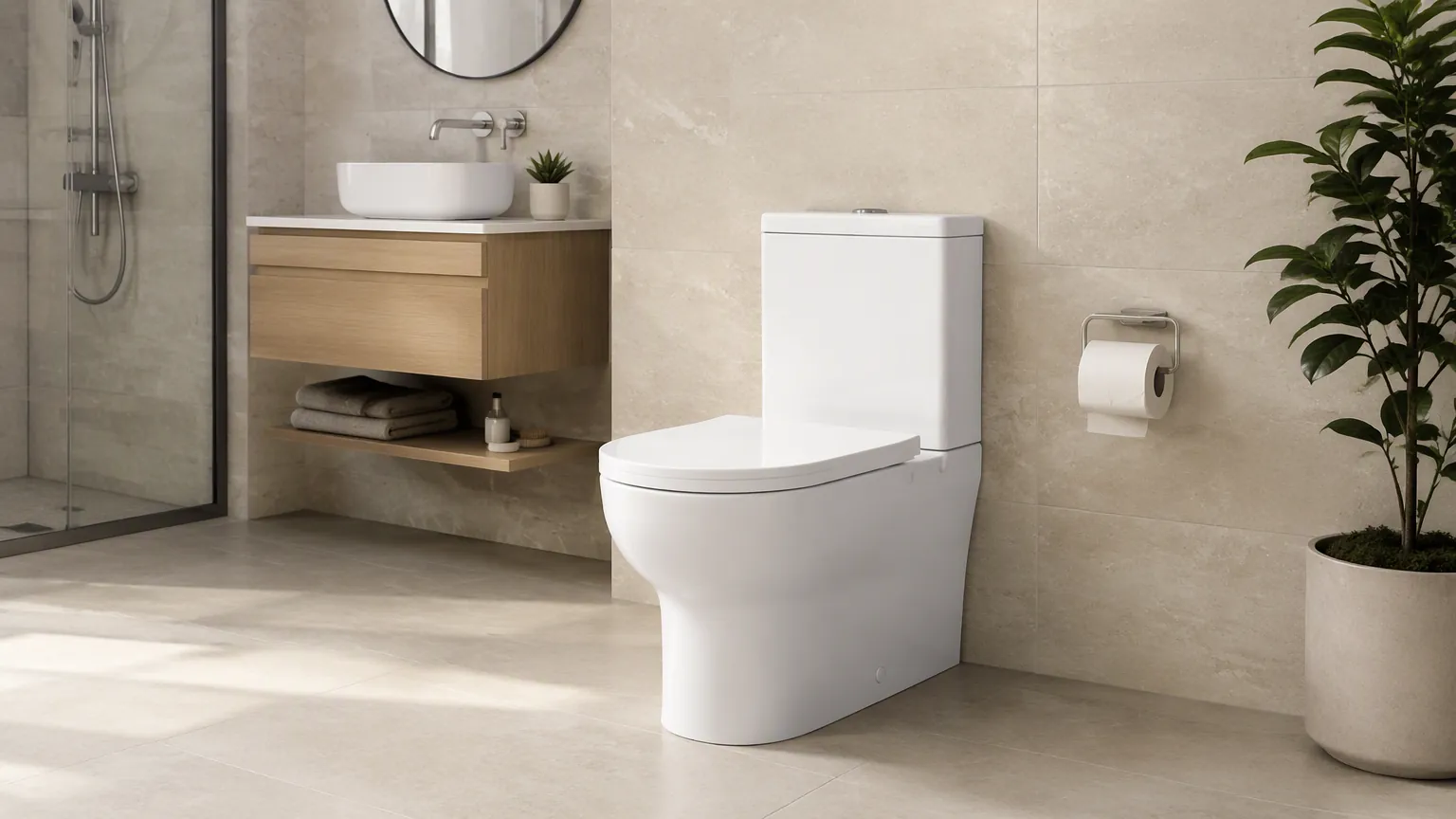
Here is the part most buyers miss. In perhaps eight cases out of ten, these three names point at one object. That object is a vitreous china seat toilet with a cistern, a seat, and a floor or wall outlet. The names differ by speaker, not by product.
| Term | Who uses it | What it usually means | Risk when you read it alone |
|---|---|---|---|
| Commode | South Asia, Gulf trading desks | A seat toilet, as opposed to a squat pan | May arrive as a bedside commode chair in Western care channels |
| Western toilet | South Asia, Southeast Asia, Africa | Seat toilet, explicitly not squat | Says nothing about outlet, trap, or mounting |
| Water closet / WC | Drawings, British and Gulf specs | The fixture and often the room | Covers wall-hung, floor-mounted, and back-to-wall alike |
| Pan | Trade and plumbing slang | The ceramic body only | Excludes cistern, seat, and fittings |
| Squat pan / Indian pan | South Asia, parts of the Gulf | A floor-level fixture used in a squatting posture | Requires a recessed or raised platform detail |
The Britannica entry on the water closet traces WC back to the enclosed room rather than the ceramic itself. That history explains a common collision. A drawing can call a whole bathroom a WC, while a purchase order uses the same letters for one pan. Consequently the abbreviation tells you nothing about mounting, trap direction, or rough-in.
The Only Distinction That Changes the Drawing: Seat or Squat
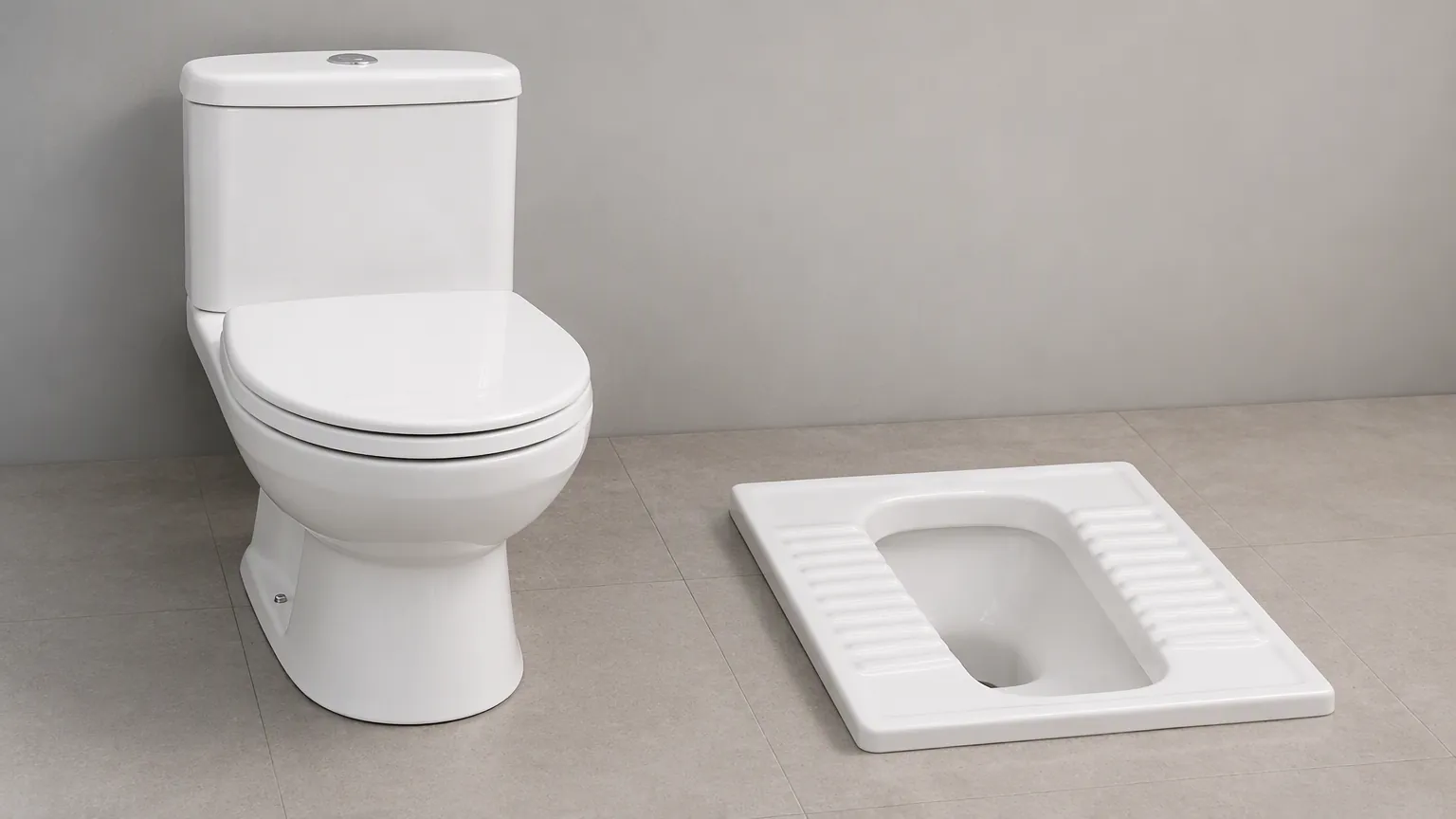
Strip the naming away and one decision actually reshapes the room. A seat toilet puts the user at roughly 400 mm above finished floor level. A squat pan sits in or on the floor. So the drainage, the floor build-up, and the user posture all change together.
The practical consequences run further than most schedules admit. A squat pan needs either a recess in the slab or a raised platform. That detail must reach the structural drawing early. A seat toilet needs clear space beside its centreline and in front of it. Cleaning protocols differ, because a squat pan gets hosed down while a seat pan gets wiped. User expectation differs too, and it varies by building. Staff accommodation, schools, and transport hubs in several markets still expect squat pans in public blocks. Guest rooms and private apartments expect seat toilets. The reference description of squat fixtures covers that posture and its plumbing implications in detail.
So ask the question that matters. Not what shall we call it, but who uses this room and what posture do they expect.
Where a Commode Toilet Quote Goes Wrong
A commode toilet quotation that carries no outlet dimension is not a quotation. It is an invitation to guess. Four failure modes repeat on projects that rely on trade nicknames.
The factory answers from its own catalogue. A supplier reads commode, checks its best-selling line, and prices that. Your project may need a back-to-wall unit with a concealed cistern. The price you compare then sits in a different product family entirely.
The trap direction gets assumed. S-trap discharges through the floor, and P-trap discharges through the wall. Most factories default to whichever dominates their export region. That default explains why our Mumbai shipment arrived with 250 mm S-trap pans. If your rough-in and outlet geometry are missing from the enquiry, nobody can catch the mismatch before production. Our own comparison of S-trap and P-trap drain types lays out the measurement sequence.
The rough-in gets rounded. A 300 mm rough-in and a 400 mm rough-in look identical on a price list. Against a finished wall they behave very differently. That single number decides whether the cistern sits flush or stands proud of the tiles.
The paperwork stops matching the goods. Invoice descriptions built on a nickname invite questions at customs. Officers compare the declared description against the goods, against the certificate, and against the model code on the carton. When those three disagree, containers wait, and demurrage accrues daily.
How a Commode Toilet Spec Should Read Instead
Write the fixture as a parameter set. Then, if you like, put the local nickname in brackets for your own team. The parameters do the work. A complete line reads roughly like this. Floor-mounted two-piece, P-trap 180 mm outlet, siphonic, dual flush 3/6 L, vitreous china, soft-close UF seat, SASO certified, white.
Every word in that line removes an assumption. Mounting settles whether the floor or the wall carries load. Trap direction and outlet size settle the drainage interface. Flush type settles noise and trapway geometry. Flush volume settles the water submission. Material settles durability and cleaning. Certification settles whether the shipment clears.
Where your project sits in a market with strict product conformity, that last parameter deserves its own line. Saudi projects, for instance, run product conformity against SASO requirements before shipment. North American and several Gulf specifications instead lean on IAPMO listings. IAPMO publishes the certification scope that buyers can check directly. European buyers ask for CE documentation, and Australian projects ask for a WaterMark licence. Our breakdown of CE and cUPC evidence for importers shows what a credible certificate file looks like.
Also state the rough-in explicitly. Our porcelain toilet dimensions and rough-in guide gives the measurement points that installers actually use on site.
Flush Performance Sits Outside the Naming Question
Buyers often treat the word commode as though it carried a performance class. It does not. A seat toilet can use a wash-down action or a siphonic action, and the two behave differently in service. Wash-down relies on the momentum of water leaving the rim, so it clears fast and runs louder. Siphonic pulls the bowl contents through a trapway, so it runs quieter and needs a larger water seal. Hotels usually prefer the quieter option for guest floors. Schools and transit buildings often accept the louder option for its simpler trapway. Our siphonic versus wash-down comparison covers the trade-off in depth.
Water volume is a separate axis again. In the United States the EPA WaterSense product programme sets a maximum flush volume for labelled toilets. Many green rating systems worldwide borrow that figure. Gulf green building regulations set their own fixture budgets. So a project in Dubai or Abu Dhabi can demand a different number from a project in Riyadh. Therefore never let a nickname carry the water story. State the flush volume in litres, state the test standard, and attach the test report.
Material Language Adds a Second Layer of Confusion
Terminology confusion does not stop at the product name. Ceramic, porcelain, and vitreous china get used interchangeably on quotations, and the differences matter for a commercial specification. Vitreous china describes a body fired to a low absorption rate. That rate drives staining, crazing, and long-term odour. Porcelain and ceramic describe families rather than grades. So a supplier can use any of the three words honestly while delivering quite different bodies.
Ask for the absorption figure and the standard behind it, not the adjective. Then hold the approved sample against the shipment. Our porcelain versus ceramic comparison walks through the numbers worth requesting.
Verify Every Commode Toilet Shipment Before It Leaves the Factory
Verification takes twenty minutes per model and prevents most of the disputes that follow. Run it in this order.
- Measure the outlet centre against the approved drawing, and photograph the tape in place.
- Dry-fit the seat and lid, then check that the hinge covers sit flush with the pan.
- Run three flushes with the supplied fittings and watch the refill valve reseat.
- Inspect the glaze under a raking light, and mark any pinhole or orange-peel area.
- Weigh one packed carton and confirm it matches the packing declaration.
- Read the carton print against the invoice description and the certificate model code.
That last step catches the paperwork failure, which is the one that costs calendar time rather than money. A mismatch found in the factory takes an afternoon to fix. The same mismatch found at the port takes weeks.
Regional Buyer’s Map: Which Word Opens Which Door
Use the local term to be understood, then confirm in parameters. The table below reflects how our own enquiries arrive.
| Market | Common term on the enquiry | What to confirm immediately |
|---|---|---|
| India, Pakistan, Bangladesh | Commode, western toilet, Indian pan | Seat versus squat, then trap direction |
| Saudi Arabia | WC, western toilet | SASO conformity model code, flush volume |
| UAE, Qatar, Kuwait | WC, wall-hung WC | Mounting method, concealed cistern framing |
| Southeast Asia | Water closet, closet | Rough-in and outlet size |
| Europe | WC, pan | CE documentation, flush volume |
| North America | Toilet, water closet | cUPC listing, 1.28 gpf or lower |
| Africa | Commode, WC | Trap direction, packaging for long haulage |
Gulf projects deserve one extra note. Much of the region’s specification culture arrives through South Asian and British practice. So commode, WC, and western toilet can appear on the same drawing set. Our Saudi Arabia procurement guide maps the certification and documentation path for that market.
What a Commode Toilet Order Looks Like Two Years Later
Naming mistakes surface at handover. Real cost shows up in year two. By then the seats have taken the load, the flush valves have cycled a few thousand times, and somebody has asked for spares.
Seats and lids fail first. A soft-close hinge loses its damping long before the ceramic cracks, and a broken lid puts a unit out of service as surely as a broken pan. So order spares with the shipment rather than after it. Two to three percent of seat and lid volume covers most multi-year projects, and adding them to the original container costs almost nothing in freight.
Then the model leaves production. Factories refresh moulds every few years, and a commode toilet bought without a spares commitment can become an orphan overnight. Ask the supplier to state how long the seat mould will stay available, and get that in writing. In our experience the honest answer runs between three and seven years.
Colour drift is the quiet version of the same problem. White is not one colour. A replacement pan from a later batch can sit beside the originals and read slightly cooler, and a hotel corridor shows that difference immediately. Therefore keep a sealed reference panel for the life of the project.
Mixing seat and squat fixtures doubles the spare problem. Each variant adds a stock line, so a project carrying both types should plan two spare lines from the first order.
Packing, Breakage, and the Replacement Clause
A commode toilet order that ships without a packing clause has already accepted the breakage risk. Ceramic travels badly when packing is cheap. A carton that survives a port transfer can still fail on the last leg, particularly on long overland hauls into African and Central Asian markets.
Specify the packing instead of accepting it. Ask for the carton grade, the internal protection method, and whether pallets or wooden crates carry the load. Then ask what happens when units arrive broken, and read the answer slowly. A clause allowing claims within seven days of arrival, supported by photographs of the carton and the unit, is workable. A clause demanding the broken goods back before any replacement is not.
Agree the replacement route before the first container ships. Most factories credit the value against the next order, which suits repeat projects and fails one-off jobs. Ask instead for immediate replacement on the following shipment where the volume justifies it.
Frequently Asked Questions
Is a commode the same as a western toilet?
In South Asian and Gulf trade usage, yes. Both terms describe a seat toilet. Neither term specifies the outlet direction, the mounting method, or the rough-in. Both remain incomplete on a purchase order.
Why do Western suppliers sometimes quote a chair?
Because commode retains its furniture and care-equipment senses. Those senses survive in English outside the trade. A supplier outside South Asia or the Gulf has no reason to assume you mean a ceramic pan.
Should the drawings say WC or water closet?
Either works, provided the schedule carries the parameters. Drawings use WC as a room and fixture label, and the specification schedule carries the product definition.
Does the naming affect the HS classification?
Classification follows the product and its material, not the trade nickname. Still, customs officers read the invoice description first, so align that description with the goods and the certificate.
Contractor’s Checklist Before You Order
- State mounting type, structure, trap direction, and outlet size in one line.
- State rough-in in millimetres, measured to the finished wall.
- State flush type, flush volume, and the test standard behind them.
- State the body material, the absorption figure, and the standard.
- Name every required certification, and attach the certificate number to the model code.
- Confirm seat and lid material, hinge type, and soft-close function.
- Agree the packing standard and the breakage replacement clause.
- Approve a sealed sample and reference it on the purchase order.
The Verdict
Commode, western toilet, and WC are social words. They help you be understood in a market, and they carry almost no engineering content. A project that orders on those words alone transfers the definition to whoever reads the enquiry first. That party will always choose from its own catalogue.
Write the parameters instead. One line of mounting, trap, outlet, rough-in, flush volume, material, and certification removes every guess in this article. Use the local word afterwards if it makes the meeting easier. Keep the parameters on the purchase order, where the money is.