
A kitchen faucet does more than turn water on and off. It shapes how your sink area looks, how comfortably you prep meals, and how smoothly everyday cleanup feels. The right choice balances style, finish, function, sink size, and faucet installation requirements so your kitchen looks cohesive and works the way you actually live.
What makes a kitchen faucet style “perfect” for your space?
The perfect kitchen faucet style is the one that fits your sink, matches your kitchen’s design language, and supports your daily habits without creating maintenance or installation headaches. A beautiful faucet can still feel wrong if it splashes, blocks a window, clashes with cabinet hardware, or lacks the reach you need. Start with how you use the sink, then choose the shape, handle type, finish, and features that make those tasks easier.
Think of the faucet as one of the most-used tools in the room. It should feel intuitive when your hands are messy, tall enough for pots, proportionate to the sink, and visually connected to the rest of the space. When form and function line up, the kitchen sink faucet becomes a design detail you notice for the right reasons.
Faucet styles set the tone for the whole sink area
Kitchen faucet designs usually fall into a few broad style families. You do not need to follow them rigidly, but they can help you narrow the field before you get lost in finishes and features.
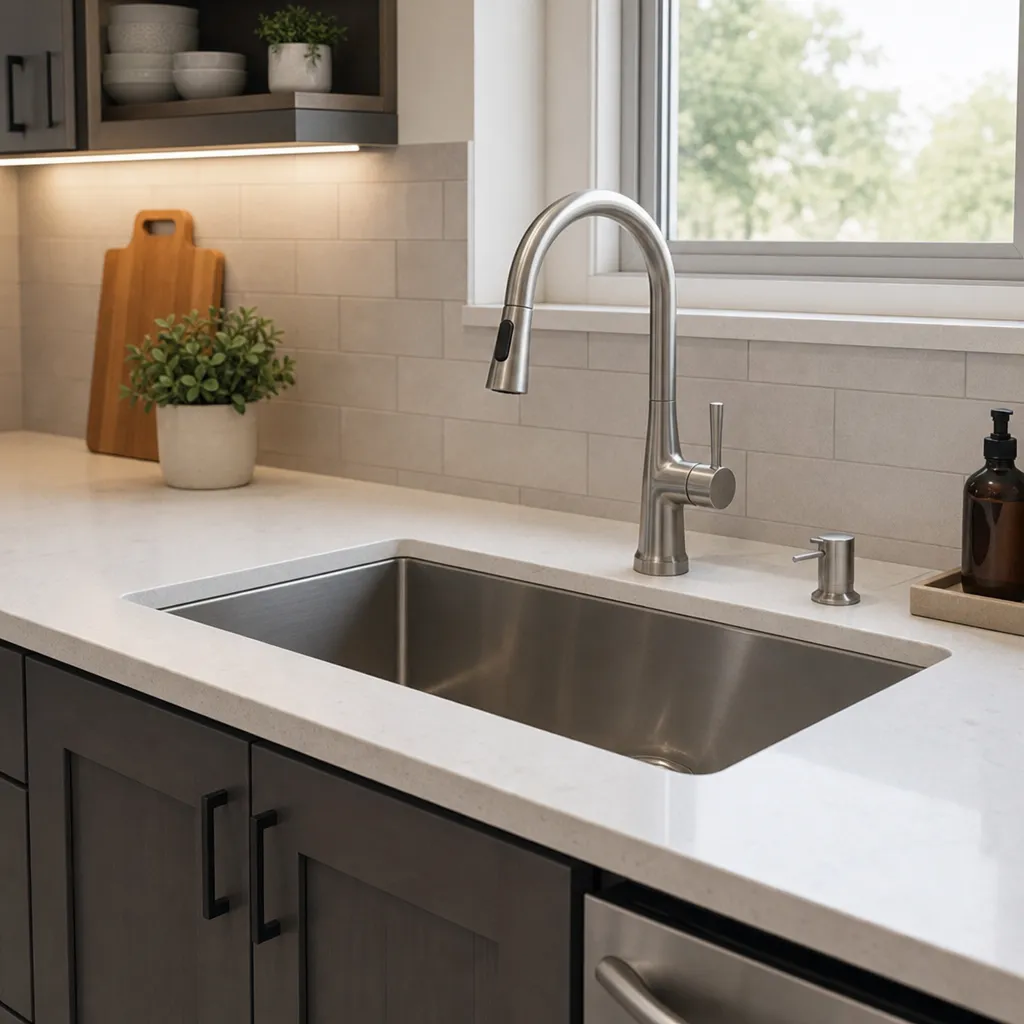
A modern faucet often has clean lines, a simple arch, and minimal detailing. It works well with flat-panel cabinets, quartz or stone counters, and uncluttered spaces. A black kitchen faucet, brushed steel faucet, or sleek single handle kitchen faucet can feel especially natural in this setting.
A transitional faucet blends traditional and modern details. It may have a softer curve, a familiar silhouette, and a finish that pairs well with many cabinet and hardware choices. This is a practical option if your kitchen includes both classic and updated elements.
A traditional faucet usually has more decorative shaping, rounded handles, or bridge-style details. It can look beautiful in warm, layered kitchens with natural wood, apron-front sinks, stone counters, or vintage-inspired lighting.
An industrial or professional-style faucet tends to be taller and bolder, sometimes with a spring coil or exposed pull-down head. It can make a strong statement, but it should be scaled carefully. In a small kitchen, an oversized fixture may dominate the sink area instead of enhancing it.
Match the faucet to your sink and countertop
Before choosing a finish or silhouette, confirm the practical fit. A faucet that looks great online may not work with your existing sink configuration, backsplash clearance, or countertop holes.
Start by checking how many mounting holes your sink or countertop has. Some faucets need one hole, while others may need separate holes for handles, sprayers, soap dispensers, or accessories. If you are replacing an existing kitchen sink faucet, this detail can quickly narrow your options.
Also look at the faucet height and spout reach. A tall arc is helpful for filling large pots, but it can splash more in a shallow sink. A shorter faucet may look balanced in a compact kitchen but feel limiting if you wash baking sheets, stockpots, or oversized bowls. Spout reach matters too: the water stream should land comfortably inside the basin, not too close to the back wall and not so far forward that it splashes toward you.
Use this quick pre-shopping checklist:
- Count the number of holes in your sink or countertop.
- Measure the distance from the faucet locati0n to the backsplash or window ledge.
- Note the sink depth and basin width.
- Decide whether you need a pull-down, pull-out, side sprayer, or simple fixed spout.
- Check whether your cabinet space below the sink allows room for hoses and connections.
- Consider who uses the kitchen most and whether handle reach or motion control would matter.
These small checks can prevent returns, awkward adjustments, and avoidable faucet installation surprises.
Handle choice affects comfort and control
Handle style is not only a design decision. It changes how you control water temperature and flow, especially when your hands are full, wet, or dirty.
A single handle kitchen faucet is popular because it keeps the deck area simple and allows one-handed control. You can adjust flow and temperature with one lever, which is convenient during cooking. This style also works well for smaller sinks or minimalist kitchens because it reduces visual clutter.
A two-handle faucet gives separate hot and cold control. Some people prefer the symmetry and traditional look, especially in classic kitchens. It can also provide precise temperature blending, though it usually requires more hand movement than a single-lever design.
A touch or motion-activated faucet can be useful if you often handle raw ingredients, dough, or messy prep work. It may reduce the need to touch the handle repeatedly, but it can involve batteries, sensors, or extra components. If simplicity and easy troubleshooting are priorities, a manual faucet may be more appealing.
When possible, test the handle movement in person. The best kitchen faucets feel smooth, stable, and natural to operate. A handle that looks elegant but feels stiff or awkward will become frustrating over time.
How should you choose a faucet finish?
Choose a faucet finish by balancing your kitchen’s color palette, cabinet hardware, sink material, lighting, and maintenance preferences. The finish should either coordinate with nearby metal tones or create an intentional contrast. It should also fit your tolerance for fingerprints, water spots, patina, and cleaning frequency.
A stainless or brushed nickel finish is versatile, familiar, and easy to pair with many appliances. It tends to blend in rather than become the visual centerpiece. If your kitchen already has stainless appliances and cool-toned hardware, this choice often feels seamless.
A black kitchen faucet creates contrast and definition. It can look crisp against white counters, warm wood, stone, or light tile. Black finishes are especially effective when repeated elsewhere, such as in cabinet pulls, lighting, window frames, or bar stools. Without that repetition, the faucet may look isolated.
A brass faucet for kitchen designs can add warmth and character. Brass pairs beautifully with natural textures, creamy neutrals, green cabinetry, navy cabinets, or marble-inspired surfaces. Depending on the finish, it may look polished and refined or aged and relaxed. If you choose brass, pay attention to undertones because not all brass finishes match each other.
Chrome remains a bright, classic option. It reflects light well and can make a sink area feel clean and sharp, though it may show water spots more readily than brushed finishes. Oil-rubbed bronze or darker warm finishes can suit rustic, traditional, or old-world kitchens, but they should connect to other design elements so they feel intentional.
Proportion matters more than trend
It is tempting to choose a faucet based on what is trending, but proportion usually has a bigger impact on whether the result looks right. A faucet should feel appropriately scaled to the sink, counter, and surrounding cabinetry.
For a large farmhouse sink or wide undermount basin, a taller faucet with a generous arc can look balanced and provide useful clearance. For a compact bar sink, prep sink, or apartment kitchen, a lower-profile faucet may be more practical. If your sink sits under a window, measure carefully so the faucet does not interfere with trim, blinds, or the ability to open the window.
The same principle applies to visual weight. A slim faucet can disappear in a large kitchen with heavy stone counters and oversized pendants. A chunky professional faucet can overwhelm a narrow galley kitchen. Instead of asking only, “Is this stylish?” ask, “Does this faucet look like it belongs with everything around it?”
Features should solve real kitchen problems
Extra features are most valuable when they support how you cook and clean. If a feature sounds impressive but does not match your habits, it may add complexity without adding much benefit.
A pull-down sprayer is useful for deep sinks, rinsing produce, washing large cookware, and cleaning the basin. It is often paired with high-arc faucets and is a common choice in busy kitchens. A pull-out sprayer can work well with smaller sinks because the hose pulls toward you, sometimes with a lower faucet profile.
A spray and stream toggle is handy if you switch between filling pots and rinsing dishes. A strong spray pattern helps remove food residue, while a steady stream is better for filling glasses, pitchers, and pans. Some faucets also include pause buttons, which can help when moving the sprayer between areas of the sink.
Consider these practical feature questions before buying:
- Do you wash large pots, sheet pans, or cutting boards often?
- Do you need a sprayer that reaches every corner of the sink?
- Would a high-arc faucet cause splashing in your basin?
- Do you want the simplest possible faucet installation and maintenance?
- Will children, guests, or older adults use the faucet regularly?
- Are you comfortable with batteries or sensors if choosing touchless operation?
The best choice is not always the faucet with the longest feature list. It is the faucet whose features reduce friction in your daily routine.
Faucet installation can influence the style you choose
Faucet installation should be considered before you commit to a style, especially if you are replacing an existing fixture. The number of holes, supply line compatibility, counter thickness, and under-sink access can all affect what will work.
If your current sink has extra holes, you may be able to use a deck plate to cover them when installing a single-hole faucet. This can be a clean solution, though some homeowners prefer the look of a faucet mounted directly without a plate. If you have too few holes for the faucet you want, installation may become more involved, particularly with stone countertops.
Under-sink space also matters. Pull-down and pull-out faucets need room for the hose and weight to move freely. If storage bins, plumbing, or disposal equipment crowd the cabinet, the sprayer may not retract smoothly. Planning around these details helps protect both the faucet’s appearance and its everyday performance.
For many straightforward replacements, a capable homeowner may feel comfortable handling installation. More complex situations, such as drilling new holes, dealing with old valves, or changing plumbing connections, may call for a professional. Either way, read the product requirements before purchase rather than after the box is open.
Coordinating the faucet with the rest of the kitchen
A faucet does not need to match every metal finish in the kitchen, but it should look connected to the overall design. Mixed metals can feel elevated when they are repeated with intention. They can feel accidental when each fixture introduces a different tone with no relationship to the room.
If your cabinet pulls are brushed nickel, a stainless or brushed faucet will create a calm, coordinated look. If your lighting is black, a black kitchen faucet can echo that contrast and help the sink area feel integrated. If you have warm wood cabinets or creamy stone, a brass faucet for kitchen designs can bring warmth forward and make the space feel more layered.
Also consider the sink material. A stainless sink pairs easily with many finishes, while a white fireclay or composite sink may make dark or warm metals stand out more. Countertop pattern matters as well. A dramatic stone surface may call for a simpler faucet silhouette, while a quiet countertop can handle a stronger faucet statement.
Common mistakes to avoid
Even a high-quality faucet can disappoint if it is chosen in isolation. Many problems happen because style, scale, and installation details were not considered together.
Avoid these common mistakes:
- Choosing a faucet before confirming sink and countertop hole configuration.
- Buying an oversized high-arc faucet for a shallow sink.
- Selecting a finish that clashes with nearby hardware unintentionally.
- Ignoring backsplash or window clearance.
- Choosing a trendy finish that does not fit the rest of the room.
- Forgetting to check sprayer hose clearance under the sink.
- Prioritizing appearance while overlooking handle comfort.
- Assuming all brass, black, or stainless finishes look the same across brands.
A few minutes of measuring and comparison can make the difference between a faucet that simply looks nice and one that feels like it was designed for your kitchen.
The best kitchen faucets balance beauty and habit
The best kitchen faucets are not defined by one finish, handle type, or trend. They are the faucets that make everyday tasks easier while supporting the style of the room. For one home, that may be a simple single handle kitchen faucet in brushed stainless. For another, it may be a dramatic black kitchen faucet or a warm brass faucet for kitchen character.
As you narrow your options, picture the faucet in use, not just in a product photo. Imagine filling a tall pot, rinsing greens, wiping the counter, washing a pan, and turning the handle with messy hands. If the faucet looks good and works well in those moments, you are close to the right choice.
Final takeaway
Choosing a kitchen faucet is really about aligning design, comfort, and practicality. Measure first, choose a style that fits your kitchen’s personality, and let your daily routines guide the features. When the finish, scale, handle type, and installation requirements all make sense together, your kitchen faucet becomes both a functional tool and a polished design detail.